• unilogou. Powered by Blogger.

    Showing posts with label moon express. Show all posts
    Showing posts with label moon express. Show all posts

    Wednesday, 3 August 2016

    Moon Express becomes first private company to receive permission to go to the moon

    Posted By: Uni logo - 14:33:00

    Moon Express has officially become the first private company in the world to receive permission to travel beyond Earth’s orbit. After months of conversations with government officials, the company received the green light from the FAA to venture to the moon in 2017.
    “We are now free to set sail as explorers to Earth’s eighth continent, the moon, seeking new knowledge and resources to expand Earth’s economic sphere for the benefit of all humanity,” said Bob Richards, co-founder and CEO of Moon Express.
    The announcement marks an important milestone for private companies in the space industry because, so far, all commercial space activities have been limited to operations within Earth’s orbit.
    Moon Express was born out of the Google Lunar X-PRIZE, an international contest with $30 million up for grabs for a private company who can soft-land on the moon and travel across its surface.
    If successful, Moon Express will become the fourth entity in history to soft-land on the moon. The first three were all superpowers — the U.S., USSR and China – while Moon Express is privately funded and comprises 26 entrepreneurs and engineers.
    It’s important to note that the permission given to Moon Express doesn’t necessarily set a precedent for other companies. Naveen Jain, co-founder of Moon Express, told TechCrunch that this permission is a one-time exception for their company. Jain stated the U.S. government plans to take future requests to travel beyond Earth’s orbit on a case-by-case basis until laws governing this activity can be passed.
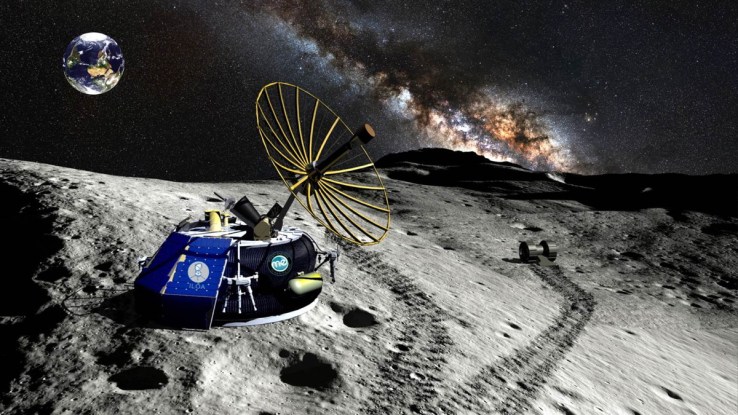
    Illustration of Moon Express lander / Image courtesy of Moon Express
    Interestingly, the legalities surrounding a private mission to the moon came about a bit backwards.
    First, Moon Express purchased a launch to the moon with Rocket Lab in October 2015. At that time, they didn’t have permission from the government to go to the moon or the regulatory security that they could have ownership of lunar resources they obtained if theycould get there.
    Then, in November 2015, the Commercial Space Launch Competitiveness Act was passed, which explicitly stated that private companies are allowed full ownership of resources they extract in space. The bill made it legal for Moon Express to mine the moon and keep what they extracted, but they still didn’t have permission to travel to the moon in the first place.
    This was the last piece of the regulatory puzzle, but from a security point of view, giving this permission to anyone with the resources to go is a bit tricky.
    For example, national assets like reconnaissance satellites that monitor specific areas of the Earth are located over 20,000 miles away in geosynchronous orbit (GEO). This is the farthest orbit that private companies have placed satellites in to date. Going beyond this orbit could potentially give a company full view of some of the most important space-based security satellites, making it important for the government to know exactly what a company intends to do on a mission past GEO.
    for receiving permission to do so. Jain explained that representatives from multiple federal agencies, including the State Department and the NSA worked together to determine that the FAA, which is already responsible for granting launch licenses to rocket companies, should be the official point of contact for this type of activity.
    On April 8th, 2016, Moon Express submitted an application for a 2017 commercial lunar mission to the FAA and has since received approval to move forward with its plans.
    “This simply shows that every company can achieve their moon-shot,” said Jain.
    The company will launch to the moon in the second half of 2017 on a rocket provided byRocket Lab. Jain stated that Moon Express’ first mission, which is a one-way trip, is expected to be profitable due to private payloads and sponsorships. The company also fully expects NASA to participate by sending a paid scientific payload, although their business plan is not dependent on it.
    Once on the surface, Moon Express hopes to win further X-PRIZE awards by moving across the surface. Instead of roving, they will re-fire their rockets on the MX-1 lander and “hop” to different locations.
    When asked if they expect to beat other frontrunners in the competition, Jain focused instead on their future plans, saying “We don’t start a company to win a prize. Winning the Google Lunar X-PRIZE would just be the icing on the cake. We choose to go to the moon because it’s good business.”
    In the future, the company expects to make money by harvesting resources on the Moon, like water and Helium-3, creating a fuel depot on the surface and eventually performing round-trip missions with the capability of bringing payloads back to the Earth. By the end of the year, Moon Express plans to double their employee base to over 50 people.
    Jain told TechCrunch that he believes this is just the beginning of private companies’ presence in deep space and that the way people will make money in space is only limited by our imagination. Likening it to how the iPhone’s App Store enabled the creation of a diverse set of apps from companies all over the world, Jain said “We just don’t know what the Pokemon Go or the Snapchat of the space industry is yet.”
    Now that Moon Express has received official permission to move forward with its plans, we can expect other U.S. companies with similar lunar aspirations, like Astrobotic, to follow suit in the near future.
    It’s been nearly a decade since the Google Lunar X-PRIZE was announced and now most of the regulatory pieces are finally falling into place. Eventually, space-faring nations will need to put a plan in place to streamline private ventures beyond Earth’s orbit. For now, we’ll have to watch exploration progress one company at a time.

    How the First Private Moon Landing Will Spur the Future of Space Mining

    Posted By: Uni logo - 14:26:00

    Moon Express just became the first private company in history to be approved for a lunar surface mission. The California-based startup plans to land its 20-pound MX-1 spacecraft on the Moon in 2017.
    "This is not only a milestone, but really a threshold for the entire commercial space industry,” Moon Express CEO Bob Richards told Space.com. "Somebody had to be first."
    The decision, announced by the Federal Aviation Administration (FAA) on Wednesday, may sound the starting pistol for a new era in spaceflight, defined at least as much by commercial ventures and resource extraction as by scientific and exploratory missions. Mining the Moon for valuable materials has been a hot topic of speculationfor years, but with the FAA’s official greenlight, Moon Express is poised to force the issue.
    That’s not to suggest, however, that the company’s 2017 lander will return to Earth laden with overflowing chests of Moon booty. At this point, the FAA has only approved Moon Express’s request to conduct a lunar surface mission, not mine it for resources.
    “It appears that the FAA has granted a licence to Moon Express to carry out a permissible space activity,” Sa’id Mosteshar, director of the London Institute of Space Policy and Law, told me. “The licence does not give Moon Express any exclusive or property right. It merely permits Moon Express to launch a spacecraft, travel to the Moon, and land there.”
    If successful, Moon Express’s landing will mark the first time any American organization has soft-landed a spacecraft on the Moon since Apollo 17 touched down in 1972. This kind of achievement is exactly what the emerging commercial space sector has always been hyped to accomplish. By untethering exploration from the purview of government agencies alone, space travel is becoming faster, cheaper, andmore widely accessible to the public.


    Indeed, Moon Express already has some exciting experiments lined up for its mission. According to Richards, the lander might install a small “mooncam” observatory at its landing site that would be viewable to anyone through YouTube. The company is also angling to nab the $30 million Google Lunar X-Prize, so it will have to demonstrate that its MX-1 vehicle can move at least 500 meters, and send high definition imagery back to Earth.
    But ultimately, Moon Express has its eyes on an even bigger prize: The Moon’s bountiful resources. Our natural satellite contains many precious materials, such as water, iron ore, and helium-3. Even the Moon’s normal regolith rock is treasured simply for its interplanetary exoticism.
    “I believe that the first trillionaires will be generated by investments in space resources,” Richards said in a 2014 Motherboard documentary. “Our goal is that in 2020, we’ll bring something back that you can hold in your hand; between two to six kilograms of stuff. It could be worth upwards of a billion dollars. And then the game is on.”
    It will be interesting to see how many other commercial players end up joining this game by following Moon Express’s lead. “There are already a number of private entities planning to go to the Moon and to carry out various activities there,” Mosteshar told me.

    “However, until and unless it becomes clear that exploitation of lunar resources is permitted, I would not expect many investors to risk vast sums of money on attempting to mine the Moon or other celestial bodies.”
    Striking that legal balance represents such uncharted territory that Moon Express had to work together with the FAA to figure out a temporary regulatory patch enabling the company to abide by both US law and international treaties for its 2017 mission. This is a promising cooperative starting point, but more comprehensive and consistent regulatory frameworks will have to be developed in order to ensure that off-Earth resources are managed sustainably.
    To that point, some of the language that Moon Express executives have used regarding planetary mining is worth reflecting on, as the company celebrates its milestone achievement.
    "We are now free to set sail as explorers to Earth's eighth continent, the Moon, seeking new knowledge and resources to expand Earth's economic sphere for the benefit of humanity," said Richards in a statement.
    Referring to the Moon as “Earth’s eighth continent” seems dicey in light of the fact that all seven continents on our own planet are imperiled by human activity, much of it borne from unchecked industrial development. Likewise, Jain’s past comparisons of lunar mining to ocean resource extraction poses similar problems.
    “I [...] think the Moon will be treated no differently than the international water in our oceans,“ Jain told the Los Angeles Times in 2011. “In this case, no one really owns the water but any company or country can mine the resources [...] as long as they follow certain safety/moral guidelines,”
    Again, a statement like that would be much more comforting if Earth’s oceans weren’t in devastating ecological freefall as a result of human commercial pressures, much of which takes place in international waters.
    Point being: We should tread carefully. Moon mining does have the potential to benefit humanity, but as with most commodities markets, the sticking will be ensuring that wealth generation does not slip into exploitation. Space exploration is our opportunity to transcend the self-destructive, provincial mindset nurtured by planetary living. Let’s not screw it up.

    Copyright © 2016 Uni logo™ is a registered trademark.

    Designed by Unilogou. Hosted on Blogger Platform.