BERLIN — Cool doesn't even begin to describe Lenovo's Yoga Book, announced Wednesday at IFA 2016.
The Yoga Book is about the size of a children's hardcover book — Lenovo compared it side by side with a hardcover Dr. Seuss book — and serves as a mini tablet, laptop and a digital notebook
The Yoga Book is thin, light and wild. Lenovo is launching two versions — Android ($499) and Windows 10 ($599) — later this year.
10.1-inch full HD display.
IMAGE: MICHAEL RATHMAYR/MASHABLE
The device has a 10.1-inch full HD glossy display on one half and a matte surface on the other half. Its hinge allows the screen to fold 360 degrees backwards into a mini tablet.
With a touch of a button, the matte half turns on a "Halo" keyboard and trackpad layout. Typing on it is similar to typing on an iPad, which is to say, there's absolutely no tactile feedback and no actual key actuation. As much as I hate the shallow keyboard on the new MacBook, typing on a flat surface is even worse.
IMAGE: MICHAEL RATHMAYR/MASHABLE
IMAGE: MICHAEL RATHMAYR/MASHABLE
IMAGE: MICHAEL RATHMAYR/MASHABLE
I would go as far to say typing on the Yoga Book's keyboard is terrible. I typed slower and made a ton more errors than on a keyboard with real key travel.
Built-in digitizer.
IMAGE: MICHAEL RATHMAYR/MASHABLE
But there are a lot of cool features on the Yoga Book, too. The best is the digitizer. With the keyboard turned off, you can place a piece of paper on top and use a stylus with a real ballpoint tip to write or draw and the Yoga Book will make an exact digital copy on the screen for saving or sharing. It's basically digital carbon paper (if you're old enough to know what that is).
If this sounds familiar to Wacom's Smart Bamboo, that's because it is Wacom technology. The digitizer is sensitive enough to detect scribbles through a stack of paper.
Spec-wise, the Yoga Book is powered by a 2.4GHz quad-core Intel Atom x5 Processor, 4GB of RAM and has 64GB of storage (expandable via microSD card). Lenovo says there will be Wi-Fi and LTE models. There's also an 8-megapixel camera on the front. Lenovo claims up to 15 hours of battery life for the Android model and up to 13 hours for the Windows 10 version.
It's an interesting concept, to say the least. It's clearly aimed at students, notebook lovers and scrapbookers, but it's hard to tell if it'll ever take off.
Get ready for a massive MacBook Pro update. Apple is planning to unveil new 13-inch and 15-inch MacBook Pro laptops with retina displays soon. According to a new report fromBloomberg’s Mark Gurman, Apple is building a completely new pro laptop with many new features, such as a Touch ID sensor and an OLED mini screen above the keyboard.
If you’ve been following MacBook Pro rumors, you know these rumors aren’t new. But Gurman is confirming what well-informed analyst Ming-Chi Kuo from KGI Securities and9to5mac have already been saying: yes, the new MacBook Pro is going to be a big release.
Let’s start with the shape of the device. The new MacBook Pro should be thinner and lighter, but not wedge-shaped like the MacBook Air or 12-inch retina MacBook. The bezels around the display should be smaller, and the overall frame of the device should be smaller.
The fact that the new MacBook Pro won’t look like a MacBook Air is a good sign for those who rely a lot on the multitude of ports on the existing MacBook Pro — there will be more than one port. Apple could switch to USB Type-C ports to replace USB ports, the MagSafe port and even Thunderbolt ports as USB-C ports can support the Thunderbolt protocol. Maybe Apple will drop the HDMI port and SD card slot to save up on space, maybe not.
Under the hood, Apple will most probably use the Intel Skylake processors, giving a performance boost and improving energy consumption. You can expect better Wi-Fi and Bluetooth chips as well.
But the most significant addition will be a narrow OLED display right above the keyboard. It should replace the physical function keys with a touchscreen. This could be the most surprising element of this MacBook Pro as nobody knows exactly how Apple will use this strip. You could control basic laptop functions from this screen, such as volume and media buttons. But Apple could also take advantage of this screen to display shortcuts and information depending on the app you’re using.
Apple also plans to integrate a Touch ID sensor in your Mac. This would let you unlock your laptop without having to type your password. More importantly, the Touch ID sensor would ship with a secure enclave, making your Mac more secure than before. It would let app developers use Touch ID for other things — password managers could take advantage of Touch ID for example. And finally, it would make Apple Pay for macOS Sierra more secure.
Recently, many have pointed out that the MacBook Pro is embarrassingly outdated. The last major update was in June 2012, bringing a retina display and a thinner design to the MacBook Pro lineup.
But people tend to forget that the unibody MacBook Pro was introduced in 2008, also four years before the retina update. Apple doesn’t change its laptops very often, relying on internal component upgrades every now and then.
And yet, Skylake processors should have come sooner to the MacBook Pro. Gurman is saying that Apple won’t introduce the new MacBook Pro at the iPhone launch event that will likely happen on September 7. I could see Apple introducing the new laptop in October. It’s about time.
A new trend seems to be rising among Chinese manufacturers, and it's an odd one at that. While rumors chalk off Apple's MacBook Air as dead (the reasoning being that it's been all but replaced by the company's new ultra-thin MacBook) a crop of new ultraportables with "Air" in their names are showing up in China.
A few days ago, it was Xiaomi's Mi Notebook Air; on Thursday, Lenovo launched the Lenovo Air 13 Pro, a 13-inch, Windows 10-based ultraportable with a dedicated graphics chip.
The Lenovo Air 13 Pro has a 13.3-inch full HD screen, an Intel Core i5 or i7 (Skylake) processor, 4GB of RAM, 256GB/512GB of SSD storage and Nvidia's GeForce GTX940MX graphics chip.
It sounds like a dead ringer for Xiaomi's 13-inch offering, but there are differences. The Lenovo starts with less RAM — 4GB vs. 8GB — but it comes with a fingerprint sensor, and it has a more powerful graphics chip (2GB of RAM vs 1GB). The price of the two (at least during Lenovo's pre-order period) is the same: RMB 4,999, or roughly $750.
That price will go up when the device hits stores. The least expensive version, with 4GB of RAM, a 256GB SSD and an Intel Core i5 processor will cost RMB 5,499 ($827). The variant with the same SSD but with a Core i7 processor and 8GB of RAM will go for RMB 6,299 ($947); if you want a 512GB on top of that, you'll have to pay RMB 6,999 ($1052).
In terms of design, the Air 13 Pro doesn't stray too far from today's standards, with a black keyboard on a gold or silver body and a subdued company logo on the lid. It weighs 2.84 pounds and has a 0.58-inch thick body — exactly like Xiaomi's Mi Notebook Air, and somewhere in-between Apple's MacBook and MacBook Air.
As far as ports go, we've counted 2 USB 3.0 ports, a USB Type-C port, a memory card reader and a headphone jack.
Lenovo's ultraportable is aimed for the Chinese market. Availability in other countries has not been announced.
Chinese smartphone and smart device maker Xiaomi just announced its first laptop — and boy does it look familiar to products belonging to a company that begins with the letter ‘A’ 😉
The Chinese tech giant is holding a press event to unveil its new Redmi Pro smartphone today, but it also dropped a surprise with the unveiling of the Mi Notebook Air. Even the name sounds familiar, right?
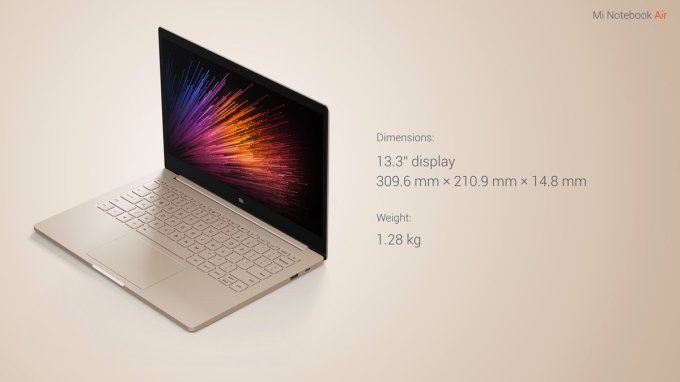
The laptop comes in two sizes — 13.3-inch and 12.5-inch — running Windows with a full-HD display, full-metal body and type-C USB charging and two USB slots. There’s a full-sized keyboard with Apple-esque keys that are individually backlit. The company’s ‘Xiaomi Sync’ software is pre-installed to pair data from a Xiaomi smartphone, and you can unlock the laptop using a Mi Band wearable.
The starting price is 3599 CNY, or around $540, for the 12.5-inch model with the larger, flagship model coming in at 4,999, or $750. Don’t hold your breath on an international launch, since many of Xiaomi’s products — particularly its first forays into new categories — are China-only affairs. What we know so far is it will go on sale in China from August 2.
Under the hood, Xiaomi is promising an Intel Core i5 Processor with 8GB DDR4 RAM and 256GB PCIe SSD, and an expandable SSD slot. For games, there’s a dedicated NVIDIA GeForce 940MX graphics card. Size-wise, we are talking 306.9 mm x 210.9 mm x 14.8 mm with an apparent weight of 1.28 kg.
Those specs slip a little for the smaller model, which includes an Intel Core M3 processor with integrated graphics, 4GB RAM and 128GB in expandable SSD.
As is so often the case, Apple is the standard for Xiaomi’s product comparison. The Chinese company said the Mi Notebook Air is thinner (13 percent) than its equivalent Macbook Air, and 11 percent smaller than its rival thanks to a 5.56 mm bezel.
There was plenty of speculation about a Xiaomi laptop last year, and now that has materialized into a physical product it’ll be interesting to see how many units Xiaomi ships. Let it not be forgotten that the company has struggled to justify its huge $45 billion valuation. It sold “over 70 million devices” in 2015 and, while that figure is very respectable,an increase on its previous year while many in the industry are seeing volumes fall, it was some way behind Xiaomi’s original target. Added to that, there’s been no indication that its smart home focus — the idea that Xiaomi can build an ecosystem of products for Chinese consumers — has come to fruition yet.
That focus was a key driver for Xiaomi’s colossal valuation. Because, with hardware a fiercely competitive business with low margins despite Xiaomi’s smart approach to sourcing components, the potential for a data and services business that connects the dots can help Xiaomi stand apart from its rivals.
Some may see a laptop as an unnecessary product line, particularly in China where the audience is mobile-first internet users, but does fit into Xiaomi’s ambition to own every connected device in a Chinese consumer household. Or at least to offer an attractive option for any kind of internet-connected hardware product.
As part of its annual back to school refresh, HP's updated its Pavilion-branded laptops, which include its 2-in-1 laptops, standard laptops and all-in-one PCs.
All of the Pavilion machines are now running Windows 10. But most striking, on the laptops, they're all sporting a new "digital threaded" design on the palm rest that HP says was inspired by Nike's Flyknit sneakers. You'll either really love the design or hate it.
The 2016 HP Pavilion x360 laptops in 11-, 13- and 15-inch.
IMAGE: RAYMOND WONG/MASHABLE
HP says this was what they were shooting trying to shoot for with the new design:
IMAGE: RAYMOND WONG/MASHABLE
Like last year's models, the Pavilion x360 comes in three sizes: 11.6-inch (starting at $379.99), 13.3-inch (starting at $479.99) and 15.6-inch (starting at $579.99). And since they're convertible machines, you can switch between laptop, tent, stand and tablet modes.
The laptop in "stand" mode.
IMAGE: RAYMOND WONG/MASHABLE
Their lower price points means they're made of plastic and not premium metal like on the Spectre x360. The 2-in-1 laptops come in multiple colors and as far as I could tell, the design is sturdy enough to survive a typical student lifestyle.
HP's streamlined the Pavilion x360 laptops to tighten up some of the nuts and bolts. The hinge on the 11- and 13-inch models are metal (the same one from the Spectre x360), but the 15-inch's is plastic.
The keyboards feel great on the laptops, except the cramped on on the 11-inch.
IMAGE: RAYMOND WONG/MASHABLE
In my brief hands on with the machines, I found the keyboards were comfy and felt good (the 11-inch is still cramped), the trackpads felt more responsive than last time around with smoother tracking and scrolling, and the the touchscreens were responsive, too.
The laptops have HD screens, which, truthfully, didn't look great. But you can bump it up to a full HD IPS screen on the 13- and 15-inch laptops for extra. HP's partnership to include B&O Play sound in its devices extends to the Pavilion x360s.
Tons and tons of ports on these laptops.
IMAGE: RAYMOND WONG/MASHABLE
Performance-wise, the 11-inch is configurable with an Intel Celeron, Pentium or Core i3 (Skylake) processor and up to 8GB of RAM. The 13-inch with a Core i3 or i5 (Skylake) processors and up to 16GB of RAM. And the 15-inch with a Pentium or Core i3, i5, or i7 (Skylake) chip with up to 8GB of RAM and an optional NVIDIA GeForce 930M graphics chip.
Battery life is rated at up to 10 hours on the 11-inch, up to 9 hours on the 13-inch and up to 9.25 hours on the 15-inch Pavilion x360. Some models support HP Fast Charge, which lets you charge them up from 0% to 90% in about 90 minutes.
HP Pavilion Notebooks
IMAGE: RAYMOND WONG/MASHABLE
The Pavilion Notebook lineup doesn't come with a hinge that lets you flip the screen all the way back, but it does come with the new threaded palm rest design.
They also come in three display sizes and in various colors: 14.-inch (starting at $539.99), 15.6-inch (starting at $579.99) and 17.3-inch (starting at $899.99). Resolution choices include HD, full HD and 4K; touchscreens are optional.
The 2016 Pavilion Notebooks are still made of plastic. There's nothing remarkable about the design. The 14- and 15-inch are up to 22% thinner and have occupy a smaller footprint over last year's models, though. Like all of HP's laptops, they have B&O Play sound.
IMAGE: RAYMOND WONG/MASHABLE
The 14-inch Pavilion Notebook is configurable with Intel Core i3, i5, or i7 (Skylake) processors, up to 16GB of RAM and an optional NVIDIA GeForce 940MX graphics chip. The 15-inch with Core i3, i5 or i7 (Skylake) chips, up to 16GB of RAM and optional NVIDIA GeForce 940MX, GTX 950M, GTX 960M graphics; seventh-generation AMD A12-9700 quad-core with optional Radeon R7 Graphics is also an alternative. The 17-inch model is configurable with Core i3, i5 or i7 (Skylake) processors, up to 16GB of RAM and an optional NVIDIA GeForce GTX 960M graphics chip.
Battery life is rated at up to 10 hours on the 14-inch and 9.5 hours for both the 15- and 17-inch laptops. All of the Pavilion Notebooks come with the aforementioned HP Fast Charge.
Pavilion All-in-Ones
IMAGE: RAYMOND WONG/MASHABLE
Not a laptop person? No biggie. HP's also refreshed its all-in-one (AiO) Pavilion desktop running Windows 10.
Available with a 23.8- or 27-inch full HD or QHD resolution display, the new AiO can be specced out in and Intel Pentium or up to Core i7 (Skylake) processors, up to 16GB of RAM, up to 3TB of hard drive storage (or hybrid hard drive/SSD up to 1TB), and optional NVIDIA GT 930A graphics of seventh-generation AMD A10 graphics.
IMAGE: RAYMOND WONG/MASHABLE
Audio is, of course, by B&O Play. Below the front-facing speaker grille all the ports, including a USB Type-C port that can be used to charge other devices, USB 3.0 port, 3-in-1 memory card slot and a headphone jack. Around back are more ports: another USB 3.0 port, a USB 2.0 port, ethernet, and HDMI.
A touchscreen isn't standard, but you can customize it with one. You can also opt for an Intel RealSense camera for Windows Hello authentication.
The 23.8-inch model starts at $699.99 and the 27-inch model starts at $999.99.




 Popular
 Tags
Tags Videos