• unilogou. Powered by Blogger.

    Showing posts with label ASTRONOMY. Show all posts
    Showing posts with label ASTRONOMY. Show all posts

    Wednesday, 10 August 2016

    NASA awards companies $65 million to develop habitats for deep space

    Posted By: Uni logo - 14:59:00

    NASA is serious about going to Mars, and not just for a quick visit, either. It just committed $65 million, spread over two years and six companies, for the purpose of developing and testing deep-space habitats that could be used on the way to — and on the surface of — the Red Planet.
    It’s part of the organization’s NEXTStep (not to be confused with the NeXTSTEP OS), an ongoing partnership program under NASA’s Advanced Exploration Systems that funds private research into technology for space exploration.
    Last year’s NEXTStep contracts were for a variety of things, but this year they’re all on the same track: “deep space habitats where humans will live and work independently for months or years at a time, without cargo supply deliveries from Earth.” We’re talking spaceships here — big ones.
    The numbers are bigger, too: the previous year’s contracts amounted to a total of perhaps $15 million divided 10 ways — $65 million 6 ways is, it hardly needs saying, a much more considerable investment.
    The lucky companies are all taking slightly different approaches to the problem of deep space habitation.
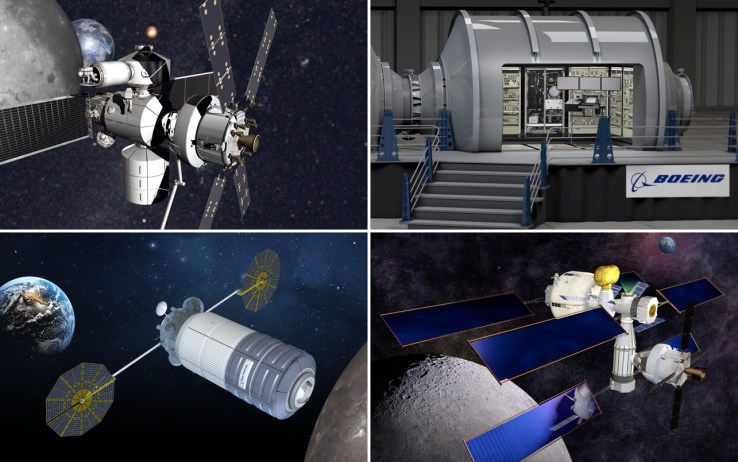
    From top left: Lockheed Martin, Boeing, Orbital ATK, and Sierra Nevada's concept spacecraft.
    Bigelow is a name you may already be familiar with: the Bigelow Expandable Activity Module was recently attached to the International Space Station and is currentlyundergoing testing. The company plans to develop one about 20 times larger (330 vs 16 cubic feet) that they call the Expandable Bigelow Advanced Station Enhancement, or XBASE. There are advantages to being able to pack your modules tightly and expand them later, but the BEAM’s troubled deployment shows there are challenges as well. Of course, that’s what testing is for.
    Lockheed Martin doesn’t want to let good space gear go to waste, either; its plan is to refurbish one of the cargo modules carried by the Space Shuttles into a livable multi-purpose environment. The idea is, essentially, to use proven equipment as a base to test future developments, like data and crew transfer between the module and, say, the Orion spacecraft.
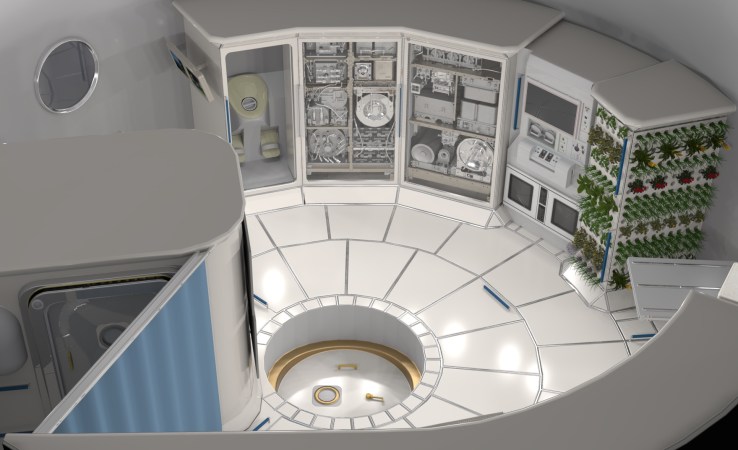
    NASA concept of the interior of a habitable module.
    Another avid recycler is NanoRacks, whose commercial experimentation platform outside the ISS just went live yesterday. Nanoracks has a rather crazy idea: convert the final rocket stage, with its spacious fuel compartment, into a habitable space. It’s working with Space Systems Loral and the United Launch Alliance to see if this is crazy enough to work — or just plain crazy.
    Sierra Nevada (specifically its subsidiary Space Systems) has perhaps the most ambitious plan. Over four commercial launches, the company wants to build on one of its Dream Chaser cargo modules, adding a propulsion system, an expandable environment, and life support. Taking it in stages means better risk management.
    Boeing and Orbital ATK didn’t provide many details: the former just says it’s building a full-scale prototype for extensive testing, and the latter is adapting one of its Cygnus spacecraft to the purpose.
    It’s all very early, of course, and these projects, among others, are for exploring possibilities and finding potential problems, not actually producing something we can send to Mars or beyond. The technology investigated by these companies will have to prove itself on the ground first, then in orbit, and eventually in cislunar space — the “proving ground” for long term mission hardware.
    NASA didn’t specify how much each project was receiving, or the exact timelines or deliverables expected from each — although results are certainly expected by the time the contracts’ 24 months are up. I contacted NASA for more details and will update this post if I hear back.

    Saturday, 18 June 2016

    This pocket-sized camera makes it much easier to take photos of stars

    Posted By: Uni logo - 05:17:00
    Https%3a%2f%2fblueprint-api-production.s3.amazonaws.com%2fuploads%2fcard%2fimage%2f110006%2ftinymos


    SINGAPORE — Often, what separates the pros from amateurs when photographing under challenging situations is having the technical knowhow to get the shot.
    Astrophotography pretty much ranks up there in the realm of tough scenarios. First, you'll need pretty fancy equipment (good quality telephoto lenses don't come cheap), and after that you're going to need to know how to process the final shot on your computer to make it pop.
    TinyMOS, a startup from Singapore which is producing a pocket shooter for stargazers, dropped by the Mashable office to show us some tricks it's building into its camera's brain, to help amateurs close the gap with the pros.
    One method the camera's processor will do is called stacking, where it takes multiple shots of a scene and analyses them to eventually produce a composite of all the sharpest portions.


    The moon, as captured by the camera's prototype.
    IMAGE: TINYMOS

    Grey Tan, one of TinyMOS' founders, explained that similar to the way a long road appears to be "waving" on a hot day as moving air distorts one's vision of it, this effect is multiplied through the atmosphere while looking at a faraway planet. Taking multiple pictures allows the camera to capture different parts of a scene that are waving in and out of focus, so the final shot is sharper.

    Secondly, the camera will perform some smart processing to reduce image noise — the little flecks and imperfections you sometimes see in photos. The traditional method, known as dark-frame subtraction, involves the photographer covering the lens and shooting the dark scene to expose these flecks, before combining the shots later in Photoshop to remove them from the photo.
    But the Tiny1 will try to do this itself by scanning its own sensor — the digital "film" that it captures shots on — each time it's charging, so it has that blueprint of dots and flecks that it'll use to process the shot.
    This process is especially necessary in astrophotography, because image noise is very much exacerbated for long exposures in darkened scenes.


    You can see Saturn's rings.
    IMAGE: TINYMOS

    These software techniques aren't new to photographers or astronomy buffs, who already know how to stack photos to get them sharper and remove noise in Photoshop. But the idea is to try to automate these methods so amateurs get a better crack at producing a nice shot of the moon, Tan said.
    And just in case you need to know where to point the camera in the first place, the team is building in a feature that'll show you what you're pointing at in the sky, similar to apps like Star Walk. That's how dummy-proof TinyMOS wants it to be.

    The camera is nearly a reality

    Like most crowdfunded products, the Tiny1 isn't quite ready yet. For now, the prototype's touch screen doesn't work, the team said.


    The new camera's body (foreground) together with the older prototype.
    IMAGE: VICTORIA HO/MASHABLE

    But for the startup, which has been chasing its dream for the past two years, success may soon be well in sight. TinyMOS hit its Indiegogo goal of $100,000 within four hours of launching the campaign on Monday, which has so far attracted 616 backers.
    Tan also revealed that the Indiegogo campaign is getting more backers adding on adapters for traditional lenses than expected, and that the team is receiving requests for Sony and Micro Four Thirds mounts, in addition to the Canon and Nikon lens mounts it already offers.


    The camera with a mount attached.
    IMAGE: VICTORIA HO/MASHABLE

    "That makes sense. People who use Sony and Micro Four Thirds cameras really care about portability," Tan said.
    The prototype was made in Germany, but the team will move manufacturing to either Singapore or the neighbouring Indonesian island of Batam, where they can keep a closer eye on production.

    Saturday, 30 April 2016

    Japan's new space telescope declared dead in space

    Posted By: Uni logo - 11:28:00
    9a81303c441941968066a95e4024a15f

    Japan’s brand new space telescope has met a sad end.
    On Thursday, the Japan’s space agency (JAXA) announced that they would stop attempting to communicate with the ASTRO-H space observatory after it was found that the telescope cannot recover from a failure that began in March.
    The observatory — which is designed to study far-off objects like black holes and exploding stars in extreme detail — was launched on February 17, and was expected to have a long and healthy observational life in space.
    Japan’s space agency started experiencing communications problems with ASTRO-H, also called Hitomi, on March 26, and since that time, agency officials have been attempting to regain control of the observatory, which was thought to be spinning out of control in its orbit.
    Until now, there was some hope that the $265 million mission could be rescued. Scientists thought they’d received three signals from Hitomi since the problems began in March; however, the space agency is now saying that those signals were not sent by the spacecraft.
    "JAXA will cease the efforts to restore ASTRO-H and will focus on the investigation of anomaly causes," the agency said in a statement.
    New data has also revealed that both solar arrays have broken off the observatory, JAXA added.
    “There is now a huge gap in humanity's toolkit for studying black holes, supernovae and energetic processes in the universe,” astronomer Jonathan McDowell told Mashable via email.
    JAXA has not yet found the root cause of the fatal problem, but it plans to “carefully review all phases from design, manufacturing, verification, and operations to identify the causes that may have led to this anomaly,” JAXA added.
    At the moment, it looks like the spacecraft experienced some kind of error which caused it to start rotating unexpectedly, leading to the separation of the solar arrays.
    This kind of major failure is wide-reaching in the astronomy community.
    Scientists from all over the world were relying on ASTRO-H to beam home data for research projects focused on looking at the universe in X-ray light. Some researchers and engineers spent decades working to make this project a reality.
    Some astronomers expressed their disappointment over the end of the mission on Twitter
    While Hitomi’s life was short, it still reportedly produced some amazing science.
    The telescope was able to observe both the Crab Nebula and Perseus galaxy cluster, according to Space.com, which could help scientists break down the exact science of how gas and dust behave in those regions of space.
    At the moment, two other X-ray observatories are going strong.
    Both Chandra and XMM-Newton are healthy, according to McDowell, but they are both more than 10 years old, a pretty advanced age for a telescope in space.
    Other more specialized X-ray telescopes like NuStar are also still working, but they are smaller and unable to gather the kind of data Hitomi was collecting until its demise.
    In 2028, the European Space Agency is expected to launch another major X-ray observatory called Athena, leaving a gap of about 12 years between ASTRO-H’s end and the launch of the next flagship telescope of its kind.
    That gap may seem grim, but McDowell is hopeful that some kind of mission might be squeeze into the void left by Hitomi.
    “I'm hoping Chandra will last till Athena goes up,” McDowell said. “But I think there's also an opportunity for a new fast-track mission to fill that gap.”

    Copyright © 2016 Uni logo™ is a registered trademark.

    Designed by Unilogou. Hosted on Blogger Platform.