• unilogou. Powered by Blogger.

    Showing posts with label GOOGLE I/O. Show all posts
    Showing posts with label GOOGLE I/O. Show all posts

    Saturday, 21 May 2016

    Posted By: Uni logo - 00:56:00

    Https%3a%2f%2fblueprint-api-production.s3.amazonaws.com%2fuploads%2fcard%2fimage%2f93712%2f63159f29e4a14088ae568123cbecb907

    MOUNTAIN VIEW, Calif. — Google's Project Tango is ready for prime time.

    Conceived back in 2012 as a way to enable our devices to see like we do, Tango has evolved from prototype to prototype, and now is on the verge of its first real-deal release. Lenovo will unveil the world's first Tango-enabled device on June 9.
    It's a big milestone for the computer vision project, which aims to give smartphones and tablets sensor-enabled superpowers. A Tango phone will be able to, among other things, take precise measurements of rooms, "remember" environments and track how objects have moved, and even create moving, virtual characters that can interact with the real world. It's one of the most complete examples of augmented reality in tech right now.
    But on the heels of all the announcements Google made at its I/O developer conference, Tango's imminent coming-out party feels a bit anticlimactic. Google has been developing Tango in plain sight for a couple of years — the developer kit, which includes a tablet with Tango sensors, has been available for some time — and the impending Lenovo release feels more like punctuation than a statement. Tellingly, Tango was barely mentioned at all in the I/O keynote.
    What's more, Tango appears to have been overshadowed by other projects at Google, in particular Daydream, Google's platform for properly bridging VR with Android. Daydream includes a new spec for Android phones to rate them as VR-ready, meaning they'll be able to create virtual worlds and objects that users will be able to interact with, with minimal latency.
    The home screen in Google Daydream.
    IMAGE: GOOGLE

    Virtual worlds colliding

    Wait a sec… virtual objects? Interactivity? Rigorous hardware and software specs for manufacturers to ensure a smooth user experience? That sounds a lot like a certain augmented reality project that rhymes with "mango."
    Certainly, Daydream and Tango have a lot in common, and not just broadly. The motion tracking that's endemic to Tango would seem to be directly applicable to the VR experiences of Daydream. It feels like a no-brainer to combine these two technologies, perhaps creating a Tango-powered headset that provides a 360-degree augmented reality experience instead of a full virtual environment — like Microsoft HoloLens, but smartphone-powered.
    Don't hold your breath for such a device. Even though Google VR chief Clay Bavor strongly hinted at a similar device (virtually the only mention of Tango in Wednesday's keynote), Tango leader Johnny Lee told Mashable that comparing Tango and Daydream is apples and oranges — at least for now.
    Tango was in development years before Daydream, Lee said, and the spec is entirely different. Whereas Tango is mainly about positional tracking, Daydream prioritizes visual performance. The Lenovo Tango device doesn't meet the Daydream requirements — in particular the display, latency and sensors. Not to mention Daydream phones will need specific headsets built for them, and there's no planned controller or headset for the Lenovo device, Lee said.
    Could Daydream-ready phones also be Tango devices?
    Okay, but what about going the other way: Could Daydream-ready phones also be Tango devices? It's possible, certainly, although Lee told us none of the Daydream phones currently in development has the required sensor hardware to enable Tango-powered experiences.
    So it seems these two related technologies will stand apart for now, even if — as Bavor hinted with his keynote comments and cameo appearance at a Tango session at I/O — they will inevitably someday be married. With Microsoft taking a strong early lead with HoloLens, and Facebook's stated plans to get into the augmented reality business, Google has to be thinking along the same lines.

    A second crack at Glass

    A Daydream Tango device might not even resemble a smartphone, tablet or VR-style headset. Augmented reality tends to work better with the actual real world in the field of view, not a screen. Logically, then, the right device to deliver a Tango-Daydream experience is a pair of smart glasses.
    A rendering of the Google Daydream reference design for a headset and controller.
    IMAGE: GOOGLE
    Whoa, Nelly. If Google is working on that, they have good reason not to talk about it. You may remember a little gadget called Google Glass. While that wasn't true augmented reality, it nonetheless certainly seared Google (and the public) on smart glasses. If Google is working on such a headset, it has good reason not to talk about it, at least for now.
    Until then, each of these technologies needs to prove themselves on their own. When Tango arrives, its practical abilities will likely be appealing to parts of the enterprise, but it's unclear it there's an audience beyond that. Daydream, however, is aiming higher — its goal is no less than to give mobile VR a mass consumer audience.
    If Daydream succeeds, Google will have all the tools in place to take augmented reality mainstream, perhaps finally creating a device that delivers on the promise of that first concept video for Glass. The only question then will be: Will we actually want to wear it?

    Google is finally bringing Android apps to Chromebooks

    Posted By: Uni logo - 00:34:00
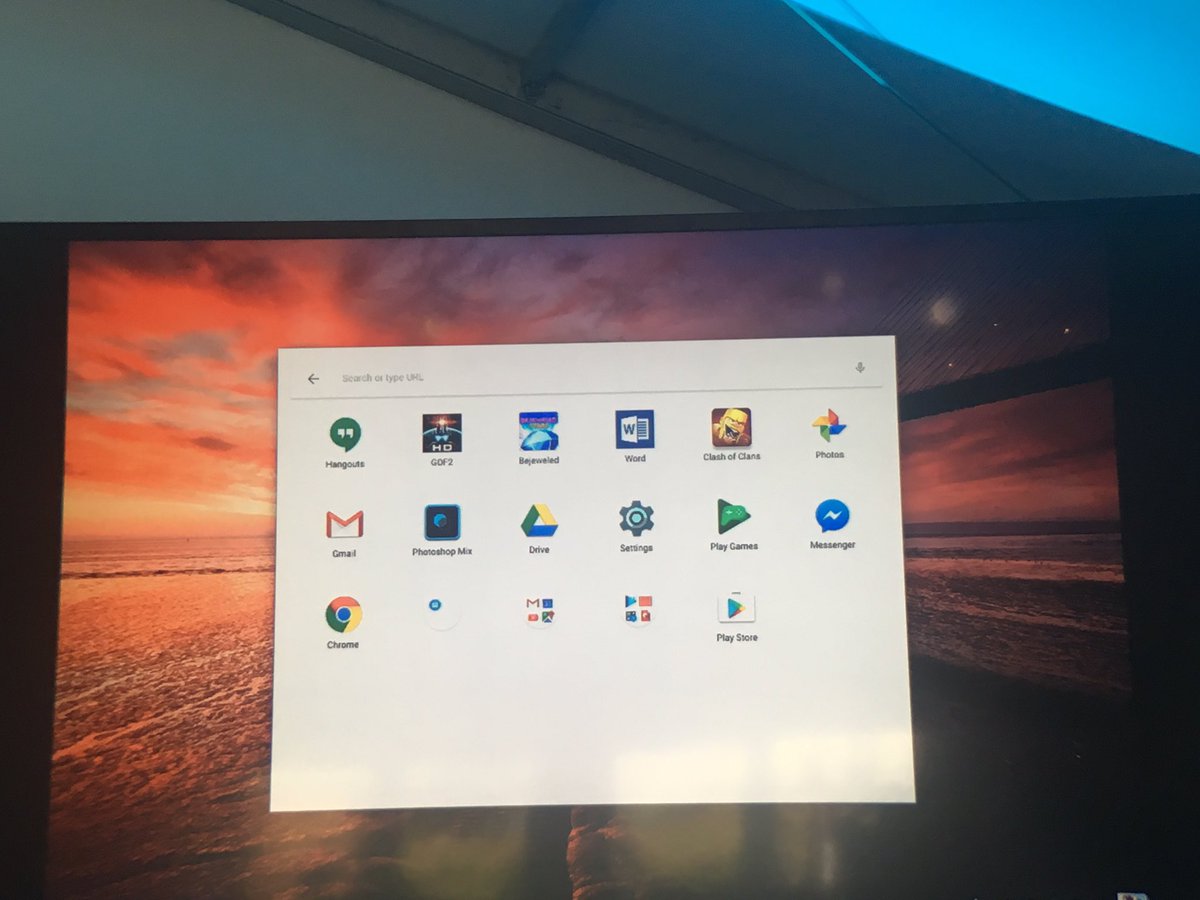
    Https%3a%2f%2fblueprint-api-production.s3.amazonaws.com%2fuploads%2fcard%2fimage%2f93427%2fb113_pixel2_silver_applauncher-1

    MOUNTAIN VIEW, Calif. — Google's Play Store, home to more than 1 million Android apps, is finally moving beyond the confines of Android.
    Chrome OS, the operating system that powers Chromebooks, is getting support for the Play Store, Google announced Thursday during a session at its I/O developer conference.
    Though Google previewed the news Thursday, Android apps won't officially launch until later in 2016. But developers can begin to optimize their apps for Chrome OS ahead of the launch.
    Once the Google Play Store is available to Chromebooks, users will be able to download Android apps to their desktop — even if they don't have a web or desktop version. During a demo Thursday, Senior Director of Product Management Kan Liu showed off Clash of Clans,Adobe's and Photoshop Mix running on a Chromebook.
    Any app that's available in Google Play on Android will also be available in Google Play on Chrome, though there may be some device-specific restrictions (phone dialer apps, for example, may not be available since they require a cellular connection.)
    Still, developers will be able to optimize their apps for Chrome OS — by creating better experiences for mouse and keyboard input, for example — beginning in June, if they have an Asus Chromebook Flip, Chromebook Pixel (2015) or Acer Chromebook R11. You can see a full list of supported device here.
    While some had speculated that Google would also bring Android apps to its Chrome browser, Google said this change was limited Chrome OS, at least for now. 
    More than two years in the making, the move marks the biggest step yet toward Google's goal of creating a more unified experience between Chrome and Android.
    Google first began to bring Android apps to Chrome OS in 2014 as part of a project called App Runtime for Chrome, but relatively few developers took advantage of the capability. And since then, rumors have persisted that Google planned to merge Android and Chrome. Meanwhile, Chromebooks themselves are more popular than ever. Research firm IDC reported that Chromebooks outsold Macs for the first time during the first quarter of 2016 — a stat Google touted during its announcement Thursday.
    Now Google has finally offered a look into its vision for the future of Chrome OS. 
    Update: This story has been updated to clarify that Android apps are only coming to Google Play on Chrome OS. An earlier version said the apps would be available on the Chrome browser, as well.

    Thursday, 19 May 2016

    Live from the Google I/O keynote

    Posted By: Uni logo - 04:19:00
    Https%3a%2f%2fblueprint-api-production.s3.amazonaws.com%2fuploads%2fcard%2fimage%2f91447%2fap_747107436006


    Google's biggest event of the year is about to get under way.
    The I/O developer conference is set to begin Wednesday with a keynote from Google CEO Sundar Pichai and all signs suggest it will be jam-packed with announcements.
    One highlight, of course, will be the next version of Android, right now known only as "N." But we're also expecting to hear about wearables and virtual reality, Android Pay and Android Auto. Late-breaking rumors suggest we'll get a look Google's Amazon Echo killer after all. 
    With a new venue — I/O is taking place in Google's backyard in Mountain View — and nearly three full days of sessions and announcements, this year's conference promises to be one of the most eventful yet. 
    Pichai's keynote is scheduled to begin at 10 a.m. PT and Mashable's live coverage will kick off at 9 a.m. PT so check back then for the latest news and analysis from Mountain View.


    Google launches Google Assistant to take on Siri and Alexa

    Posted By: Uni logo - 04:02:00
    Io_keynote-054

    Look out SIRI. Step aside Alexa, Google has its own voice-based digital assistant: Google Assistant.
    While it lacks a proper or even pretty name, this could be the mother of all voice-activated assistants. 
    "Our ability to do conversational understanding is far ahead of what other assistants can do," said Google CEO Sundar Pichai, who announced the new assistant from the Google I/O 2016 developers conference keynote stage on Wednesday. He noted that 20% of all Google searches are accomplished via voice.
    Pichai demonstrated Google Assistant's prowess by asking it first about "Who directed The Revenant?" Google Assistant correctly answered with "Alejandro G. Iñárritu," but then Pichai showed how he could continue the conversation without repeating the director's name.
    The company also introduced Google Home, a hardware device that will work with Google Assistant and ship later his year.
    With Home, Google Assistant will respond to anyone who says, "OK, Google." It will let users manage and access schedules, find out about traffic, track packages, and ask Google Assistant general interest questions.
    You can sign up for more details about Home at http://home.google.com/
    During the keynote, Google executives noted that there will be a Google Assistant ecosystem, which means it will appear in the aforementioned hardware, on smartphones and in apps, like the new Google messaging app, Allo. Google Assistant will actually work during conversations and automatically try to help with, for instance, dinner reservations the group is discussing. It will also bring in outside, relevant information like restaurant cards, (the kind you normally see in Google Now and Google search results), and then guide users through setting number of diners, time to dine and making reservations with Open Table.
    Google Allo

    Google Allo with Google Assistant
    IMAGE: GOOGLE

    You can now use Android pay to get cash from ATMs

    Posted By: Uni logo - 01:56:00
    Ap_111014157387

    Google's mobile payments platform will now let you get cash at the ATM without ever touching your wallet.
    Android Pay now supports card-free ATM transactions at Bank of America, Google announced Wednesday at its I/O developers conference. The feature is available now at locations throughout San Francisco and the Bay Area.
    The update puts Google ahead of its US competition — neither Apple Pay or Samsung Pay support ATM transactions yet, though both companies have announced plans to support the feature.
    Cash withdrawals at the ATMs work very similarly to typical transactions, except you begin by tapping your phone on the ATM, rather than inserting a card. 
    Android Pay is also making its first big international push, with the payments platform launching in the UK Wednesday and coming to Singapore and Australia "soon."
    The mobile payment system, which Google first unveiled a year ago, is also getting support for contactless payments on public transit, with support for Transport London, which includes busses and trains. 

    Android Pay's biggest competitor, Apple Pay, has been rapidly expanding across banks and the globe, coming to Singapore, Australia and China since the beginning of the year. But with Google's latest announcement, it looks like Android Pay isn't far behind.
    At launch, Android Pay was supported by more than 700,000 stores in the U.S. Now, it will also be compatible with all electronic, contactless payment systems in the UK including in Starbucks, Waitrose and public transportation stations, provided you have a card from one of the supported banks. Android Pay in the UK is now supported by Bank of Scotland, First Direct, Halifax, HSBC, Lloyds Bank, M&S Bank, MBNA and Nationwide Building Society and Google says more banks will add support soon.

    Copyright © 2016 Uni logo™ is a registered trademark.

    Designed by Unilogou. Hosted on Blogger Platform.