Messaging apps like WhatsApp and WeChat have become the platform giants of recent years, scaling huge user bases powered by the momentum of network effects. But might there be another location on the smartphone that’s potent enough for an app to transform into a platform in its own right? Barcelona-based startup
Thingthing reckons there is. And their bet is that it’s the Qwerty keys that live under smartphone users’ fingertips that could be the next big thing on mobile.
Thingthing has built an
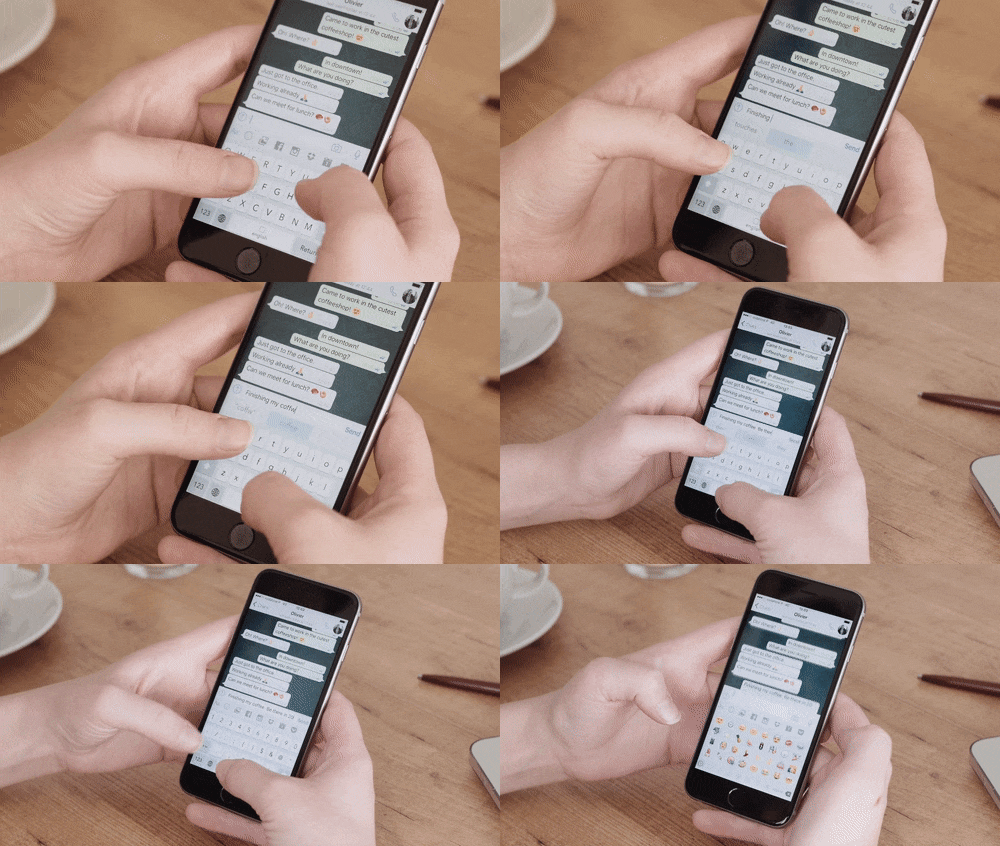
iOS keyboard app focused on amping up user productivity by decreasing the amount of app switching users have to do by loading productivity-focused additional functionality into the keyboard — just tap on one of the command keys above the Qwerty keys to summon your camera roll, or a stack of trending GIFs, or a list of your recent Dropbox files, or a multi-day view of your calendar, and so on. The select slice of data is displayed in the place where the keyboard was just before you hit the icon.
Third party accounts that can be linked to Thingthing’s keyboard at this point include Dropbox, Box, Google Drive, Facebook, Instagram, Flickr, Pocket and Todoist. The app can also be connected to your phone’s camera roll and calendar. And of course, as must be the case for any self-respecting keyboard app, there’s an icon to shortcut to your emoji — and emoji suggestions built into the keyboard’s next word prediction tech.
With linked third party apps/services Thingthing is plugging into the relevant APIs to support the particular functionality being offered — such as, for example, the ability to view and share files from your Google Drive. It’s also thinking a lot about designing the options it offers users. It’s not pulling everything into such a tiny space; just what it thinks someone with something to type quickly really needs to see/grab. Plante dubs these “contextual actions”.
Examples include the ability to select and paste a photo into the message you’re typing. Or to select and send a few possible calendar dates. The core idea here is to allow the user to gain swifter access to information siloed away in a third party service at the moment they are tapping out a message — and without needing to tap away to that other app — to speed up related communications, whether someone is trying to arrange a meeting via email. Or chatting with friends on WhatsApp.
A few taps on the Thingthing keyboard and you can grab the right calendar dates or fire a photo right into your chat without needing to tap away from whatever messaging app you were using.
What’s really interesting here is that the keyboard cuts across different services, and can therefore act as the connective tissue linking multiple services — doing away with the need for users to visit another app directly for simple use-cases (like grabbing a file).
And while a keyboard might not appear, at first pass, to have the massive network pull of a social or messaging giant, there’s a clear sub-set of pro-users who will appreciate the immediate productivity gains in the short term. And potentially a wider audience beyond that — if even more compelling short-cuts can be loaded right into the keyboard in future, as Thingthing is hinting will be its direction of travel.
Thingthing is today announcing it’s closed a €350,000 ($400k) seed round, led by Simile Venture Partners. Other investors in the round include Saatchinvest, Pioneers Ventures, Seedcamp (with the team having recently gone through their winter bootcamp program), plus some business angels.
It’s also talking about having secured partnerships with “leading brands” — although it’s not specifying exactly who or what those partnerships entail at this point. More details will be shared on this in the coming year, co-founder and CEO Olivier Plante tells TechCrunch. An Android version of the keyboard is also in the works.
“They’ve seen the opportunity in a keyboard being a platform,” says Plante of Thingthing’s investors. “Being something transversal everywhere, that can provide much more than just productivity tools.”
Commenting on the funding in a statement, Tatiana Kim, managing partner at Simile Venture Partners added: “Mobile has become the primary channel of communication and messaging is an essential part of our user experience. Thingthing is tackling a problem of efficiency in users interaction in a novel and intelligent way. We appreciate that the team is focused on user-centered design, has clear vision of development strategy and ambition for global coverage.”
Of the six brand partnerships Plante says that some are “leaders in productivity” and others are “leaders in services”.
“We’re working on something where the vision is ‘just type’ — so where people only type and while they’re typing they can access other services,” he continues. “This is something that we call contextual information. So depending on the context you can access services that go beyond just productivity.”
“Facebook is trying to do something around messaging around these lines but we believe that the keyboard is extending everything,” he adds.
TechCrunch last covered Thingthing back in
September, soon after it had launched the first version of its app — which did not initially include an actual Qwerty keyboard, requiring users to toggle to use the native iOS keyboard (or another keyboard app of their choice). At the time we lauded the clean design and the strength of the core idea.
Since then the rather large missing piece that has been locked down by Thingthing is an actual keyboard of its own, with the team building next word prediction tech (currently just for English), and using public data sources such as Twitter and Reddit to train its learning algorithms, according to Plante.
“We built our own keyboard, with our own algorithms,” he says. “We built that from scratch. And at the speed we’re going we’re at the level where — SwiftKey did something in eight years, we can do what SwiftKey did in about three years and a half.
“The algorithm was built by our CTO who has been doing work around machine learning and AI. He was able to in opposite to what SwiftKey has built — because SwiftKey needs your data to be really intelligent, so the more your connect things the more it is intelligent, we were able to create a machine learning AI from public data.”
At this early stage Plante says Thingthing has around 20,000 monthly active users. “People have typed a lot of words!” he adds, estimating it at between three to four million words at this point. “This is an aggregated data. Pure analytics. We don’t see any words, we just infer.”
A compact, three-day on-screen calendar view is a new feature in the latest update to the app, plugging in a useful, at-a-glance overview of your availability for the current and two following days. Flick a finger back or forth to go back in time to check where you were, or scroll further into the future week. Want to suggest three possible appointment slots for a meeting? Tap on the times on the relevant day/s and then hit the transfer button that pops up at the bottom corner as slots are selected and the graphical data wings into the message you were typing — but now in text form, specifying the day, date, time and timezone. Truly delightful design.
Thingthing will be working next on ways to simplifying sharing group meeting info via the calendar, according to Plante. “We’re going to create experiences that are solving complex problems. Not life threatening problems but things that help. And where Thingthing becomes the hub of everything — you can do so much more stuff with this,” he adds.
With
third party keyboard apps there can of course be very sizable privacy concerns, given how much data a user is potentially handing over to an outside entity when they agree to grant them ‘full access’. And Thingthing is also asking for access to a raft of additional services — so there are potentially hugely magnified privacy concerns here. And Plante knows it. Which is why he stresses “privacy by design” as a core principle for the team, noting, for example, that ThingThing stores all data relating to users locally, on their device (in the shell app), not on its servers.
That said, whatever additional data partnerships Thingthing is cooking up to power its future services push may, inevitably, clash with a privacy first ethos. Or at very least open up some fresh privacy concerns, depending on the entities that are being plugged into the keyboard and how Thingthing goes about informing users about the privacy trade-offs they might be making as they type.
“We don’t rely on your private data for now, and if we rely on it in the future it’s because there’s really a reason for it — it will be better for you as a user,” is how Plante squares this future circle.






 Popular
 Tags
Tags Videos