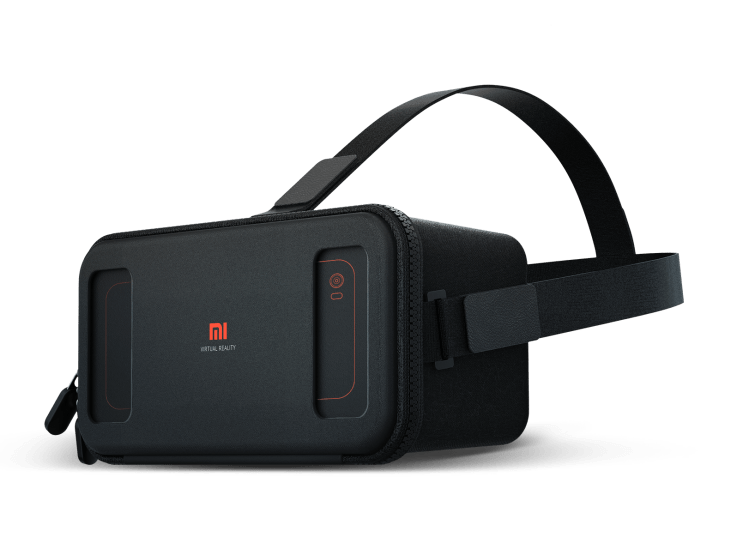
Xiaomi is broadening its already expansive range of products by venturing into virtual reality for the first time.
The company today announced the ‘Mi VR Play’, an “entry-level” virtual reality headset that it hopes can open this new exciting medium up to new audiences because not everyone has thousands of dollars needed to set up an Oculus Rift or HTC Vive. Democratizing technology is the thesis behind most of Xiaomi’s competitively-priced products, including the $550/750 notebook announced last week that will rival Apple’s Macbook in China.
Mi VR Play has significantly improved upon the design typically used in similar VR products — it is wrapped in lightweight, durable Lycra for long-lasting comfort. In the future, Mi VR Play will also be available in a selection of bold prints and colours for even more stylish options. The unique two-way zipper helps to ensure compatibility, providing a secure grip on a wide range of 4.7- to 5.7-inch smartphones. At the same time, the dual openings on the front allow for slight positioning adjustments and ventilation.
Sounds good so far?
Here’s the catch — you can’t go and buy one, even if you’re in China.
Xiaomi is making it available to a limited number of beta test users, who signed up on August 1 when Xiaomi put out a call for volunteers. One million users signed up in just eight hours, the company said, but Xiaomi has selected just a fraction of those — likely “tens of thousands”, a representative told TechCrunch.
For those lucky ones accepted into the test program, the Mi VR Play will cost just RMB 1 ($0.15).
Xiaomi told us that it has plans to make the headset more widely available in the future, but there’s no schedule for that right now. Along those lines, it isn’t clear how much the headset will cost once it is on sale to all. We suspect it won’t be RMB 1, sadly.
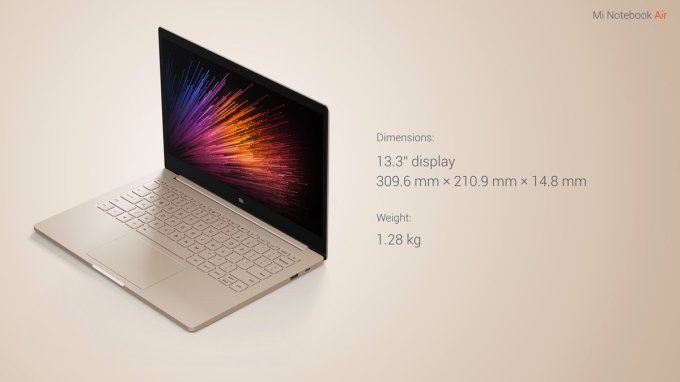
Chinese smartphone and smart device maker Xiaomi just announced its first laptop — and boy does it look familiar to products belonging to a company that begins with the letter ‘A’ 😉
The Chinese tech giant is holding a press event to unveil its new Redmi Pro smartphone today, but it also dropped a surprise with the unveiling of the Mi Notebook Air. Even the name sounds familiar, right?
The laptop comes in two sizes — 13.3-inch and 12.5-inch — running Windows with a full-HD display, full-metal body and type-C USB charging and two USB slots. There’s a full-sized keyboard with Apple-esque keys that are individually backlit. The company’s ‘Xiaomi Sync’ software is pre-installed to pair data from a Xiaomi smartphone, and you can unlock the laptop using a Mi Band wearable.
The starting price is 3599 CNY, or around $540, for the 12.5-inch model with the larger, flagship model coming in at 4,999, or $750. Don’t hold your breath on an international launch, since many of Xiaomi’s products — particularly its first forays into new categories — are China-only affairs. What we know so far is it will go on sale in China from August 2.
Under the hood, Xiaomi is promising an Intel Core i5 Processor with 8GB DDR4 RAM and 256GB PCIe SSD, and an expandable SSD slot. For games, there’s a dedicated NVIDIA GeForce 940MX graphics card. Size-wise, we are talking 306.9 mm x 210.9 mm x 14.8 mm with an apparent weight of 1.28 kg.
Those specs slip a little for the smaller model, which includes an Intel Core M3 processor with integrated graphics, 4GB RAM and 128GB in expandable SSD.
As is so often the case, Apple is the standard for Xiaomi’s product comparison. The Chinese company said the Mi Notebook Air is thinner (13 percent) than its equivalent Macbook Air, and 11 percent smaller than its rival thanks to a 5.56 mm bezel.
There was plenty of speculation about a Xiaomi laptop last year, and now that has materialized into a physical product it’ll be interesting to see how many units Xiaomi ships. Let it not be forgotten that the company has struggled to justify its huge $45 billion valuation. It sold “over 70 million devices” in 2015 and, while that figure is very respectable,an increase on its previous year while many in the industry are seeing volumes fall, it was some way behind Xiaomi’s original target. Added to that, there’s been no indication that its smart home focus — the idea that Xiaomi can build an ecosystem of products for Chinese consumers — has come to fruition yet.
That focus was a key driver for Xiaomi’s colossal valuation. Because, with hardware a fiercely competitive business with low margins despite Xiaomi’s smart approach to sourcing components, the potential for a data and services business that connects the dots can help Xiaomi stand apart from its rivals.
Some may see a laptop as an unnecessary product line, particularly in China where the audience is mobile-first internet users, but does fit into Xiaomi’s ambition to own every connected device in a Chinese consumer household. Or at least to offer an attractive option for any kind of internet-connected hardware product.
Remember when budget phones had middling specs? It makes sense: To keep the price low, the manufacturer had to include a cheaper part or three. But nowadays, those cheap parts might mean a tiny performance hit, and — due to the heated race in China to offer a great phone at a low price — in some areas they're actually technologically ahead of the more expensive versions.
Case in point: Xiaomi's new Redmi Pro smartphone. It's a 5.5-inch phone with a metal body, a full HD OLED display, a 10-core MediaTek Helio X20/X25 processor, a fingerprint sensor, and a 4,050mAh battery. It also has a dual camera on the back — a 13-megapixel sensor coupled with a 5-megapixel one for additional depth information, and can be configured to have 4GB of RAM and 128GB of storage.
If that sounds better than basically any other flagship out there, you're not wrong; the only major part that falls into the "budget" category is the MediaTek processor, but we doubt the more powerful Helio X25 variant (which comes with the top Redmi Pro model) will significantly lag behind the current king of mobile CPUs, the octa-core Qualcomm Snapdragon 820.
Xiaomi has been consistently offering great phones at very low prices — its flagship Xiaomi Mi 5 starts at about $305 and offers performance comparable to the best smartphones out there. But unless you absolutely must have a Snapdragon processor, the Redmi Pro sounds like an even better offer.
IMAGE: XIAOMI
The starting price for the Redmi Pro is RMB 1,499 or about $225; for that, you'll get the slower (but still 10-core) MediaTek Helio X20 processor, 3GB of RAM and 32GB of storage. For RMB 1,699 ($255) you'll get the faster Helio X25 processor, 4GB of RAM and 64GB of storage. And RMB 1,999 ($300) will get you 4GB of RAM and 128GB of storage, coupled with the Helio X25 CPU.
We'll let that sink in: For 300 bucks, you can get a phone with dual cameras, 10 processor cores, and as much storage space as the top-of-the-line iPhone 6S, which costs nearly three times as much.
IMAGE: XIAOMI
The Redmi Pro is not the first phone with a deca-core processor on the market; Meizu's Pro 6 sports the same processor and has a 21-megapixel (single) rear camera. However, it's priced higher, especially if you opt in for more storage. We'll need to take a closer look at the Redmi Pro to see how it performs in the real world (that dual camera, supposedly offering a DSLR-like bokeh effect, is particularly interesting), but right now it sounds like a very attractive smartphone at an insanely low price.
Xiaomi Redmi Pro will be available in China through Xiaomi's Mi.com, as well as Mi Home stores on August 6.
Remember when budget phones had middling specs? It makes sense: To keep the price low, the manufacturer had to include a cheaper part or three. But nowadays, those cheap parts might mean a tiny performance hit, and — due to the heated race in China to offer a great phone at a low price — in some areas they're actually technologically ahead of the more expensive versions.
Case in point: Xiaomi's new Redmi Pro smartphone. It's a 5.5-inch phone with a metal body, a full HD OLED display, a 10-core MediaTek Helio X20/X25 processor, a fingerprint sensor, and a 4,050mAh battery. It also has a dual camera on the back — a 13-megapixel sensor coupled with a 5-megapixel one for additional depth information, and can be configured to have 4GB of RAM and 128GB of storage.
If that sounds better than basically any other flagship out there, you're not wrong; the only major part that falls into the "budget" category is the MediaTek processor, but we doubt the more powerful Helio X25 variant (which comes with the top Redmi Pro model) will significantly lag behind the current king of mobile CPUs, the octa-core Qualcomm Snapdragon 820.
Xiaomi has been consistently offering great phones at very low prices — its flagshipXiaomi Mi 5 starts at about $305 and offers performance comparable to the best smartphones out there. But unless you absolutely must have a Snapdragon processor, the Redmi Pro sounds like an even better offer.
IMAGE: XIAOMI
The starting price for the Redmi Pro is RMB 1,499 or about $225; for that, you'll get the slower (but still 10-core) MediaTek Helio X20 processor, 3GB of RAM and 32GB of storage. For RMB 1,699 ($255) you'll get the faster Helio X25 processor, 4GB of RAM and 64GB of storage. And RMB 1,999 ($300) will get you 4GB of RAM and 128GB of storage, coupled with the Helio X25 CPU.
We'll let that sink in: For 300 bucks, you can get a phone with dual cameras, 10 processor cores, and as much storage space as the top-of-the-line iPhone 6S, which costs nearly three times as much.
IMAGE: XIAOMI
The Redmi Pro is not the first phone with a deca-core processor on the market; Meizu's Pro 6 sports the same processor and has a 21-megapixel (single) rear camera. However, it's priced higher, especially if you opt in for more storage. We'll need to take a closer look at the Redmi Pro to see how it performs in the real world (that dual camera, supposedly offering a DSLR-like bokeh effect, is particularly interesting), but right now it sounds like a very attractive smartphone at an insanely low price.
Xiaomi Redmi Pro will be available in China through Xiaomi's Mi.com, as well as Mi Home stores on August 6.
Chinese smartphone giant Xiaomi has announced it will purchase 1,500 of Microsoft's patents, many of those related to mobile software, as it marks the next step in its pursuit of Western expansion. The financial terms of the deal were not disclosed.
While the Android maker dominates its home market with an intimidating 26% share of the fast-growing scene, intellectual property challenges inhibit its ability to grow as quickly outside.
In 2014, Ericsson sued Xiaomi in India, and a Delhi High Court judge banned Xiaomi from selling some of its devices in the country.
Since then, Xiaomi has been trying to broaden its patent portfolio, inking deals with Qualcomm for instance, as it navigates the tricky minefield of Android royalty payments.
Squeezed at home both from low-end and high-end Android makers, it makes sense for Xiaomi to invest its sizeable R&D might toward expanding its product offerings, and reaching a bigger audience.
Its recently unveiled Mi Drone, for example, is set to target DJI, which so far has dominated the aerial photography scene. Xiaomi's new drone does what Xiaomi does best — bringing the price point down while maintaining comparable specs to the competition.
Xiaomi makes rice cookers, too. This is its CEO, Lei Jun, showing one off on stage.
IMAGE: AP
Microsoft Office on every Xiaomi
Along with the patent-licensing agreement, Xiaomi also announced on Wednesday it has agreed to pre-install Microsoft Office and Skype on its devices, allowing Microsoft's bread-and-butter products to reach tens of millions of Xiaomi users in Asia.
For Microsoft, it's just another confirmation that the company has all but given up on pushing people over to Windows phones; instead, it's trying to be more present on iOS and Android devices.
Starting from September this year, Xiaomi's Mi 5, Mi Max, Mi 4s, Redmi Note 3 and Redmi 3, will come with Microsoft Word, Excel, PowerPoint, Outlook and Skype apps loaded on them.
Xiaomi has an existing relationship with Microsoft, with its Mi Cloud service relying on Microsoft Azure servers.
Chinese tech giant Xiaomi is getting into the drone business.
The company sent out a teaser image for its upcoming drone last week. Ahead of its big unveil on May 25, Android Central has discovered a 20-second teaser video, which was posted to Youku, China's version of YouTube.
Based on the short teaser video, we now know Xiaomi's sleek white drone will have four blades and a ball-shaped camera mounted on the underbelly of the drone that swivels. The drone is rumored to be able to shoot in 4K resolution.
Xiaomi's drone will likely compete directly against DJI's drones. Though DJI makes professional drones designed specifically to carry large cameras for filmmakers, the company's consumer drones, such as the new DJI Phantom 4, have proven to be a huge hit with hobbyists and regular folk.
With the Phantom 4, DJI introduced several useful and safety features such as tap-to-fly for easier operation by beginners, auto-follow (for selfie addicts) and obstacle avoidance.
But the Phantom 4 is pricey at $1,400. Xiaomi has made a name for itself selling highly polished devices, like its new flagship Mi 5 Android smartphone, at low prices. If it does the same with its drone, DJI may have to start worrying.
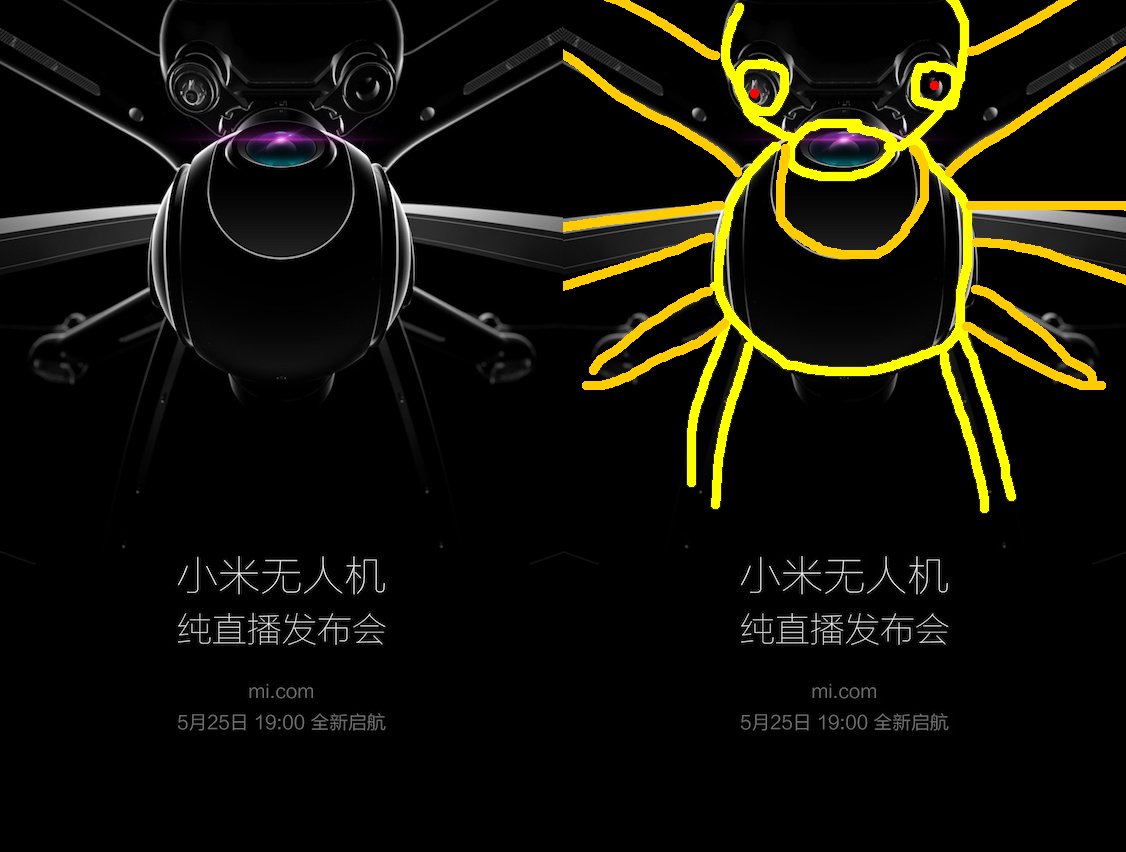
Here's the teaser Xiaomi sent out last week. Anyone else see a bee?
Xiaomi has been running a livestream online to demonstrate the battery life of its behemoth 6.44-inch Mi Max phablet — and the show's been on for nearly two weeks now.
The Chinese phone giant launched the stream on May 10 at 4pm in the afternoon local time, right after it launched the device. It's got a Mi Max in the frame turned on with a SIM card in it, but on standby and not running any apps.
Each hour, the phone's screen is briefly turned on to show it's still running. Thanks to the phone's massive body, Xiaomi's been able to put a 4,850 mAh battery in it, which has been powering the device for a mind-boggling two weeks.
Crazy as that sounds, the stream, up on Chinese video site Bilibili, attracted over 20 million unique views by the weekend — about 11 days into broadcast. And it's still going strong. Users tuning in continue to flood the chat box with a whizzing stream of remarks.
This is a capture of the chat box's comments coming in on Monday — day 13:
And this is how the screen of the broadcast looks, with the comments overlaid:
The show has so far featured skits with actors lip syncing to a Chinese cartoon, streams of video game battles played live, and general talkshow segments with groups of people chatting.
Xiaomi has also given out Mi Max phones to commenters live on the show, which has no doubt only helped to fuel the noise. It's so far handed out 777 devices to viewers, the company said.
We wonder if Xiaomi knew it would be tough running a nonstop show for as long as this. It seems to have an inkling: it named the stream the "Xiaomi Max ultra enduring boring livestream." (Its original name in Chinese: 小米Max超耐久无聊待机直播)
On Weibo, netizens seem to agree that the livestream is "boring". A user called Wang Dian said: "What a boring livestream, but there are 10,000 people tuned in right now."
Others seem to be impressed at Xiaomi's ability to keep the show going. "It's 'boring' but I'm watching every day," said a user called Mickey, posting from the Bilibili app over the weekend.
Several Chinese papers have commented on the livestream, with one saying it taps into the "emptiness" of present youth in the country who are addicted to their devices and online videos.
Is there anything Xiaomi can't do? The Chinese company, known for making cheap but powerful smartphones, makes a ton of other gadgets, including a kid-oriented smartwatch, a fitness band, a 4K-ready media box, a rice cooker (yes, really) and a self-balancing scooter.
Now, judging by an image posted on the company's Weibo account, it's also going to launch a drone.
Besides an image of a bug-resembling, futuristic looking drone, and a date — May 25 — the poster contains no additional info about the device. Last week's teaser, which consisted only of an image of a wooden propeller, offered even less in terms of details.
IMAGE: XIAOMI
However, Xiaomi is known for sleek yet very cheap devices — its Mi Band costs only $15, and its Segway competitor, the Ninebot mini, costs around $314. It's fair to assume the drone will at least match — if not undercut — the prices of similarly specced drones out there, but we'll know more next week.
Like a number of other bits and bobs announced at Google I/O thus far, there are still some important questions left unanswered about the Mi Box — but here’s what we do know about Xiaomi’s forthcoming set-top box.
It’s sleek, it’s small and it’s apparently won the Chinese phone maker a couple of design awards already. The Mi Box is powered by Android TV 6.0, is capable of beaming 4K video at 60 FPS and supports Dolby Digital Plus audio playback.
It does HDMI 2.0a and features a quad-core ARM processor, Mali 450 GPU and has 2GB of RAM and 8GB of storage, which is expandable via USB. Oh, and there’s a Bluetooth remote, as well. That peripheral supports voice control, so users can search for content, ask contextual questions (actors’ names, etc.) and launch apps using their voice. The controller also doubles as a gaming controller for Android TV-compatible games.
The company will also be offering a separate Mi Game Controller, which is compatible with the set-top box and other Android devices. Availability details for both products are still forthcoming, though the company noted that the product is “coming soon” in a press release issued today. A Xiaomi spokesperson added that the company is “working closely with Google” on the U.S. launch.
The wearables market has seen over 67 percent annual growth in the past twelve months, but the smartwatch industry continues to drag down the numbers.
Market research firm IDC posted sales results for the first quarter, which shows Fitbit and Xiaomi ahead of the rest by a considerable margin. The two companies hold 24.5 and 17 percent of the market, respectively.
Apple comes in third with 1.5 million sales in the first quarter, accounting for 7.5 percent of the market. It has done considerably better than its rival, Samsung, in fifth place with 700,000 sales.
Android Wear manufacturers did not reach the top five, beaten by Garmin and BBK, a Chinese firm that sells a kids watch. IDC does count more than 37 percent of sales in ‘Other’ however, so it is possible that Android Wear watches surpass Samsung or Apple when combined.
Fitness appears to be the key function for wearables in 2016, as it has been for the past few years. Fitbit sold 4.8 million and Xiaomi sold 3.7 million this quarter; both firms provide inexpensive wearables that track health and fitness with limited interactivity on the wearable.
Smartwatches and wearables going their own ways
“There’s a clear bifurcation and growth within the wearables market,” said Jitesh Ubrani, senior research analyst for IDC’s Mobile Device Trackers. “Smart watches attempt to offer holistic experiences by being everything to everyone, while basic wearables like fitness bands, connected clothing, or hearables have a focused approach and often offer specialized use cases.”
Xmetrics CEO had a similar opinion of the wearable market, saying that in the next few years more customers will move towards a simplistic and singular experience.
That doesn’t mean smartwatches are dead in the water, however it might be a few years before we can expect it to be on the same level as mobiles or PCs.
NEW DELHI: Xiaomi will launch its Mi Max smartphone featuring a massive 6.4-inch screen on May 10 in Beijing. The company also shared a glimpseof the smartphone in a Weibo post stating the 6.4-inch smartphone will fit in denim pockets.
The device will look similar to the Mi 5 and will come with a fingerprint scanner. It is still early to comment whether the smartphone would be introduced in India or not. The specs are expected to be similar as well. The Mi 5 handset runs on Android 6.0 Marshmallow operating system and is powered by a quad-core Qualcomm Snapdragon 820 processor. The device comes in 3GB/4GB RAM and 32GB/64GB/128GB storage variants.
Xiaomi decided to name the 6.4-inch smartphone as Max after an online poll. Some photos of the device's front panel have surfaced online. These pictures are reportedly straight from the production line. The shots show the phablet's front panel and it appears huge. In tune with Xiaomi's design language, the image shows side bezels, capacitive keys and sensor array.
Recently, Xiaomi's rival Lenovo launched Phab phablet with a 6.9-inch screen. The Lenovo Phab sports a 6.98-inch HD display with 1280x720 pixels resolution. The device runs on Android 5.1 Lollipop operating system topped with the Vibe UI of the company. It is powered by a quad-core Qualcomm Snapdragon 410 processor clocked at 1.2GHz. The phablet offers 2GB of RAM and 16GB internal storage which can be expanded further using a microSD card.
The Lenovo Phab offers dual sim functionality and comes equipped with Dolby Atmos, 3 microphones and dedicated voice processor support. The device flaunts a 13MP rear camera with LED flash and a 5MP front-facing camera for selfies. The connectivity options of the device include 4G, LTE, 3G, Wi-Fi, Bluetooth and GPS. It houses a massive 4,250 mAh battery for smooth functioning.
"We should launch the air purifier in India," Hugo Barra quips absentmindedly as we sit in the eighth floor suite of the Sheraton hotel in New Delhi, overlooking the Qutub Minar. The 12th century monument is barely visible through Delhi's infamous haze on this Friday afternoon. Delhi has some of the worst air quality in the world, often scoring worse than Beijing.
As we order coffee, I stare at the Xiaomi Mi 5 lying on the table, or whatever's left of it after undergoing a trademark Barra teardown session. However, Xiaomi's flagship device is not what we are talking about today.
Even as Barra and Xiaomi put their muscle behind ensuring the Mi 5's success, there are nearly 200 employees working on the 11th floor of Xiaomi's Beijing headquarters — and none of them are working on the post-launch dynamics of the Mi 5 or developing the next Mi Note or Mi 6. In fact, none of these employees work on any product made by Xiaomi.
This exclusive group, Marshalled by Liu De, one of Xiaomi's eight co-founders, includes specialists across product management, industrial design, supply chain management, marketing and other functions. Their job is to assist those companies — more than 50 currently — that make what Barra calls the the "Mi Ecosystem."
Xiaomi is known for its cheap smartphones whose specs and features rival Apple's iPhones, its ridiculous flash sales that run out in seconds and its massive product launch events that are attended by thousands of fans. But these 200 employees are leading a transformation from within, one that could change the world's perception of the company.
Giving 'Made in China' a good name
Xiaomi vice president of global operations Hugo Barra points toward the Mi TV 2 after a presentation in San Francisco.
IMAGE: JEFF CHIU/ASSOCIATED PRESS
"China's manufacturing bays are often viewed as low-quality and copycat," Barra tells me. "This is not very different from how Japan was considered in the '60s. How Sony, Toshiba, Panasonic and others helped turn around the image for Japan, we think we would be able to do that for China."
"It is almost a noble cause — the notion of building a consumer electronics company out of China with products that are designed in China but are world class and very very innovative."
"The initial goal was to populate our e-commerce store with interesting products that people will love and that will cause them to keep coming back," Barra says. "If all we sold were phones, we probably won't have much traffic because people only buy phones once in a while. So the idea was to have a family of products that will allow us to have a full on e-commerce store. The first thought was, 'Let's focus on mobile accessories,' and that's how the first product in which we invested, the Mi power bank, came into being."
Shenzhen is a bustling metropolis just north of Hong Kong and China's first Special Economic Zone. What was once a sleepy fishing village, is now home to 18 million people, mostly migrants, who work in the hundreds of factories that build pretty much everything in the world of electronics — from the iPhone's SIM ejector pin to the iPhones themselves. Xiaomi had hoped that, being from China, it would be an easy task to get a manufacturer in Shenzhen to custom-build power banks and put the Mi branding on top of it. But it wasn't.
Quickly enough, Xiaomi understood most of these manufacturers were there to make a quick killing and move on. Many were cutting corners to make higher margins, while others weren't interested in a long-term partnership. Quality was the least of their concerns — most of their customers were interested simply making cheap accessories. Xiaomi, however, didn't want to compromise on quality as it would impact the perception of its smartphones.
The other option: Xiaomi could build the power bank and other accessories itself. But that would have meant dedicating valuable resources away from its core smartphone team to build an ecosystem of accessories and dilute the company's focus.
So instead, Xiaomi's enterprising founder Lei Jun had the novel idea of backing and even incubating startups that would build innovative accessories that Xiaomi could sell on its online store.
Lei Jun, Chairman and CEO of Xiaomi Technology, delivers a speech at a launch event for Xiaomi's new digital products in Beijing, China.
The 46-year-old founder of Xiaomi is a serial investor. Lei Jun started off as an engineer at Kingsoft and went on to become the software company's president. He also founded Joyo.com, which was eventually acquired by Amazon for $75 million. He invested in mobile browser maker UCWeb, which became the largest third-party smartphone browser with over 500 million users and was bought by Alibaba in 2014. He also invested in the Chinese video streaming platform YY and became the founding member of Shunwei Capital, an investment firm that funded many companies closer to Xiaomi's interests.
Making incubation and industry
Under Lei Jun's guidance, Xiaomi started investing in startups in the mobile accessory space. The initial candidates were those in the power bank and personal audio devices, which would pair well on Xiaomi's online store along with its smartphones.
The first company Xiaomi invested in was Zimi, the maker of the Mi Power Bank. Xiaomi helped the startup with the design of the product, introduced it to Xiaomi's supply chain and manufacturing partners, and placed the power bank in its online store, mi.com, which had become among the biggest e-commerce destinations in China, thanks to the success of the company's smartphones.
The "Mi Power Bank" was an instant hit. It had an appealing design, the aggressive pricing one would expect from Xiaomi (it starts at $9.99), and the trust it had built with its users. Xiaomi says it's sold more than 47 million power banks to date. There's still so much demand for them that they're almost never in stock. Fake Mi Power Banks flood markets in both China and India, while Xiaomi's rivals have launched their own power banks that don't look much different from the one that started the trend.
With the success of the Mi Power Bank, Xiaomi started to aggressively look for more products it could build and sell right when the Internet of Things, or IoT, became the talk of the office. One of the first IoT startups in Xiaomi's portfolio, which also brought Xiaomi's accessory business under global spotlight, was Huami. The $11 "Mi Band" it built for Xiaomi ended up being so successful that it was second only to Fitbit in in worldwide wearable sales in 2015, according to IDC. Xiaomi claims it's sold over 18.5 million Mi Bands so far.
Xiaomi kept investing in startups and also sought out entrepreneurs whom it could incubate to work on new products. However, it started taking a toll on Xiaomi's internal teams that were helping these "portfolio" companies. Lei Jun decided to give the arrangement more structure and called upon Xiaomi's co-founder and head of industrial design, Liu De, to see if he would lead the newly created division."As a company, we underestimated the potential of the product," says Barra. "We knew we had a killer product insight — let's make a wearable device with a 30-day battery. We didn't really realize the impact it would have. Of course, the price helps but if you look at all the people here in India and also in China, who could easily spend $200 on a wearable or even more on an Apple Watch, wearing the Mi Band. You ask them why and they invariably say because of the battery life and they don't have to charge it. That insight and the price made it such a runaway product."
Soon Liu De's Mi Ecosystem team had over 200 full-time employees in an office on the 11th floor of Xiaomi's headquarters in Beijing. The division didn't just do portfolio management but also decided which product category to go for next and sought out entrepreneurs and partners who could help them build those products. One common theme of majority of startups is that they have "mi" in their name, which means rice in Chinese (Xiaomi means "little rice").
Xiaomi usually invests in startups either in the Seed or Series A round. The amount varies from a little under a million dollars to a couple of million dollars. Xiaomi doesn't always look at a controlling stake but just enough to ensure the startup is aligned with its vision.
The ecosystem takes shape
The startups were chugging along nicely when Xiaomi's ambitions had a sort of an epiphany. The "mi" startups were belting out products like Wi-Fi routers (like a much cheaper version of Apple's AirPort), wireless weighing scales, selfie sticks, a pen to test water quality, a Segway-like Ninebot Mini hoverboard, in-ear and over-the-ear headphones, smart TVs, movement and occupancy sensors for homes, surveillance and web cameras, and much more.
The accessories business was doing well for Xiaomi and worked in tandem with its plans to become an Internet services company. All of these products were sold on Xiaomi's online store as well as its Mi Home app, where you could not only control your connected Mi devices but also buy new stuff. The success of these products emboldened Xiaomi to double down on them and at the same time extend their scope. It felt it was time it could go beyond the common accessories and appliances like smart TVs.
"It dawned on us that there is so much opportunity in a wide area of products simply because there hasn't been much innovation here," says Barra. "You know, they have kind of remained the same, the design hasn't been rethought, they haven't evolved, connected to the Internet... There was just a lot of opportunity."
Thus came the big a-ha moment: Xiaomi decided to make an air purifier. So far the company had made accessories that would be companion products to its smartphones or tiny gadgets that would appeal to its young, tech-savvy customers. But could it sell a home appliance without a natural connection to a smartphone? And could it create the same kind of hype for such a traditionally "boring" product?
Turns out it could.
Xiaomi incubated a company called Zhimi and tasked it with making an air purifier worthy of carrying the Mi brand. It had to look good, offer better air purification than existing models, and it had to be connected to the Internet so users could control it with their Mi phones.
It took Xiaomi and Zhimi less than a year to achieve that. Not only did the Mi Air Purifier look like a work of art — something you wouldn't mind placing in the center of your room rather than tucking it away in a corner — it was also smart. Users could get real-time indoor air quality reports on their smartphones, they could control the air purifier remotely, and it could even automatically order new filters from Mi.com! No other air purifier in the market offered all this
The Mi Air Purifier accounted for 20% of all new air-purifier sales in China within seven months of launch, Xiaomi claims, and it has sold over a million units so far. It has already launched a smaller, better version of the first-generation Mi Air Purifier.
"All these are simple ideas if you think from a Silicon Valley point of view, but they were being thought about in an old industry point of view — selling them through old distribution channel with huge margins," Barra says almost matter-of-factly.
Xiaomi is not just rethinking how to make existing appliances smart, connected and beautiful — it's also looking at how to make expensive appliances more affordable and bring them within the reach of many more. Its latest bet, a RMB 1,000 (approximately $150) Mi Rice Cooker, could have the potential to get the Mi brand even in households that don't have a Xiaomi smartphone.
Like all other devices in the Mi Ecosystem, even the Rice Cooker is connected to the Internet and comes with its own app that let users control it with their smartphones. All the user needs to do is scan the barcode of the rice packet and the cooker would do all the cooking. Xiaomi claims its rice cooker can compete with expensive, top-of-the-line rice cookers from Japanese brands, which not only cost a lot to manufacture but have high margins, too.
"Making a good rice cooker is not that easy," says Barra. "We set out thinking how can we redesign a rice cooker to deliver a similar quality and to simplify the manufacturing process. That's what we do — we rethink and redesign products rather than do it the same way the industry has been doing for a decade."
Rice is serious business in China and a lot of Xiaomi's success in becoming a major home appliance company could ride on the success of the Mi Rice Cooker. Lei Jun has set an ambitious goal of RMB 10.5 billion ($1.62 billion) in revenues from the Mi Ecosystem in 2016. The Mi Rice Cooker better does well, else that's a lot of Mi Power Banks and Mi Bands to sell.
Xiaomi's story has barely begun. It's still known as the cheap-smartphone upstart that's challenging the likes of Samsung and Apple in various markets, but that description is rapidly becoming inadequate to encapsulate the company's large product catalog and even-larger ambition. In the end, its impact on China and the world may have less to do with mobile than anyone ever thought.
Have something to add to this story? Share it in the





 Popular
 Tags
Tags Videos