• unilogou. Powered by Blogger.

    Showing posts with label NASA. Show all posts
    Showing posts with label NASA. Show all posts

    Wednesday, 10 August 2016

    NASA awards companies $65 million to develop habitats for deep space

    Posted By: Uni logo - 14:59:00

    NASA is serious about going to Mars, and not just for a quick visit, either. It just committed $65 million, spread over two years and six companies, for the purpose of developing and testing deep-space habitats that could be used on the way to — and on the surface of — the Red Planet.
    It’s part of the organization’s NEXTStep (not to be confused with the NeXTSTEP OS), an ongoing partnership program under NASA’s Advanced Exploration Systems that funds private research into technology for space exploration.
    Last year’s NEXTStep contracts were for a variety of things, but this year they’re all on the same track: “deep space habitats where humans will live and work independently for months or years at a time, without cargo supply deliveries from Earth.” We’re talking spaceships here — big ones.
    The numbers are bigger, too: the previous year’s contracts amounted to a total of perhaps $15 million divided 10 ways — $65 million 6 ways is, it hardly needs saying, a much more considerable investment.
    The lucky companies are all taking slightly different approaches to the problem of deep space habitation.
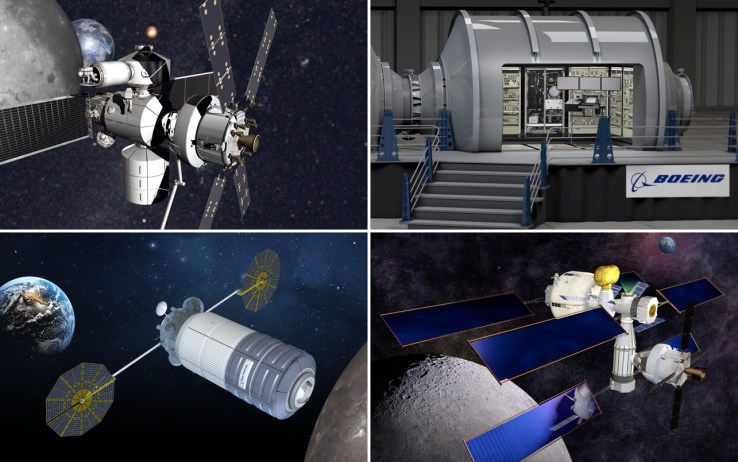
    From top left: Lockheed Martin, Boeing, Orbital ATK, and Sierra Nevada's concept spacecraft.
    Bigelow is a name you may already be familiar with: the Bigelow Expandable Activity Module was recently attached to the International Space Station and is currentlyundergoing testing. The company plans to develop one about 20 times larger (330 vs 16 cubic feet) that they call the Expandable Bigelow Advanced Station Enhancement, or XBASE. There are advantages to being able to pack your modules tightly and expand them later, but the BEAM’s troubled deployment shows there are challenges as well. Of course, that’s what testing is for.
    Lockheed Martin doesn’t want to let good space gear go to waste, either; its plan is to refurbish one of the cargo modules carried by the Space Shuttles into a livable multi-purpose environment. The idea is, essentially, to use proven equipment as a base to test future developments, like data and crew transfer between the module and, say, the Orion spacecraft.
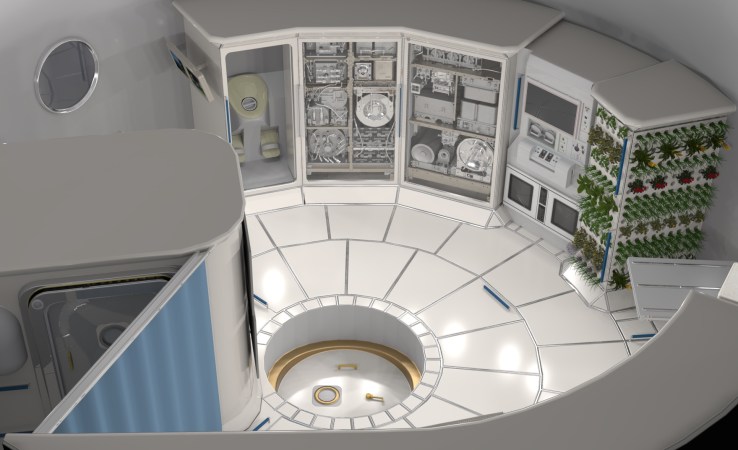
    NASA concept of the interior of a habitable module.
    Another avid recycler is NanoRacks, whose commercial experimentation platform outside the ISS just went live yesterday. Nanoracks has a rather crazy idea: convert the final rocket stage, with its spacious fuel compartment, into a habitable space. It’s working with Space Systems Loral and the United Launch Alliance to see if this is crazy enough to work — or just plain crazy.
    Sierra Nevada (specifically its subsidiary Space Systems) has perhaps the most ambitious plan. Over four commercial launches, the company wants to build on one of its Dream Chaser cargo modules, adding a propulsion system, an expandable environment, and life support. Taking it in stages means better risk management.
    Boeing and Orbital ATK didn’t provide many details: the former just says it’s building a full-scale prototype for extensive testing, and the latter is adapting one of its Cygnus spacecraft to the purpose.
    It’s all very early, of course, and these projects, among others, are for exploring possibilities and finding potential problems, not actually producing something we can send to Mars or beyond. The technology investigated by these companies will have to prove itself on the ground first, then in orbit, and eventually in cislunar space — the “proving ground” for long term mission hardware.
    NASA didn’t specify how much each project was receiving, or the exact timelines or deliverables expected from each — although results are certainly expected by the time the contracts’ 24 months are up. I contacted NASA for more details and will update this post if I hear back.

    Wednesday, 3 August 2016

    How the First Private Moon Landing Will Spur the Future of Space Mining

    Posted By: Uni logo - 14:26:00

    Moon Express just became the first private company in history to be approved for a lunar surface mission. The California-based startup plans to land its 20-pound MX-1 spacecraft on the Moon in 2017.
    "This is not only a milestone, but really a threshold for the entire commercial space industry,” Moon Express CEO Bob Richards told Space.com. "Somebody had to be first."
    The decision, announced by the Federal Aviation Administration (FAA) on Wednesday, may sound the starting pistol for a new era in spaceflight, defined at least as much by commercial ventures and resource extraction as by scientific and exploratory missions. Mining the Moon for valuable materials has been a hot topic of speculationfor years, but with the FAA’s official greenlight, Moon Express is poised to force the issue.
    That’s not to suggest, however, that the company’s 2017 lander will return to Earth laden with overflowing chests of Moon booty. At this point, the FAA has only approved Moon Express’s request to conduct a lunar surface mission, not mine it for resources.
    “It appears that the FAA has granted a licence to Moon Express to carry out a permissible space activity,” Sa’id Mosteshar, director of the London Institute of Space Policy and Law, told me. “The licence does not give Moon Express any exclusive or property right. It merely permits Moon Express to launch a spacecraft, travel to the Moon, and land there.”
    If successful, Moon Express’s landing will mark the first time any American organization has soft-landed a spacecraft on the Moon since Apollo 17 touched down in 1972. This kind of achievement is exactly what the emerging commercial space sector has always been hyped to accomplish. By untethering exploration from the purview of government agencies alone, space travel is becoming faster, cheaper, andmore widely accessible to the public.


    Indeed, Moon Express already has some exciting experiments lined up for its mission. According to Richards, the lander might install a small “mooncam” observatory at its landing site that would be viewable to anyone through YouTube. The company is also angling to nab the $30 million Google Lunar X-Prize, so it will have to demonstrate that its MX-1 vehicle can move at least 500 meters, and send high definition imagery back to Earth.
    But ultimately, Moon Express has its eyes on an even bigger prize: The Moon’s bountiful resources. Our natural satellite contains many precious materials, such as water, iron ore, and helium-3. Even the Moon’s normal regolith rock is treasured simply for its interplanetary exoticism.
    “I believe that the first trillionaires will be generated by investments in space resources,” Richards said in a 2014 Motherboard documentary. “Our goal is that in 2020, we’ll bring something back that you can hold in your hand; between two to six kilograms of stuff. It could be worth upwards of a billion dollars. And then the game is on.”
    It will be interesting to see how many other commercial players end up joining this game by following Moon Express’s lead. “There are already a number of private entities planning to go to the Moon and to carry out various activities there,” Mosteshar told me.

    “However, until and unless it becomes clear that exploitation of lunar resources is permitted, I would not expect many investors to risk vast sums of money on attempting to mine the Moon or other celestial bodies.”
    Striking that legal balance represents such uncharted territory that Moon Express had to work together with the FAA to figure out a temporary regulatory patch enabling the company to abide by both US law and international treaties for its 2017 mission. This is a promising cooperative starting point, but more comprehensive and consistent regulatory frameworks will have to be developed in order to ensure that off-Earth resources are managed sustainably.
    To that point, some of the language that Moon Express executives have used regarding planetary mining is worth reflecting on, as the company celebrates its milestone achievement.
    "We are now free to set sail as explorers to Earth's eighth continent, the Moon, seeking new knowledge and resources to expand Earth's economic sphere for the benefit of humanity," said Richards in a statement.
    Referring to the Moon as “Earth’s eighth continent” seems dicey in light of the fact that all seven continents on our own planet are imperiled by human activity, much of it borne from unchecked industrial development. Likewise, Jain’s past comparisons of lunar mining to ocean resource extraction poses similar problems.
    “I [...] think the Moon will be treated no differently than the international water in our oceans,“ Jain told the Los Angeles Times in 2011. “In this case, no one really owns the water but any company or country can mine the resources [...] as long as they follow certain safety/moral guidelines,”
    Again, a statement like that would be much more comforting if Earth’s oceans weren’t in devastating ecological freefall as a result of human commercial pressures, much of which takes place in international waters.
    Point being: We should tread carefully. Moon mining does have the potential to benefit humanity, but as with most commodities markets, the sticking will be ensuring that wealth generation does not slip into exploitation. Space exploration is our opportunity to transcend the self-destructive, provincial mindset nurtured by planetary living. Let’s not screw it up.

    Tuesday, 2 August 2016

    Why Gamma Ray Bursts Are the Most Epic of All Apocalyptic Scenarios

    Posted By: Uni logo - 14:19:00

    Asteroid impacts. Nuclear war. Unhinged climate change. These are all respectable, solid entries into the great pantheon of doomsday scenarios that could wipe out life on Earth.
    But when it comes to sheer destructive flair, gamma ray bursts (GRBs) take the apocalyptic cake. Forged in catastrophic cosmic disruptions like supernovae and neutron star mergers, GRBs are the brightest phenomena in the universe. Capable of releasing more energy in a single second than the Sun will in its entire lifetime of ten billion years, these bursts are essentially the universe’s unique riff on projectile barfing.
    The mind-boggling force and fascinating observational history of GRBs is explored in this newly released short from Kurzgesagt (In a Nutshell), a channel famed for its lighthearted animated primers on complex topics. The video’s narrator does not shy away from the epic, face-melting powers of these events, referring to them alternately as “cosmic snipers,” “celestial laser guns,” and “the biggest superweapon in the universe.”

    Interestingly enough, GRBs were first discovered accidentally by an American spy satellite series called Vela, which were launched to monitor Soviet orbital activities during the Space Race. The Vela satellites were built to detect gamma ray radiation from any nuclear detonation tests that the USSR might conduct in space.
    Fortunately, the satellites came up blank on space nukes, but in 1967, they picked up the first signatures of a gamma ray burst. Perplexed by its blinding luminosity and prolonged eruption, scientists accelerated observations of GRBs, and found that the universe clearly enjoys shooting them off.
    Today, thousands of these bursts have been observed and catalogued in many distant galaxies. To get a sense of just how often these cosmic plasma guns fire, check outthis online visual history hosted by UC Berkeley.
    It’s a bit disconcerting to watch the skies light up with these genuine death rays, each one a merciless destroyer of countless worlds unknown to us. There’s some comfort in the fact that GRBs have never been observed within our own Milky Way galaxy, but by no means does that mean that they couldn’t rain down on us with all their incinerating power.
    “A nearby GRB could be disastrous,” the Kurzgesagt narrator points out. “If one goes off within a few light years of us it would totally cook the surface of the Earth, or at least, the half that is facing it. But even a more distant GRB could end life on Earth, and it wouldn’t need to score a headshot to kill us.”
    In fact, a popular theory suggests that Earth may have already been rocked by a gamma ray burst, which sparked the Ordovician mass extinction event 450 million years ago.
    GRBs have even been put forward as a solution for the Fermi paradox, which highlights the contradiction between the wealth of life we might expect to find in the wider universe, compared to the eerie silence that actually confronts us.
    How many intelligent civilizations might have gone up in gamma ray smoke over the course of billions of years? Could we be the next one up in the cosmic crosshairs?
    It’s unlikely, but certainly not impossible. And to add a little more nightmare fuel to the general existential dread GRBs evoke, it’s worth noting that there is absolutely nothing we can do to stop them.
    “Since gamma rays travel at the speed of light, we won’t know one is headed our way until it arrives,” the Kurzgesagt short concludes. “So there could already be a GRB on its way to kill us all, and we won’t know until it hits us, and we’re dead.”

    Monday, 1 August 2016

    NASA’s Juno Spacecraft Sends First In-orbit View

    Posted By: Uni logo - 01:42:00


    The JunoCam camera on board NASA's Juno mission is operational and sending down information after the shuttle's July 4 landing in Jupiter. Juno's obvious light camera was turned on six days after Juno let go its primary motor and set itself into space around the biggest planetary tenant of our nearby planetary group. The principal high-determination pictures of the gas monster Jupiter are still a couple of weeks away.

    "This scene from JunoCam shows it survived its first go through Jupiter's great radiation environment with no corruption and is prepared to go up against Jupiter," said Scott Bolton, chief examiner from the Southwest Research Institute in San Antonio. "We can hardly wait to see the primary perspective of Jupiter's shafts."

    The new view was gotten on July 10, 2016, at 10:30 a.m. PDT (1:30 p.m. EDT, 5:30 UTC), when the shuttle was 2.7 million miles (4.3 million kilometers) from Jupiter on the outbound leg of its underlying 53.5-day catch circle. The shading picture demonstrates climatic components on Jupiter, including the well known Great Red Spot, and three of the huge planet's four biggest moons - Io, Europa and Ganymede, from left to right in the picture.

    "JunoCam will keep on taking pictures as we go around in this first circle," said Candy Hansen, Juno co-examiner from the Planetary Science Institute, Tucson, Arizona. "The primary high-determination pictures of the planet will be gone up against August 27 when Juno makes its next close go to Jupiter."

    JunoCam is a shading, noticeable light camera intended to catch striking photos of Jupiter's shafts and cloud tops. As Juno's eyes, it will give a wide view, giving setting to the shuttle's different instruments. JunoCam was incorporated on the shuttle particularly for reasons for open engagement; in spite of the fact that its pictures will be useful to the science group, it is not viewed as one of the mission's science instruments.

    The Juno group is as of now attempting to place all pictures taken by JunoCam on the mission's site, where the general population can get to them.

    Amid its central goal of investigation, Juno will circle the Jovian world 37 times, taking off low over the planet's cloud tops - as close as around 2,600 miles (4,100 kilometers). Amid these flybys, Juno will test underneath the darkening overcast front of Jupiter and study its auroras to take in more about the planet's roots, structure, climate and magnetosphere.

    JPL deals with the Juno mission for the key agent, Scott Bolton, of Southwest Research Institute in San Antonio. Juno is a piece of NASA's New Frontiers Program, which is overseen at NASA's Marshall Space Flight Center in Huntsville, Alabama, for NASA's Science Mission Directorate. Michael Ravine of Malin Space Science Systems, San Diego, is the JunoCam instrument lead. Lockheed Martin Space Systems, Denver, manufactured the rocket. Caltech in Pasadena oversees JPL for NASA.

    NASA’s Juno Spacecraft Sends First In-orbit View

    Five years in the wake of withdrawing Earth, and a month in the wake of slipping into space around Jupiter, NASA's Juno rocket is nearing a defining moment. On July 31 at 12:41 p.m. PDT (3:41 p.m. EDT), Juno will achieve the most remote point in its circle of Jupiter surprisingly, known as "apojove," 5 million miles (8.1 million kilometers) from the mammoth planet. After that point, Jupiter's gravitational grasp on Juno will bring about the rocket to start falling back toward the planet for another pass, this time with its investigative eyes totally open. 

    The shuttle is as of now executing the first of two long circles before starting its science mission. Every catch circle is about two months in length - an incredible sit tight for the mission's enthusiastic group of researchers - however it's nothing contrasted with the long hold up the group continued on the trek to Jupiter. 

    Juno dispatched on Aug. 5, 2011. The rocket took a long, circling way around the internal nearby planetary group to set up an Earth flyby, in which our planet's gravity flung the turning test ahead toward Jupiter. 

    "For a long time we've been centered around getting to Jupiter. Presently we're there, and we're focusing on starting many flybys of Jupiter to get the science we're after," said Scott Bolton, Juno central specialist at Southwest Research Institute in San Antonio.Juno touched base at Jupiter on July 4, terminating its principle rocket motor as made arrangements for 35 minutes. The faultless move permitted Jupiter's gravity to catch the sun based controlled rocket into the first of two 53.4-day-long circles, alluded to as catch circles. Taking after the catch circles, Juno will fire its motor yet again to abbreviate its orbital period to 14 days and start its science mission. 

    In any case, before that happens, on Aug. 27, Juno must complete its first lap around Jupiter, with a completion line that speaks to the mission's nearest ignore the gas mammoth. Amid the experience, Juno will skim past Jupiter at a minor 2,600 miles (4,200 kilometers) over the cloud tops. 

    Juno's science instruments were killed amid circle insertion, to streamline rocket operations amid that basic move. Interestingly, every one of the instruments will gather information amid the Aug. 27 pass, which serves as a trial keep running before the mission gets the opportunity to work gathering the valuable information it wanted. 

    "We're in a brilliant condition of wellbeing, with the rocket and every one of the instruments completely looked at and prepared for our first very close take a gander at Jupiter," said Rick Nybakken, Juno venture administrator at NASA's Jet Propulsion Laboratory, Pasadena, California. 

    With its intense suite of science instruments, Juno will test Jupiter's profound structure, air dissemination and the high-vitality material science of its attractive surroundings. What Juno finds there will uncover critical intimations to Jupiter's arrangement and advancement, alongside bits of knowledge about how our planetary framework and others are fabricated. 

    JPL deals with the Juno mission for the central examiner, Scott Bolton, of Southwest Research Institute in San Antonio. Juno is a piece of NASA's New Frontiers Program, which is overseen at NASA's Marshall Space Flight Center in Huntsville, Alabama, for NASA's Science Mission Directorate. Caltech in Pasadena oversees JPL for NASA.

    Sunday, 31 July 2016

    The first lunar road trip

    Posted By: Uni logo - 09:35:00
    File:Apollo 15 Lunar Rover and Irwin.jpg
    1971 was a great year for the glorification of vintage American road trips. Hunter S. Thompson published Fear and Loathing in Las Vegas, the Route 66 film Two-Lane Blacktop was released, and some of the Grateful Dead’s early “Road Trips” albums were recorded.
    But despite all that competition stateside, the coolest American road trip of 1971 did not take place within the borders of the US. In fact, it didn’t even take place on the planet. On July 31, 1971, Apollo 15 astronauts David Scott and James Irwin took NASA’s sweetest set of wheels out for a spin on the Moon.
    Setting out at 9:13 AM Eastern US time, the two men enjoyed a lovely Saturday drive through the lunar countryside, with sightseeing stops along the way. Their ride, NASA’s Lunar Roving Vehicle (LRV), was a “brilliant piece of engineering with sealed electric motors in the hub of each wheel,” according to Two Sides of the Moon, Scott’sjoint autobiography with Russian cosmonaut Alexey Leonov.
    The trip was undertaken at the breakneck pace of six miles per hour, and marked the first time anyone had driven an automobile off Earth. Scott said this extreme offroading trip felt like “a cross between a bucking bronco and a small boat in a heavy swell.”
    “Driving the rover was actually more like flying an airplane, albeit with four wheels, than driving a car,” Scott said. “Instead of a steering wheel, which would have been very difficult to grasp in our bulky suits, it was controlled with a joystick mounted on a control console between my seat and Jim’s. Despite our maximum speed of only seven or eight mph, the reduced gravity and very irregular surface meant one or more of the independently suspended wheels lifted away from the surface every time we hit uneven terrain.”
    “Driving into the Sun was the most difficult, since the glare caused a ‘wash-out’ of the surface features,” he continued. “Though the rover could turn on a dime and had very good traction and power, the wire-mesh wheels kicked up impressive rooster-tails of dust, which were deflected by large fenders.”
    On top of all that, Scott and Irwin must have been acutely aware that if they totaled their moon buggy, there would be no roadside assistance to help them get back to base. For that reason, the pair were instructed to drive only as far as they could walk with the oxygen in their life support systems, just in case the LRV broke down.
    Over the course of six hours and 33 minutes, Scott and Irwin completed a southern traverse of about 5.6 miles around the Hadley–Apennine region of the Moon, located on the eastern edge of the massive Mare Imbrium crater (aka the right eye of the Man in the Moon). They hit up Elbow and Saint George craters along the way—picking up samples, taking pictures, and filming their activities—before heading back north to the Apollo 15 Falcon lunar module (LM). They subsisted on fruit sticks that had been packed into pouches below their chins during the drive.
    For the most part, every detail of this inaugural interplanetary drive was heavily scrutinized by Mission Control in Houston. But Scott cheekily managed to get one “off the record” stop in on the way back to the Falcon.
    “Once, when Houston prompted us to get moving and head home,” he recounted, “I was so determined to pick up a very interesting black rock, which I could see not far away sitting all alone on the gray surface without a speck of dust, that I had to resort to subterfuge.”
    “I stopped the rover and pretended to adjust Jim’s seatbelt so that I could stoop to pick it up. This beautiful rounded piece of scoriaceous basalt was later dubbed the ‘seatbelt basalt.’”
    Irwin hammed it up over the radio to Mission Control, to help buy his commander the time he needed to grab the rock. It’s worth taking a look at the transcript of that moment to grasp the sheer scampiness of this mad basalt caper. Here’s part one, featuring the “wink wink” moment between Scott and Irwin and their efforts to distract Joe Allen at Mission Control.
    Scott: Oh, there's some vesicular basalt right there, boy. Oh, man! Hey, how about...? Let's just hold on one second, we've got to have...
    Irwin: Okay; we're stopping.
    Scott: Let me get my seatbelt.
    Allen: Roger; mark that you stopped.
    Scott: It keeps coming off.
    Irwin: Why don't you hand me your seatbelt?
    Scott: Just a minute.
    Irwin: Then get off. (Pause)
    Scott: If I can find it. (Pause) There it is. (Pause) If you'll hang on to it here for a second.
    Irwin: Okay, I've got it. (Long Pause)
    [Unbeknownst to Houston, Dave has stopped to pick up a piece of the basalt.]
    You have to love the unbridled enthusiasm with which Scott first acknowledges the rock, and the conspiratorial pauses that follow. But it only gets better from there.
    Allen: And are you moving again?
    Irwin: No, we're stopped here, Joe. I'll let you know when we move.
    Allen: Roger. (Long Pause)
    Irwin: You know, Joe, these small fresh craters that we've commented on, whatever caused them must create [...] or indurate the soil into the rocks (that is) creates its own rocks (regolith breccia), because there's just a concentration of rocks around the very fresh ones (craters). And by 'small' I'm talking about may be a foot to three feet diameter.
    Allen: Rog, Jim. Sounds very plausible.
    Irwin: ...And create the (lost under Joe) breccia.
    Scott: Okay, ready to hand me my (seatbelt)...
    Irwin: Yeah. (Pause) Get it (probably the piece of basalt)?
    Scott: Yep. (Long Pause)
    [Dave has finished getting the sample and is getting seated. The sampling has probably taken about a minute and 40 seconds.]
    The way Irwin casually diverts Allen’s attention by expounding on his surroundings is pretty hilarious in retrospect. The secretly obtained basalt was not discovered until Apollo scientists stumbled on it in the mission’s rock boxes, prompting Scott to fess up to his hijinx.
    Of course, that was not the only time the Apollo 15 crew bent the rules a little. A more famous example is the postage stamp scandal that erupted in the wake of the astronauts’ return, when it was discovered that the men had taken unauthorized stamp covers to the Moon, for resale.
    But for the most part, the mission that debuted the first lunar road trips was so productive that NASA called it the “most successful manned flight ever achieved” at the time. Scott and Irwin took the LRV out for two more drives on August 1 and 2, notching the rover’s odometer up to a mission total of 27.8 kilometers (17.3 miles).
    In an era when road trips were becoming the trendiest way to explore our planet, the adventurous crew of Apollo 15 took the tradition to the next level.

    Cardiovascular Problems in Apollo Astronauts Linked to Radiation

    Posted By: Uni logo - 05:29:00

    Astronauts who took part in the Apollo space program are experiencing disproportionately high rates of cardiovascular problems, according to a paperpublished Thursday in Scientific Reports by exercise physiologist Michael Delp and colleagues at Florida State University. The likely culprit: exposure to deep space radiation levels encountered during lunar expeditions far exceeding those experienced by astronauts restricted to low Earth orbit (LEO) missions.
    The study looked at the causes of death among seven Apollo astronauts versus those of 35 LEO astronauts and those of 35 astronauts who had not actually flown in space. Delp and co. note that, given the influence of Earth's geomagnetic field, it's generally been assumed that astronauts confined to LEO or even participating in short lunar trips are relatively safe from the cardiovascular effects of space radiation. This still seems to be the case.
    "The human experience with spaceflight has shown that space exploration comes with various health risks," the authors note. "As humans contemplate manned missions to Mars or prolonged habitation on the Moon, these health risks will rise as the duration of spaceflight increases and as travel goes beyond the Earth’s protective magnetosphere. During such interplanetary travel, astronauts will be exposed to multiple sources of ionizing radiation, including galactic cosmic rays, solar particle events, and trapped radiation in the Van Allen belts." 
    The study found that 43 percent of Apollo astronauts (three of seven) died of some variety of cardiovascular problem, defined as one of the following: heart failure, myocardial infarction, stroke, brain aneurysm, or blood clots. This is a rate four to five times higher than that experienced by LEO astronauts or astronauts that never made it to space at all. However, the sample size of Apollo astronauts is tiny (necessarily), and the study itself notes that caution should be taken in drawing definitive conclusions about any implied health risks.
    Presumably with this limitation in mind, Delp and his team looked to rodent models to investigate further. Mice were subjected to 14-day bouts of deep-space equivalent radiation, simulated weightlessness, or some combination of the two, and then examined six months later. This recovery delay, comprising about a quarter of a lab mouse's natural lifespan, is roughly equal to 20 human years.
    The researchers found significant decreases in arterial functioning in the irradiated mice, but found no effects that could be attributed to weightlessness. In particular, the deep-space mice exhibited diminished vasodilation—relaxation of blood vessel walls—related to the blood vessel's innermost "endothelium" layer.
    "As dysfunction of the vascular endothelium is central to the pathogenesis of vascular disease, such adverse arterial effects could lead to the development of occlusive arterial diseases, including myocardial infarction and stroke," Delp and co. write. "These findings suggest that in spite of the 'healthy worker' effect, short-duration deep space travel by this highly educated, trained and physically fit group results in a significantly elevated risk of death from CVD [cardiovascular disease]. The major environmental factor that would appear to underlie this phenomenon is deep space radiation."
    Delp isn't the only one studying the blood vessels of astronauts. Researchers have found abnormal postflight increases in arterial stiffness in astronauts spending six months or longer in orbit (read: aboard the ISS) that are akin to the increases seen as part of the normal aging process. This is thought to be related to changes in arterial pressure and the relative lack of physical exercise experienced in a weightless environment. This is currently being investigated as part of the Canadian-run experiment Vascular Echo.

    This Crazy Lizard Is the Mascot of the Latest US Spy Satellite Launch

    Posted By: Uni logo - 05:25:00

    The US National Reconnaissance Office (NRO) has become known for branding its spy satellite launches with strange and sometimes menacing imagery. But unlike the Office's infamous world-devouring octopus, the logo adorning NROL-61, which carried yet another classified payload into geosynchronous orbit on Thursday, is just flat-out bizarre.
    Launched from Cape Canaveral at 1237 GMT on Thursday, NROL-61 sent up a classified NRO satellite innocuously designated USA-269. The launch featured the image of a wild-eyed lizard straddling a rocket Major Kong-style as it blasts off into space. The lizard mascot's name is “Spike,” which also serves as the mission's code name.
    But what's really interesting about the mission patch is that it shows Spike riding what seems to be the cargo-launching Ares V rocket, rather than the mission's actual launch vehicle, the Atlas V. The Ares was a cargo-carrying rocket designed for NASA's now-defunct Constellation program, which planned to replace the space shuttle before being scrapped in 2010.
    That suggests that Spike's designer either made the logo as a tribute to the abandoned program, or that it was originally designed for Constellation and was simply re-appropriated for the NRO launch after that program was canceled.
    Just like with the launch of NRO's Mentor-7 eavesdropping satellite in late June, amateur satellite-spotters wasted no time tracking down Spike. Paul Camilleri, a hobbyist in Australia, was able to spot both the NROL-61 payload and its separated upper-stage Centaur rocket booster in the night sky just an hour after launch.
    It's also worth noting that the Atlas V 421 configuration deployed by NROL-61 has not previously been used in any of the surveillance agency's missions. While the purpose of NRO satellites can normally be puzzled out by carefully analyzing the size and details of its launch vehicle, this unusual configuration means that the satellite's exact function remains a mystery.

    Sunday, 19 June 2016

    U.S. government spent 20% more on IoT last year

    Posted By: Uni logo - 22:37:00
    The private sector may be driving new Internet of Things (IoT) technology, but a new study shows the US government is rapidly hopping on board.
    An article by Nextgov reports that a new study by research analysis firm Govini revealed that federal agencies are rapidly boosting their spending on sensor-driven technology. In fiscal 2015, the federal government spent $8.8 billion on IoT, which represents a 20% jump from fiscal 2014.
    Sensor spending specifically grew a considerable 56% from the previous year, while cloud storage for the data produced by those sensors grew by 48%.
    This increased spending comes as the government increasingly works to define its role in policing the burgeoning IoT market and develop the policy environment to help the industry grow.
    The Govini report found that most of the IoT growth came from the area of defense, which accounted for 88% of sensor spending in the previous four years. Key departments include Homeland Security which invested in a connected sensor network to monitor the US border and the Pentagon, which employs IoT tech to help soldiers improve their situational awareness.

    DoD & NASA biggest government IoT consumers

    A big non-defense spender was NASA, which has developed a connected network of devices and sensors to observe space and terrestrial patterns.
    IoT A notable example of defense-related IoT tech is the Persistent Threat Detection System by Lockheed Martin, which observes the nearby area via tethered aircraft.
    The IoT supply chain for defense spending was dominated by such large contractors as BAE Systems, Northrop Grumman, Raytheon and Lockheed Martin.
    Though big players like these are currently dominating the federal government IoT supply chain, Govini’s Matt Hummer told Nextgov in an interview that newcomers could still find opportunities to supply the US government.
    He said that federal information security protocols make it easier for smaller IoT firms to partner with big contractors when supplying federal departments and agencies. Part of this opportunity lies in the ambiguity of feds’ requests for proposals when constructing new networks which rarely mention the specific term “internet of things.”

    Wednesday, 11 May 2016

    Like Follow Follow Meet the 20-year-old girl who may be India’s youngest pilot

    Posted By: Uni logo - 10:53:00
    52d50c4d66fd613f314c6640847cb219

    This June, three women will make history by becoming the country's first female fighter pilots. In Mumbai, 20-year-old Ayesha Aziz has also broken a glass ceiling in the profession by becoming one of the youngest pilots in India.
    Driven by her childhood dream of becoming a pilot, Aziz began training at the Bombay Flying Club in 2011, when she was 16, and got her student pilot license in the same year. She took her flying lessons over the weekends, attending school during the rest of the week. “I love adventure, travel and meeting new people,” Aziz says. “I wanted to do something unconventional, and working as a pilot seemed especially unconventional.”
    Since getting her student license, Aziz is working towards clocking in the 200 flying hours that are required to get a commercial pilot license, which will enable her to work with an airline. She currently flies single engine Cessna 152 and 172 aircraft, and has completed 120 hours of flying.
    Ayesha Aziz

    IMAGE: AYESHA AZIZ
    While no one in her family in a pilot, Aziz attributes her success to her parents, especially her father, “who keeps motivating and pushing me”. Aziz says that she was fascinated by seeing aircrafts land and take-off as a kid. “Flying works against gravity, you give up everything that gets you down,” she says.
    Her role models include astronauts such as Sunita Williams, and she was further encouraged to pursue her childhood dream when she was selected to visit the NASA headquarters in 2012 to learn what it takes to be an astronaut.
    “It is challenging to be a pilot. You always have to be ahead of the aircraft and quick to takedecisions. You need presence of mind and you need to multi-task,” Aziz adds. “When you’re inside a cockpit all your worries have to be left behind, and your mind should be focused on whatyou're doing at that moment.”

    Saturday, 30 April 2016

    Chevy's Camaro SS can wirelessly charge a phone... while doing donuts

    Posted By: Uni logo - 11:28:00


    The Camaro nameplate is about a synonymous with American muscle as NASA is with space travel and the Twinkie is with indestructibility.
    With the sixth-generation Camaro, though, Chevy has massaged more into the iconic pony car than just burliness. Chevy furnished it with lots of technology, too
    What's more, that list doesn't begin to touch on the performance technology available in the Camaro SS as well. 

    IMAGE: NICK JAYNES/MASHABLE

    The 455-horsepower V8 engine boasts cylinder deactivation for improved efficiency when all eight cylinders aren't needed. Magnetic Ride Control suspension that reacts so fast to road conditions that at 60 mph it's making ride quality adjustments once every in of road traveled.
    The result isn't just one of the best Camaros ever built. The 2016 Camaro SS is also one of the best performance coupes on the planet today. And that includes the benchmark BMW M4.
    Frankly, though, its Jaguar-rivaling exhaust notes, BMW-besting handling and Audi levels of technology don't impress me. No, it's the the fact that is has all of those things that astonishes me — especially for the price.
    The Camaro SS starts just shy of $38,000. The car we donut-ed, though, clocked in at $46,000, which is around $20,000 less than the base-level BMW M4. Ignoring pricing altogether, you can't find another car that has the same levels of technology and performance right now. You just can't.

    IMAGE: NICK JAYNES/MASHABLE
    That's the funny thing about the new car market. Until virtually this year, if you wanted accessible performance, in the form of Chevy Camaros or Ford Mustangs, you had to sacrifice technology and refinement. If you didn't want to sacrifice, though, you had to spend 30% more on a European car.
    Now, at least with the Camaro SS, you can have your tech and performance, too, all at a relatively accessible price. What a time to be alive.

    Thursday, 28 April 2016

    NASA makes it rain with $243M in contracts to institutions and small businesses

    Posted By: Uni logo - 00:05:00


    NASA is spreading the dough around like a pastry chef. Today the agency announced $50 million in grants to nearly 300 different recipients, from small engineering firms to big-time research institutions. And then it truly shelled out, awarding a $193 million contract to Universities Space Research Association in Maryland.
    The smaller cash infusions are from the Small Business Innovation Research and Small Business Technology Transfer programs. These are grant competitions, basically, and NASA received 1,278 proposals, of which it accepted 399. Each has to explain the potential benefits not just for NASA, but for everyday (or at least not space-related) applications as well.
    You can read the complete lists here and here (incredibly long page warning). Try searching for cool keywords like “laser” and “robotic.”
    The projects run the gamut: flight-control software for drones and landers, LIDAR and other imaging systems, autonomous air-dropped sensors and, I kid you not, a “Planetary Vacuum Cleaner.” It’s exactly what it sounds like.
    These proposals get six months of funding, up to $125,000. If they seem promising in this Phase I period, the contract can be extended with a $750,000 Phase II award.
    There’s a better chance of that happening with these projects, by the way, than with the Innovative Advanced Concepts awards, which were for stuff like repurposing an asteroid into a huge cosmic engine. The SBIR and STTR ideas are the kind of things that get bought up by aerospace giants for millions — but without much fanfare.
    The $193 million is for “project support” from USRA, which is one of these huge organizations that quietly does all kinds of basic research and testing. USRA will be helping out with everything from science to field testing to recruitment. Considering the amount involved, the NASA press release is incredibly spare.
    Got an idea you think NASA might like? Maybe you should submit it! Consult the FAQ.

    Saturday, 23 April 2016

    NASA invests $67 million into solar electric propulsion for deep space exploration

    Posted By: Uni logo - 12:57:00


    NASA has selected Aerojet Rocketdyne for a $67 million contract to develop an advanced Solar Electric Propulsion (SEP) system for future deep-space missions.
    In a press release, NASA stated that the propulsion system could be used on robotic missions to an asteroid and in other missions related to their Journey to Mars program.
    Compared to chemical propulsion (the type of propulsion that rockets use to escape Earth’s gravity well and reach orbit), SEP has lower thrust but is more fuel-efficient and can provide thrust for longer periods of time. For these reasons, SEP works well in the vacuum of space, particularly on spacecraft with long mission lifetimes.
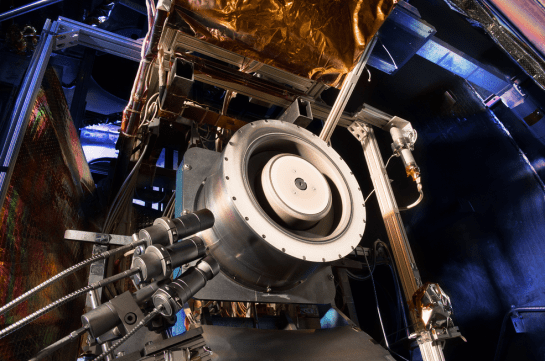
    A Hall thruster tested at NASA Glenn Research Center/ Image courtesy of NASA
    SEP engines provide thrust by converting solar energy into electricity and using that electricity to accelerate ionized propellant at extremely high speeds. The iconic blue glow from a SEP thruster is created from photons released by the ions as they lose energy upon leaving the engine.
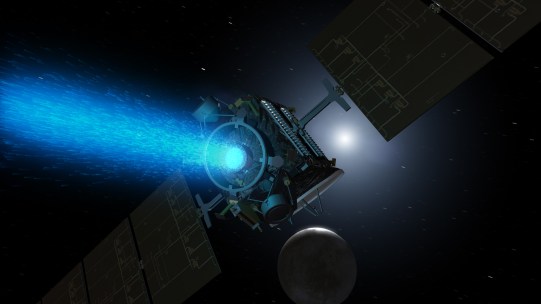
    NASA has been working on SEP technology since the 1950s and they’ve used SEP on prior missions like the Dawn spacecraft, which is currently in orbit around the dwarf planet Ceres and is the first spacecraft to orbit around two extraterrestrial bodies.
    Illustration of the Dawn spacecraft with its SEP system / Image courtesy of NASA
    Under the new contract, NASA hopes to double the thrust capability compared to current electric propulsion systems and increase the fuel efficiency by 10 times the current chemical propulsion.
    One challenge with deep-space missions that use SEP is that as you travel deeper into the solar system (farther away from the sun), it becomes more difficult to effectively capture light from the sun to power the spacecraft. Because of this, NASA stated its current SEP research is funded in parallel with work to advance solar array technology.
    During the 36-month contract, Aerojet Rocketdyne is responsible for constructing, testing and delivering an SEP product for testing and evaluation. Eventually, the goal is to have Aerojet Rocketdyne deliver four electric propulsion units that will fly in space.
    “Through this contract, NASA will be developing advanced electric propulsion elements for initial spaceflight applications, which will pave the way for an advanced solar electric propulsion demonstration mission by the end of the decade.” Steve Jurczyk, associate administrator of NASA’s Space Technology Mission Directorate
    In addition to this particular electric propulsion contract, Aerojet Rocketdyne is responsible for the chemical propulsion — the RS-25 engines — for NASA’s Space Launch System, the rocket designed to be used on missions related to NASA’s Journey to Mars initiative.
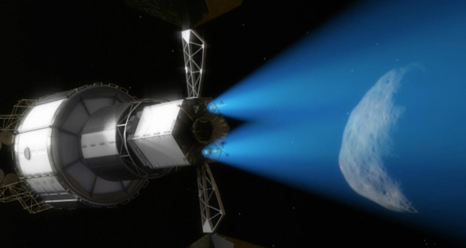
    Illustration of NASA's Asteroid Redirect Mission using SEP / Image courtesy of NASA
    Illustration of NASA’s Asteroid Redirect Mission using SEP / Image courtesy of NASA
    Aerojet Rocketdyne’s current contract is part of NASA’s overall push to advance SEP systems. NASA plans to test the largest and most advanced SEP system ever used in space on their Asteroid Redirect Mission, which is designed to capture an asteroid and place it in orbit around the moon. That mission is currently slated for the mid-2020s.

    Copyright © 2016 Uni logo™ is a registered trademark.

    Designed by Unilogou. Hosted on Blogger Platform.