• unilogou. Powered by Blogger.

    Showing posts with label TESLA MOTORS. Show all posts
    Showing posts with label TESLA MOTORS. Show all posts

    Wednesday, 17 August 2016

    World's fastest EV trounces Tesla Model S and LaFerrari in drag race

    Posted By: Uni logo - 01:32:00
    Rimac Concept One was  presented during the International Motor Show in Geneva, on Tuesday, March 1st, 2016. Photo/Rene Fluger (CTK via AP Images)

    When Croatian carmaker Rimac Automobili unveiled its Concept_One, the world's fastest electric vehicle (EV) this spring, we were blown away by both its design and performance figures.


    Thing is, though, sometimes having the best specs doesn't always translate into real-world speed and performance. But in Rimac's case, it does.
    On Tuesday morning, Archie Hamilton released a video depicting a drag race between the Concept_One, and both a Tesla Model S P90D and Ferrari LaFerrari — two of the fastest electrified vehicles (the LaFerrari is a hybrid) around. 
    For a refresher, the all-electric Concept_One is said to have 1,088 horsepower. The Model S P90D produces around 532 horsepower. And the LaFerrari's V12 engine and onboard electric motor together churn out 950 horses.
    That said, horsepower isn't everything, which is underscored by the car's 0 to 60 mph times. The P90D boasts a 2.8-second 0 to 60 mph time. Rimac's Concept_One is pegged at 2.6 seconds. And the $1 million LaFerrari claims to make that same sprint in 2.4 seconds.
    Amazingly, on that fateful day in Croatia, the Rimac won out. Heck, it's so fast it makesLudicrous mode look downright sensible.
    Here's where we come to a bit of a speed bump, so to speak. While both the P90D and LaFerrari were available to customers (I say were because the LaFerrari is sold out), the Concept_One isn't available for purchase in the strict sense; it can be custom-built on order, but you can't buy it in a store. 
    Regardless of whether its a production car or not, its accelerative capabilities are wildly impressive, 
    So let this stand as an example to us all. Just because we are privy to some astoundingly quick cars right now, the future surely holds much, much faster ones indeed.

    Thursday, 4 August 2016

    These hackers found a few ways to blind Tesla's Autopilot

    Posted By: Uni logo - 12:35:00
    Tesla Model S
    A driver of a Tesla Model S died in early May when both he and his car's semi-autonomous Autopilot system failed to see a tractor trailer crossing in front of the car on a highway in Florida.

    While it seemed like the perfect storm of real-world chance versus automotive high tech, it turns out not just an unlikely blend of coincidence could cause Tesla's Autopilot to miss an obstacle.
    Researchers at the University of South Carolina and China’s Zhejiang University, in collaboration with the Chinese security firm Qihoo 360, say they've both easily blinded Autopilot and also caused it to see phantom obstacles.
    When they take the stage later this week at the Defcon hacker conference, the researchers will detail how they used relatively accessible (but expensive) devices to deceive Tesla’s Autopilot sensors, according to Wired
    Intriguingly, the researchers, turned white-hat hackers, didn't actually have to hack the car. They simply jammed the stationary test car's front-mounted radar, ultrasonic sensors and cameras by exposing them to various machines that emitted light, radio and sound.
    As you can see in the video above, Autopilot suddenly and without warning loses track of the car ahead when the radio interferer is activated.
    What's more, the researchers created the same blinding effect by draping a car with acoustic foam, which is far cheaper than devices with five- and six-figure price tags.
    Granted, the machines employed by the researchers are expensive — and wrapping something in acoustic foam would be obvious. So, it's unlikely they would be used by would-be hackers to impair a single car. However, the tests prove that there are more issues with Tesla's Autopilot system than was initially anticipated.

    Wednesday, 3 August 2016

    Tesla exec calls other automakers' EVs 'little more than appliances'

    Posted By: Uni logo - 23:06:00
    A pair of BMW i3s charging.

    A Tesla executive dismissed competitors like the Nissan Leaf, Kia Soul EV, BMW i3 and Chevrolet Spark EV as "little more than appliances,” according to Automotive News.

    “Now, appliances are useful. But they tend to be white. They tend to be unemotional," Diarmuid O’Connell, Tesla's vice president of business development, said Tuesday at CAR Management Briefing Seminars in Michigan. 
    Specifically, O’Connell believes EVs from other brands don't offer enough range and cost too much.
    Granted, O’Connell made similar comments last year, when he likened other mass-market EVs to 'compliance' cars built to meet regulations rather than affect a meaningful change in the marketplace. Although this is not a new attitude for O’Connell, this week's comments are nonetheless, as Dave Chappelle portraying Rick James would say, "cold blooded."

    How I see it, O’Connell is taking one last jab at the competition before the flood of affordable, long-range EVs hit the market in the coming years, starting with the Chevy Bolt EV this fall. It's worth noting that Chevy will beat Tesla's Model 3 to the market with a mass-market, 200-mile-range EV by more than a year.
    And, really, O’Connell barely has a leg to stand on, when it comes to accusing carmakers of producing EVs that are too expensive. Though it starts at $70,000, the average retail price of the Model S is above $100,000 — hardly accessible to the average American car buyer.
    Still, though, he's not all wrong. The Nissan LEAF was compelling when it first launched in 2010. Now, not so much.

    Tuesday, 2 August 2016

    Posted By: Uni logo - 12:56:00
    POKÉMON GO RUNNING ON TESLA MODEL S 17-INCH DISPLAY.
    A Tesla Model S that can supposedly run Pokémon Go might be the nerdiest thing I've ever seen.
    Ever since Pokémon Go launched, I've been trying to imagine a way in which I could use a car to play. Specifically, I imagined playing with the Chevy Cruze. It has 4G LTE Wi-Fi, GPS, an 8-inch touchscreen and a reverse camera.
    Since I'm more of a wordsmith than I am a hacker, I left the idea in imagination land.
    Imagine my surprise, then, when I discovered that Pink Java's media editor is claimed to have hacked his Tesla Model S to boot up and run Pokémon Go on his car's in-dash 17-inch display.
    Now, as fun as this is, the claim raises some red flags. The man, referred to only as "Jeff" says he's declined offers to hack other Teslas because it's a "trial and error process.” This claim doesn't really pass the smell test for me.
    What's more, in addition to his Tesla hack, Jeff claims that he once rigged the lights in his home to flash when he received an email. He admits he now cannot figure out how to make it stop. This doesn't sound like the work of a master hacker, if you ask me.
    As if that weren't enough, Pink Java hasn't shared any video documentation or other details on how Jeff achieved this automotive technical feat. Given that, as well as his super-annoying house  hack, I am guessing this is a hoax.
    Regardless, my hat goes off to Jeff and the rest of Pink Java. They've at least taken my idea one step further than I dared to. Kudos.

    BONUS: Connecting 7 smart devices to the 2016 Chevy Cruze wasn't a Wi-Fi nightmare


    Wednesday, 27 July 2016

    Elon Musk takes press inside the Gigafactory for the first time

    Posted By: Uni logo - 23:14:00
    Https%3a%2f%2fblueprint-api-production.s3.amazonaws.com%2fuploads%2fcard%2fimage%2f158835%2fscreen_shot_2016-07-27_at_3.51.17_pm

    Tesla let the press into its giant new battery-producing plant, called the Gigafactory, for the first time Friday. 
    Experts told Wired the factory will be necessary to power Musk's dream fleet of EVs and hybrids (the company's goal is 500,000 cars a year). Currently, Tesla's battery production is outsourced to Asia, a costly and slower option. The new domestic factory, however, is expected to cut costs by 30 percent and is a one-hour plane ride away from the company's headquarters in Palo Alto, California. The 3,200-acre plant is located in Reno, Nevada.
    Musk also told the BBC he wants to see more of these soon, "in Europe, in India, in China ... ultimately, wherever there is a huge amount of demand for the end product.
    The factory was built in collaboration with Panasonic, which invested $1.6 billion. Robots will be responsible for most of the assembly inside the plant, streamlining Tesla's manufacturing process. 
    They will be building every part of the electric vehicles, including the solar panels to power that production. Panasonic will bring the necessary raw materials, like lithium, by rail.

    An arial view of Tesla's new Gigafactory
    IMAGE: TESLA
    As of now, the Gigafactory is about 14 percent completed, but is expected to produce 35GWh of battery power by 2018, more than the combined global production in 2014, according to the BBC. 
    Only a few select news outlets have gotten a peek so far, but the general impression remains similar. It's very big, it's very powerful and could get even more so: Wired reports Tesla has purchased another 1,864 acres near their plot.

    Tesla driver killed in Autopilot crash was speeding, report says

    Posted By: Uni logo - 02:23:00
    Https%3a%2f%2fblueprint-api-production.s3.amazonaws.com%2fuploads%2fcard%2fimage%2f157241%2fap_16208648912201

    Joshua Brown, the Tesla driver who on May 7 died in a crash in Florida while the car's Autopilot was engaged was speeding, according to a National Highway Transportation Safety Administration (NHTSA) preliminary report.
    This revelation may not surprise many people. The Model S is often billed as one of the sturdiest cars ever built. Not only does it have a five-star crash safety rating, but also its structure is so strong that it broke some of the crash-testing gear in 2013.
    So for the top of the car to be sheered off as it was in the fatal Florida crash (even considering that it had collided with a tractor trailer) suggested that the Model S must have been moving at fast speeds. (After colliding with the truck, Brown's Model S continued down the road and eventually struck a power pole and split in half before coming to rest.)
    This discovery by NHTSA leads to a second question: Should Autopilot be allowed to exceed the speed limit? Some semi-autonomous systems from other automakers, like Mercedes' Drive Pilot, read speed limit signs and adjust their cruising speeds accordingly.
    It appears, though, that the more we learn about this crash, the more questions surrounding autonomous driving and Tesla's Autopilot will be raised.

    Saturday, 2 July 2016

    What the fatal Tesla Autopilot crash means for driverless cars

    Posted By: Uni logo - 03:53:00
    Https%3a%2f%2fblueprint-api-production.s3.amazonaws.com%2fuploads%2fcard%2fimage%2f133764%2fap_216935612103
    The fact that a driver was killed in a crash inside his Tesla on Wednesday while the semi-autonomous Autopilot system was engaged is tragic. However, the collision will have ripple effects across Tesla and the rest of the automotive industry.
    That's because it brings into question people's trust in self-driving systems. While it's fair for people to feel wary of Tesla Autopilot and other semi-autonomous driving systems, it's important people don't conflate it with truly autonomous cars, or use the incident to write off self-driving vehicles altogether. 
    Tesla's blog post explaining the crash that took the life of one of its drivers while its Autopilot system was engaged is impressively detailed. From the description, we learn it was essentially a perfect storm of circumstances.
    According to Tesla, the Model S was traveling on a divided highway when a tractor trailer crossed in front of the car. The side of the truck apparently lined up perfectly with the skyline in both position and color, and because of that neither Autopilot nor the driver saw it. Autopilot missed it because the car was lined up with the middle of the truck, where there are no wheels, and the Tesla's low-mounted sensors only look downward toward the road, not above it. That allowed the car to drive underneath the trailer, killing the driver.
    Many are saying, "Clearly, this driver wasn't watching the road, like he was supposed to. How can he miss that truck?" However, we weren't there. Maybe any one of us, too, would have not seen the truck — as unlikely as that sounds. That said, it's possible (perhaps even probable) he was distracted.
    Turns out, though, whether or not the driver was distracted is only one factor to take into account when put in the context of autonomous driving. Obviously, carmakers need to get the tech right before putting it in the hands of drivers. And even when they do, there's a larger question of whether that tech — specifically semi-autonomous systems — might lull drivers into a false sense of security.

    Beta testing with cars

    Tesla clearly states that Autopilot is in beta. Anyone with an iPhone or PC probably isn't bothered by that — public betas happen all the time. Apple's Siri is a great example of a beta project that was put in the hands of customers.
    That's essentially what's going on here with Autopilot. It's in beta, meaning it's not finished. That's why Tesla warns drivers that they still need to pay attention while Autopilot is engaged. But it's becoming fairly clear that the better your semi-autonomous system is, the more drivers are tempted to "check out" from the experience.
    This is troubling because Tesla is the only automaker beta testing its driving systems on customers. Every other established brand does its testing with its employees and engineers. All of the comparable systems on the road today from other leading carmakers was developed and tested in labs and controlled environments years ago.
    BMW's CEO Harald Krüger said late last year that applying the app industry approach to beta testing is "absolutely impossible with safety features in a car.” Adding, "our technology must be 100 percent reliable."
    In the world of autonomous driving, there are levels, measured from 0 to 5. Zero autonomy is traditional driving. Level 1 is autonomous braking — where the car can independently hit the brakes to prevent an imminent collision — and it's slowly being added to most new cars. Level 2 is automatic cruise control and some automated steering. Level 3 is complete autonomous driving in certain situations, like on the freeway. Level 4 is full autonomy, driving from your garage to your destination without you touching a steering wheel or a pedal. Above that, there's a Level 5, where the human can’t even intervene (think Google's steering wheel-less cars).
    Tesla's Autopilot is considered Level 2. It uses cameras and radar to see lanes and cars and can steer the car through most everyday freeway scenarios. Some other manufacturers, like Mercedes and Volvo, have deployed Level 2 systems as well.
    The difference between Level 2 and Level 4 is immense. Full autonomy requires more than the forward-facing sensors like those on the Tesla Model S; it incorporates 360-degree computer vision across many parts of the spectrum, enabled by cameras and LIDAR (laser-based radar), as well as car-to-car communication. Autopilot does not have most of this tech.
    What's more, these systems and more — including the car's battery, for example — need to have backups, should one of them fail the car can still handle itself. Only with all these things onboard should a driver be allowed to really disengage from driving, because the whole idea is, no matter what happens, the car can handle it. That's why Volvo has said it will accept liability for its cars when they are in fully autonomous mode; a carmaker wouldn't make that claim if it wasn't fully confident in its car's capabilities.
    Despite being a Level 2, many drivers treat Tesla's Autopilot as a Level 3 or 4. As I've experienced first-hand, and what we've seen from Tesla drivers, people feel like Autopilot is so in control that they disengage — they look away, start texting or even take a nap. Behind the wheel of an Autopilot-fitted Tesla, you feel like you can pretty much check out. That is, if you don't know any better.
    Tesla did say in its blog post that Autopilot "makes frequent checks to ensure that the driver's hands remain on the wheel and provides visual and audible alerts if hands-on is not detected." I never experienced this when I tested the system, but that was prior to an update to Autopilot that Tesla pushed out in February. It's unclear whether these alerts didn't happen, the driver ignored them, or simply tapped the wheel now and then without looking up. Or, again, maybe he was paying attention — we just don't know yet.
    Other semi-autonomous systems from Volvo, Honda and Mercedes are as technically advanced as Autopilot. But for safety reasons, they don't allow you to remove your hands from the wheel for long periods of time. Those other automakers have also purposely limited the car's ability to correct itself, instead relying on the driver to do things like keep the car from drifting into another lane. That's partly why those systems aren't considered beta, like Tesla's is.
    In fact, the Mercedes-Benz E-Class's Drive Pilot system is so good, it earned the first autonomous driving license ever given to a production car in Nevada. But Mercedes didn't put that advanced system into its production car. Instead, it retarded it significantly so that drivers weren't just told but knew they were ultimately in charge of the driving, not the car.

    Setback for driverless cars?

    Let's not forget that this crash was human tragedy. The driver was a Tesla enthusiast with a family, and whatever the fallout is in the car industry, it's terrible this happened at all. But there's also a real fear that the incident will derail self-driving tech. A Jaguar engineer not too long ago told me he worried an incident with Autopilot could set back autonomous driving by a decade.
    Ultimately, though, the crash isn't a condemnation of automated driving, which has real potential to save lives. Going by average statistics, 87 people died on the road in America yesterday, and 90% of those were due to human error. Using one death to suggest that semi-autonomous tech isn't safe is misinformed at best. The endgame of autonomy is zero road fatalities.
    But it's a fair question whether a sufficiently powerful semi-autonomous system — like Autopilot — instills too much false confidence in the car's ability to drive itself, leading to drivers disengaging more than they should. During testing of its self-driving cars, Google found that its drivers — who were paid to pay attention to the road — would disengage since they essentially thought, "The car's got it." If disengagement is the norm for Level 2 systems (as I suspect it is for many drivers) this tragic crash could be just the first.
    The NHTSA is investigating the fatal wreck and Autopilot's role. When it's done, the government may be forced to write more laws that pertain to self-driving systems. That could mean the end of questionable practice of beta testing semi-autonomous driving systems, and a wider acknowledgement that those systems have to do everything possible to ensure drivers keep their eyes on the road. 

    Tesla Autopilot victim may have been watching 'Harry Potter' during crash

    Posted By: Uni logo - 03:41:00
    Https%3a%2f%2fblueprint-api-production.s3.amazonaws.com%2fuploads%2fcard%2fimage%2f134234%2fap_996061237220

    Florida Highway Patrol found a portable DVD player inside the Tesla Model S that collided with a tractor trailer on Wednesday, according to reports. The driver was killed when both he and the Autopilot system failed to see the truck crossing the highway.
    The driver of the truck involved the crash, Frank Baressi, said a Harry Potter movie was still being displayed on the DVD player, a Reuters report said.
    Baressi could not see the video playing, but rather could hear it playing as he approached the Model S, according to CNBC.
    However, officials have yet to determine whether the driver, identified as Joshua Brown, was watching the video at the time of the crash.
    Some have wondered whether the video was playing on the portable DVD player's screen or on the car's in-dash 17-inch touchscreen. Tesla has said it's not possible to watch a movie on its screen. However, a hacker was able to rig his Model S' screen to play videos.

    Saturday, 25 June 2016

    Like Follow Follow Tesla signs $9 billion agreement to build factory in China, report says

    Posted By: Uni logo - 00:19:00
    Https%3a%2f%2fblueprint-api-production.s3.amazonaws.com%2fuploads%2fcard%2fimage%2f126817%2fap_310254328302

    Tesla Motors has reportedly signed a non-binding agreement with Chinese government-owned company Jinqiao Group to construct a Tesla production plant in the city of Shanghai.
    All told, the investment could cost $9 billion, a person close to the matter told Bloomberg.
    This report comes six months after company CEO Elon Musk revealed that Tesla intended to choose a production facility site in China by the middle of 2016.
    Both companies would invest $4.5 billion toward the project, according to the report.Bloomberg points out, this would be substantially larger than Walt Disney Co.’s Shanghai theme park, which cost $5.5 billion.
    That said, it's unlikely the assembly plant would include a theme park attraction (Tesla Land, anyone?). Then again, it is Elon Musk we're talking about, so I won't mark it as out of the question.
    What we know a Chinese Tesla factory will do for the company, however, is allow it to avoid the 25% import tax it currently pays for each electric vehicle it ships to the country.
    Since there's been no public announcement of the deal, there is no timeline for the rumored project. However, two other Chinese cities, Suzhou and Hefei, are currently courting the upstart electric vehicle maker to be the location of its assembly plant in Asia, according to the report.
    Given those factors, the deal might not yet be set in stone, so to speak.

    Tuesday, 21 June 2016

    Now you can buy a Tesla while browsing for suits at this Nordstrom

    Posted By: Uni logo - 15:55:00
    Https%3a%2f%2fblueprint-api-production.s3.amazonaws.com%2fuploads%2fcard%2fimage%2f122885%2fap_508187361366

    If you thought the clothes at Nordstrom were expensive, just wait until see how much the electric cars are going for.
    Tesla has been waging a war to sell cars outside the dealership system across the U.S. — with mixed results. Rather than succumb to dealer pressure, on Monday, the upstart electric vehicle manufacturer took a step decidedly in the other direction.
    Tesla opened up a retail store inside the Nordstrom at The Grove in Los Angeles, California, USA Today reports.
    The company has staged many of its retail outlets inside malls. This new store is the first actually inside — not just adjacent to — another retail brand.
    After you push past the initial "What? Really?" reaction, the move is actually a smart one. Having a nook next to the men's suits department saves Tesla the cost of renting an entire space of its own. What's more, the Tesla buyer and Nordstrom shopper are likeminded.
    According to a Tesla statement, "the Nordstrom shopper embodies a lifestyle that parallels that of many Tesla owners –- people who are forward-thinking, savvy, and curious to explore the latest and best trends."
    While it's unlikely that even well-heeled Nordstrom buyers will be enticed into a $140,000 impulse purchase of a Model X crossover, it's nonetheless a good move to bring potential customers in who might otherwise waltz past a Tesla store elsewhere.
    Tesla's pop-up shop will be at The Grove through the end of the year. And, if you're wondering: No, you can't test drive a Tesla through the men's department. They're holding test drives in the parking lot.

    Australian electricity company will give you Tesla charging for $1 a day

    Posted By: Uni logo - 07:08:00
    Https%3a%2f%2fblueprint-api-production.s3.amazonaws.com%2fuploads%2fcard%2fimage%2f122318%2fgettyimages-95724321

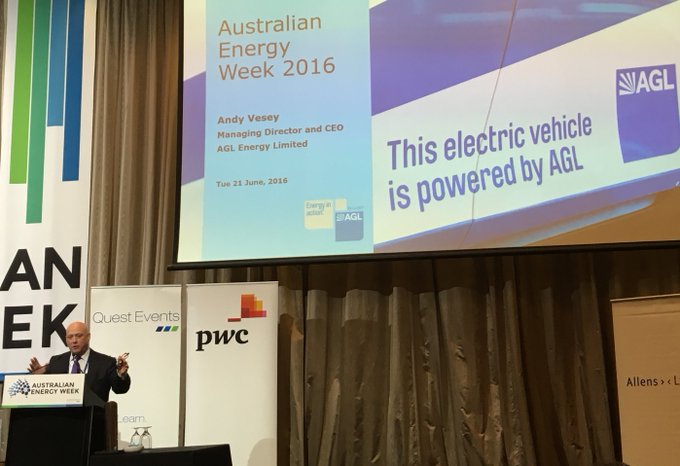
    Australian energy company, AGL, will provide customers who own electric vehicles, such as a Tesla, all-you-can-consume electricity for A$1 per day.
    The company's CEO Andy Vesey announced the new initiative at the Australia Energy Week Conference in Melbourne on Tuesday, the Australian Financial Review reported. He said it will cost a customer A$365 a year to juice up their electric vehicle to their heart's content, while it is at home. 
    It can be used for a range of electric cars including Tesla, the BMW i3, the Toyota Prius and the Nissan Leaf. The company would supply power to a customer's car charger or potentially provide them with a charger if they don't have one. 
    "For a dollar a day if you have an electric vehicle and you have a AGL smart meter and a charger you can get energy for that car for $1 a day, as much as you like," Vesey said at the conference.
    On Twitter, he confirmed the news with a note the deal will be available from November.
    To keep with the green theme, AGL will also carbon offset the offer, according to Financial Review, with the company investing in green initiatives to counter the carbon dioxide emissions. It is a clear move to stay relevant in a world that is slowly moving towards greener vehicles and renewable energy sources. 
    With the cost of charging an electric car sitting around A$4.50 per 100 kilometres in Australia, that's a pretty decent saving to put away for a rainy day. Or a cruise up the coast

    Copyright © 2016 Uni logo™ is a registered trademark.

    Designed by Unilogou. Hosted on Blogger Platform.