• unilogou. Powered by Blogger.

    Showing posts with label Space. Show all posts
    Showing posts with label Space. Show all posts

    Wednesday, 10 August 2016

    NASA awards companies $65 million to develop habitats for deep space

    Posted By: Uni logo - 14:59:00

    NASA is serious about going to Mars, and not just for a quick visit, either. It just committed $65 million, spread over two years and six companies, for the purpose of developing and testing deep-space habitats that could be used on the way to — and on the surface of — the Red Planet.
    It’s part of the organization’s NEXTStep (not to be confused with the NeXTSTEP OS), an ongoing partnership program under NASA’s Advanced Exploration Systems that funds private research into technology for space exploration.
    Last year’s NEXTStep contracts were for a variety of things, but this year they’re all on the same track: “deep space habitats where humans will live and work independently for months or years at a time, without cargo supply deliveries from Earth.” We’re talking spaceships here — big ones.
    The numbers are bigger, too: the previous year’s contracts amounted to a total of perhaps $15 million divided 10 ways — $65 million 6 ways is, it hardly needs saying, a much more considerable investment.
    The lucky companies are all taking slightly different approaches to the problem of deep space habitation.
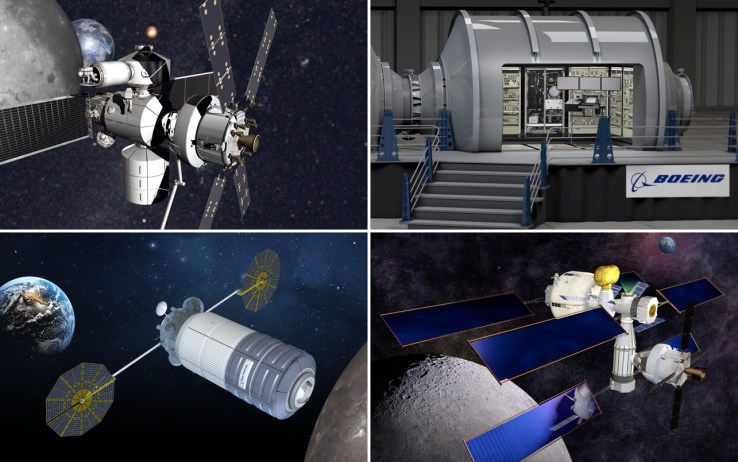
    From top left: Lockheed Martin, Boeing, Orbital ATK, and Sierra Nevada's concept spacecraft.
    Bigelow is a name you may already be familiar with: the Bigelow Expandable Activity Module was recently attached to the International Space Station and is currentlyundergoing testing. The company plans to develop one about 20 times larger (330 vs 16 cubic feet) that they call the Expandable Bigelow Advanced Station Enhancement, or XBASE. There are advantages to being able to pack your modules tightly and expand them later, but the BEAM’s troubled deployment shows there are challenges as well. Of course, that’s what testing is for.
    Lockheed Martin doesn’t want to let good space gear go to waste, either; its plan is to refurbish one of the cargo modules carried by the Space Shuttles into a livable multi-purpose environment. The idea is, essentially, to use proven equipment as a base to test future developments, like data and crew transfer between the module and, say, the Orion spacecraft.

    NASA concept of the interior of a habitable module.
    Another avid recycler is NanoRacks, whose commercial experimentation platform outside the ISS just went live yesterday. Nanoracks has a rather crazy idea: convert the final rocket stage, with its spacious fuel compartment, into a habitable space. It’s working with Space Systems Loral and the United Launch Alliance to see if this is crazy enough to work — or just plain crazy.
    Sierra Nevada (specifically its subsidiary Space Systems) has perhaps the most ambitious plan. Over four commercial launches, the company wants to build on one of its Dream Chaser cargo modules, adding a propulsion system, an expandable environment, and life support. Taking it in stages means better risk management.
    Boeing and Orbital ATK didn’t provide many details: the former just says it’s building a full-scale prototype for extensive testing, and the latter is adapting one of its Cygnus spacecraft to the purpose.
    It’s all very early, of course, and these projects, among others, are for exploring possibilities and finding potential problems, not actually producing something we can send to Mars or beyond. The technology investigated by these companies will have to prove itself on the ground first, then in orbit, and eventually in cislunar space — the “proving ground” for long term mission hardware.
    NASA didn’t specify how much each project was receiving, or the exact timelines or deliverables expected from each — although results are certainly expected by the time the contracts’ 24 months are up. I contacted NASA for more details and will update this post if I hear back.
    Wednesday, 3 August 2016

    Moon Express becomes first private company to receive permission to go to the moon

    Posted By: Uni logo - 14:33:00

    Moon Express has officially become the first private company in the world to receive permission to travel beyond Earth’s orbit. After months of conversations with government officials, the company received the green light from the FAA to venture to the moon in 2017.
    “We are now free to set sail as explorers to Earth’s eighth continent, the moon, seeking new knowledge and resources to expand Earth’s economic sphere for the benefit of all humanity,” said Bob Richards, co-founder and CEO of Moon Express.
    The announcement marks an important milestone for private companies in the space industry because, so far, all commercial space activities have been limited to operations within Earth’s orbit.
    Moon Express was born out of the Google Lunar X-PRIZE, an international contest with $30 million up for grabs for a private company who can soft-land on the moon and travel across its surface.
    If successful, Moon Express will become the fourth entity in history to soft-land on the moon. The first three were all superpowers — the U.S., USSR and China – while Moon Express is privately funded and comprises 26 entrepreneurs and engineers.
    It’s important to note that the permission given to Moon Express doesn’t necessarily set a precedent for other companies. Naveen Jain, co-founder of Moon Express, told TechCrunch that this permission is a one-time exception for their company. Jain stated the U.S. government plans to take future requests to travel beyond Earth’s orbit on a case-by-case basis until laws governing this activity can be passed.
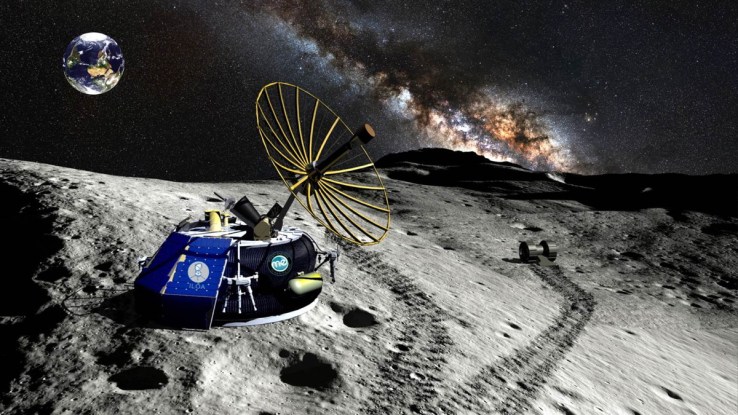
    Illustration of Moon Express lander / Image courtesy of Moon Express
    Interestingly, the legalities surrounding a private mission to the moon came about a bit backwards.
    First, Moon Express purchased a launch to the moon with Rocket Lab in October 2015. At that time, they didn’t have permission from the government to go to the moon or the regulatory security that they could have ownership of lunar resources they obtained if theycould get there.
    Then, in November 2015, the Commercial Space Launch Competitiveness Act was passed, which explicitly stated that private companies are allowed full ownership of resources they extract in space. The bill made it legal for Moon Express to mine the moon and keep what they extracted, but they still didn’t have permission to travel to the moon in the first place.
    This was the last piece of the regulatory puzzle, but from a security point of view, giving this permission to anyone with the resources to go is a bit tricky.
    For example, national assets like reconnaissance satellites that monitor specific areas of the Earth are located over 20,000 miles away in geosynchronous orbit (GEO). This is the farthest orbit that private companies have placed satellites in to date. Going beyond this orbit could potentially give a company full view of some of the most important space-based security satellites, making it important for the government to know exactly what a company intends to do on a mission past GEO.
    for receiving permission to do so. Jain explained that representatives from multiple federal agencies, including the State Department and the NSA worked together to determine that the FAA, which is already responsible for granting launch licenses to rocket companies, should be the official point of contact for this type of activity.
    On April 8th, 2016, Moon Express submitted an application for a 2017 commercial lunar mission to the FAA and has since received approval to move forward with its plans.
    “This simply shows that every company can achieve their moon-shot,” said Jain.
    The company will launch to the moon in the second half of 2017 on a rocket provided byRocket Lab. Jain stated that Moon Express’ first mission, which is a one-way trip, is expected to be profitable due to private payloads and sponsorships. The company also fully expects NASA to participate by sending a paid scientific payload, although their business plan is not dependent on it.
    Once on the surface, Moon Express hopes to win further X-PRIZE awards by moving across the surface. Instead of roving, they will re-fire their rockets on the MX-1 lander and “hop” to different locations.
    When asked if they expect to beat other frontrunners in the competition, Jain focused instead on their future plans, saying “We don’t start a company to win a prize. Winning the Google Lunar X-PRIZE would just be the icing on the cake. We choose to go to the moon because it’s good business.”
    In the future, the company expects to make money by harvesting resources on the Moon, like water and Helium-3, creating a fuel depot on the surface and eventually performing round-trip missions with the capability of bringing payloads back to the Earth. By the end of the year, Moon Express plans to double their employee base to over 50 people.
    Jain told TechCrunch that he believes this is just the beginning of private companies’ presence in deep space and that the way people will make money in space is only limited by our imagination. Likening it to how the iPhone’s App Store enabled the creation of a diverse set of apps from companies all over the world, Jain said “We just don’t know what the Pokemon Go or the Snapchat of the space industry is yet.”
    Now that Moon Express has received official permission to move forward with its plans, we can expect other U.S. companies with similar lunar aspirations, like Astrobotic, to follow suit in the near future.
    It’s been nearly a decade since the Google Lunar X-PRIZE was announced and now most of the regulatory pieces are finally falling into place. Eventually, space-faring nations will need to put a plan in place to streamline private ventures beyond Earth’s orbit. For now, we’ll have to watch exploration progress one company at a time.

    How the First Private Moon Landing Will Spur the Future of Space Mining

    Posted By: Uni logo - 14:26:00

    Moon Express just became the first private company in history to be approved for a lunar surface mission. The California-based startup plans to land its 20-pound MX-1 spacecraft on the Moon in 2017.
    "This is not only a milestone, but really a threshold for the entire commercial space industry,” Moon Express CEO Bob Richards told Space.com. "Somebody had to be first."
    The decision, announced by the Federal Aviation Administration (FAA) on Wednesday, may sound the starting pistol for a new era in spaceflight, defined at least as much by commercial ventures and resource extraction as by scientific and exploratory missions. Mining the Moon for valuable materials has been a hot topic of speculationfor years, but with the FAA’s official greenlight, Moon Express is poised to force the issue.
    That’s not to suggest, however, that the company’s 2017 lander will return to Earth laden with overflowing chests of Moon booty. At this point, the FAA has only approved Moon Express’s request to conduct a lunar surface mission, not mine it for resources.
    “It appears that the FAA has granted a licence to Moon Express to carry out a permissible space activity,” Sa’id Mosteshar, director of the London Institute of Space Policy and Law, told me. “The licence does not give Moon Express any exclusive or property right. It merely permits Moon Express to launch a spacecraft, travel to the Moon, and land there.”
    If successful, Moon Express’s landing will mark the first time any American organization has soft-landed a spacecraft on the Moon since Apollo 17 touched down in 1972. This kind of achievement is exactly what the emerging commercial space sector has always been hyped to accomplish. By untethering exploration from the purview of government agencies alone, space travel is becoming faster, cheaper, andmore widely accessible to the public.


    Indeed, Moon Express already has some exciting experiments lined up for its mission. According to Richards, the lander might install a small “mooncam” observatory at its landing site that would be viewable to anyone through YouTube. The company is also angling to nab the $30 million Google Lunar X-Prize, so it will have to demonstrate that its MX-1 vehicle can move at least 500 meters, and send high definition imagery back to Earth.
    But ultimately, Moon Express has its eyes on an even bigger prize: The Moon’s bountiful resources. Our natural satellite contains many precious materials, such as water, iron ore, and helium-3. Even the Moon’s normal regolith rock is treasured simply for its interplanetary exoticism.
    “I believe that the first trillionaires will be generated by investments in space resources,” Richards said in a 2014 Motherboard documentary. “Our goal is that in 2020, we’ll bring something back that you can hold in your hand; between two to six kilograms of stuff. It could be worth upwards of a billion dollars. And then the game is on.”
    It will be interesting to see how many other commercial players end up joining this game by following Moon Express’s lead. “There are already a number of private entities planning to go to the Moon and to carry out various activities there,” Mosteshar told me.

    “However, until and unless it becomes clear that exploitation of lunar resources is permitted, I would not expect many investors to risk vast sums of money on attempting to mine the Moon or other celestial bodies.”
    Striking that legal balance represents such uncharted territory that Moon Express had to work together with the FAA to figure out a temporary regulatory patch enabling the company to abide by both US law and international treaties for its 2017 mission. This is a promising cooperative starting point, but more comprehensive and consistent regulatory frameworks will have to be developed in order to ensure that off-Earth resources are managed sustainably.
    To that point, some of the language that Moon Express executives have used regarding planetary mining is worth reflecting on, as the company celebrates its milestone achievement.
    "We are now free to set sail as explorers to Earth's eighth continent, the Moon, seeking new knowledge and resources to expand Earth's economic sphere for the benefit of humanity," said Richards in a statement.
    Referring to the Moon as “Earth’s eighth continent” seems dicey in light of the fact that all seven continents on our own planet are imperiled by human activity, much of it borne from unchecked industrial development. Likewise, Jain’s past comparisons of lunar mining to ocean resource extraction poses similar problems.
    “I [...] think the Moon will be treated no differently than the international water in our oceans,“ Jain told the Los Angeles Times in 2011. “In this case, no one really owns the water but any company or country can mine the resources [...] as long as they follow certain safety/moral guidelines,”
    Again, a statement like that would be much more comforting if Earth’s oceans weren’t in devastating ecological freefall as a result of human commercial pressures, much of which takes place in international waters.
    Point being: We should tread carefully. Moon mining does have the potential to benefit humanity, but as with most commodities markets, the sticking will be ensuring that wealth generation does not slip into exploitation. Space exploration is our opportunity to transcend the self-destructive, provincial mindset nurtured by planetary living. Let’s not screw it up.

    Tuesday, 2 August 2016

    Why Gamma Ray Bursts Are the Most Epic of All Apocalyptic Scenarios

    Posted By: Uni logo - 14:19:00

    Asteroid impacts. Nuclear war. Unhinged climate change. These are all respectable, solid entries into the great pantheon of doomsday scenarios that could wipe out life on Earth.
    But when it comes to sheer destructive flair, gamma ray bursts (GRBs) take the apocalyptic cake. Forged in catastrophic cosmic disruptions like supernovae and neutron star mergers, GRBs are the brightest phenomena in the universe. Capable of releasing more energy in a single second than the Sun will in its entire lifetime of ten billion years, these bursts are essentially the universe’s unique riff on projectile barfing.
    The mind-boggling force and fascinating observational history of GRBs is explored in this newly released short from Kurzgesagt (In a Nutshell), a channel famed for its lighthearted animated primers on complex topics. The video’s narrator does not shy away from the epic, face-melting powers of these events, referring to them alternately as “cosmic snipers,” “celestial laser guns,” and “the biggest superweapon in the universe.”

    Interestingly enough, GRBs were first discovered accidentally by an American spy satellite series called Vela, which were launched to monitor Soviet orbital activities during the Space Race. The Vela satellites were built to detect gamma ray radiation from any nuclear detonation tests that the USSR might conduct in space.
    Fortunately, the satellites came up blank on space nukes, but in 1967, they picked up the first signatures of a gamma ray burst. Perplexed by its blinding luminosity and prolonged eruption, scientists accelerated observations of GRBs, and found that the universe clearly enjoys shooting them off.
    Today, thousands of these bursts have been observed and catalogued in many distant galaxies. To get a sense of just how often these cosmic plasma guns fire, check outthis online visual history hosted by UC Berkeley.
    It’s a bit disconcerting to watch the skies light up with these genuine death rays, each one a merciless destroyer of countless worlds unknown to us. There’s some comfort in the fact that GRBs have never been observed within our own Milky Way galaxy, but by no means does that mean that they couldn’t rain down on us with all their incinerating power.
    “A nearby GRB could be disastrous,” the Kurzgesagt narrator points out. “If one goes off within a few light years of us it would totally cook the surface of the Earth, or at least, the half that is facing it. But even a more distant GRB could end life on Earth, and it wouldn’t need to score a headshot to kill us.”
    In fact, a popular theory suggests that Earth may have already been rocked by a gamma ray burst, which sparked the Ordovician mass extinction event 450 million years ago.
    GRBs have even been put forward as a solution for the Fermi paradox, which highlights the contradiction between the wealth of life we might expect to find in the wider universe, compared to the eerie silence that actually confronts us.
    How many intelligent civilizations might have gone up in gamma ray smoke over the course of billions of years? Could we be the next one up in the cosmic crosshairs?
    It’s unlikely, but certainly not impossible. And to add a little more nightmare fuel to the general existential dread GRBs evoke, it’s worth noting that there is absolutely nothing we can do to stop them.
    “Since gamma rays travel at the speed of light, we won’t know one is headed our way until it arrives,” the Kurzgesagt short concludes. “So there could already be a GRB on its way to kill us all, and we won’t know until it hits us, and we’re dead.”

    Sunday, 31 July 2016

    Cardiovascular Problems in Apollo Astronauts Linked to Radiation

    Posted By: Uni logo - 05:29:00

    Astronauts who took part in the Apollo space program are experiencing disproportionately high rates of cardiovascular problems, according to a paperpublished Thursday in Scientific Reports by exercise physiologist Michael Delp and colleagues at Florida State University. The likely culprit: exposure to deep space radiation levels encountered during lunar expeditions far exceeding those experienced by astronauts restricted to low Earth orbit (LEO) missions.
    The study looked at the causes of death among seven Apollo astronauts versus those of 35 LEO astronauts and those of 35 astronauts who had not actually flown in space. Delp and co. note that, given the influence of Earth's geomagnetic field, it's generally been assumed that astronauts confined to LEO or even participating in short lunar trips are relatively safe from the cardiovascular effects of space radiation. This still seems to be the case.
    "The human experience with spaceflight has shown that space exploration comes with various health risks," the authors note. "As humans contemplate manned missions to Mars or prolonged habitation on the Moon, these health risks will rise as the duration of spaceflight increases and as travel goes beyond the Earth’s protective magnetosphere. During such interplanetary travel, astronauts will be exposed to multiple sources of ionizing radiation, including galactic cosmic rays, solar particle events, and trapped radiation in the Van Allen belts." 
    The study found that 43 percent of Apollo astronauts (three of seven) died of some variety of cardiovascular problem, defined as one of the following: heart failure, myocardial infarction, stroke, brain aneurysm, or blood clots. This is a rate four to five times higher than that experienced by LEO astronauts or astronauts that never made it to space at all. However, the sample size of Apollo astronauts is tiny (necessarily), and the study itself notes that caution should be taken in drawing definitive conclusions about any implied health risks.
    Presumably with this limitation in mind, Delp and his team looked to rodent models to investigate further. Mice were subjected to 14-day bouts of deep-space equivalent radiation, simulated weightlessness, or some combination of the two, and then examined six months later. This recovery delay, comprising about a quarter of a lab mouse's natural lifespan, is roughly equal to 20 human years.
    The researchers found significant decreases in arterial functioning in the irradiated mice, but found no effects that could be attributed to weightlessness. In particular, the deep-space mice exhibited diminished vasodilation—relaxation of blood vessel walls—related to the blood vessel's innermost "endothelium" layer.
    "As dysfunction of the vascular endothelium is central to the pathogenesis of vascular disease, such adverse arterial effects could lead to the development of occlusive arterial diseases, including myocardial infarction and stroke," Delp and co. write. "These findings suggest that in spite of the 'healthy worker' effect, short-duration deep space travel by this highly educated, trained and physically fit group results in a significantly elevated risk of death from CVD [cardiovascular disease]. The major environmental factor that would appear to underlie this phenomenon is deep space radiation."
    Delp isn't the only one studying the blood vessels of astronauts. Researchers have found abnormal postflight increases in arterial stiffness in astronauts spending six months or longer in orbit (read: aboard the ISS) that are akin to the increases seen as part of the normal aging process. This is thought to be related to changes in arterial pressure and the relative lack of physical exercise experienced in a weightless environment. This is currently being investigated as part of the Canadian-run experiment Vascular Echo.

    This Crazy Lizard Is the Mascot of the Latest US Spy Satellite Launch

    Posted By: Uni logo - 05:25:00

    The US National Reconnaissance Office (NRO) has become known for branding its spy satellite launches with strange and sometimes menacing imagery. But unlike the Office's infamous world-devouring octopus, the logo adorning NROL-61, which carried yet another classified payload into geosynchronous orbit on Thursday, is just flat-out bizarre.
    Launched from Cape Canaveral at 1237 GMT on Thursday, NROL-61 sent up a classified NRO satellite innocuously designated USA-269. The launch featured the image of a wild-eyed lizard straddling a rocket Major Kong-style as it blasts off into space. The lizard mascot's name is “Spike,” which also serves as the mission's code name.
    But what's really interesting about the mission patch is that it shows Spike riding what seems to be the cargo-launching Ares V rocket, rather than the mission's actual launch vehicle, the Atlas V. The Ares was a cargo-carrying rocket designed for NASA's now-defunct Constellation program, which planned to replace the space shuttle before being scrapped in 2010.
    That suggests that Spike's designer either made the logo as a tribute to the abandoned program, or that it was originally designed for Constellation and was simply re-appropriated for the NRO launch after that program was canceled.
    Just like with the launch of NRO's Mentor-7 eavesdropping satellite in late June, amateur satellite-spotters wasted no time tracking down Spike. Paul Camilleri, a hobbyist in Australia, was able to spot both the NROL-61 payload and its separated upper-stage Centaur rocket booster in the night sky just an hour after launch.
    It's also worth noting that the Atlas V 421 configuration deployed by NROL-61 has not previously been used in any of the surveillance agency's missions. While the purpose of NRO satellites can normally be puzzled out by carefully analyzing the size and details of its launch vehicle, this unusual configuration means that the satellite's exact function remains a mystery.

    Tuesday, 28 June 2016

    New, detailed mosaic from Google shows the Earth without clouds

    Posted By: Uni logo - 02:03:00
    Https%3a%2f%2fblueprint-api-production.s3.amazonaws.com%2fuploads%2fcard%2fimage%2f128706%2fa4ffeea6efd34b21ad80ce32a8842aa7

    Google is mining photos from a satellite launched in 2013 to create a better, cloud-free image of Earth from above.
    The newest mosaic is an updated version of one produced in 2013. The new version was pieced together mostly using data from the Landsat 8 satellite, launched by NASA, which snaps "twice as many images as Landsat 7 does every day," according to Google
    "This new rendition of Earth uses the most recent data available — mostly from Landsat 8 — making it our freshest global mosaic to date," Chris Herwig, program manager for Google Earth Engine wrote in a blog post
    Much of Earth is usually covered by clouds, but Google Maps combed through photo after photo to piece together the "clearest pixels" from more than 700 trillion pixels. The result is an unobstructed view of the Earth's surface with more details visible than before. 

    New York before

    A less-detailed satellite image of New York City.
    IMAGE: GOOGLE/LANDSAT

    New York after

    Skyscrapers, shadows and baseball fields in New York City.
    IMAGE: GOOGLE/LANDSAT
    "Our previous mosaic used imagery from Landsat 7 only, which at the time was the best imagery of its kind," Herwig said. "Unfortunately, Landsat 7 images captured after 2003 were affected by a hardware failure, resulting in large diagonal gaps of missing data."
    Scientists can glean a lot from this kind of data, getting a sense of deforestation and urban development in different parts of the world.
    Much of this data is freely available from the Landsat program, which has been imaging Earth's surface with various satellites since 1972. 
    Landsat 8 is the newest satellite in the fleet.

    Lake Balkhash, Kazakhstan
    IMAGE: GOOGLE/LANDSAT

    Detroit, Michigan
    IMAGE: GOOGLE/LANDSAT

    Swiss Alps
    IMAGE: GOOGLE/LANDSAT

    Brasilia, Brazil
    IMAGE: GOOGLE/LANDSAT
    You can explore the cloud-free imagery yourself either using Google Earth or through the satellite layer on Google Maps.

    Saturday, 25 June 2016

    New Hubble telescope photo shows brilliant star cluster within a nearby galaxy

    Posted By: Uni logo - 07:59:00
    Https%3a%2f%2fblueprint-api-production.s3.amazonaws.com%2fuploads%2fcard%2fimage%2f126886%2fhubble_friday_06242016

    The Hubble Space Telescope stared deeply into a small galaxy not far from the Milky Way and saw something beautiful.
    A new photo taken by the long-lived telescope shows a brilliant cluster of stars embedded within the Large Magellanic Cloud, a satellite galaxy of the Milky Way 135,000 light-years away. 
    The star cluster, named NGC 1854, is one of hundreds of star clusters of different kinds in the Large Magellanic Cloud.
    "The LMC [Large Magellanic Cloud] is a hotbed of vigorous star formation. Rich in interstellar gas and dust, the galaxy is home to approximately 60 globular clusters and 700 open clusters," NASA said in a statement
    "These clusters are frequently the subject of astronomical research, as the Large Magellanic Cloud and its little sister, the Small Magellanic Cloud, are the only systems known to contain clusters at all stages of evolution."
    Hubble scientists have used the telescope's cameras to snap images of this galaxy through the years because of its relatively close proximity to Earth. 
    Some researchers are particularly interested in that Hubble imagery in order to track the evolution of its star clusters through the years. 
    Hubble should be a productive space telescope for years to come. The intrepid eye in the sky just had its mission extended until at least 2021.

    Friday, 20 May 2016

    Look up this weekend to see Mars brighter than it has been in a decade

    Posted By: Uni logo - 22:53:00
    Https%3a%2f%2fblueprint-api-production.s3.amazonaws.com%2fuploads%2fcard%2fimage%2f94418%2f0922d3e243d9462388037d37623fbe08

    The planet Mars is closer than it has been since November 2005, so get ready for some serious skywatching this weekend.
    The red planet's close proximity to Earth now makes it brighter than it usually is in orbit, giving even amateur skywatchers a great chance to see details of the Martian surface using a low-powered telescope. 
    But even if you don't have a telescope, you can still spot Mars in skies around the world.
    "Just look southeast after the end of twilight, and you can't miss it," Alan MacRobert, senior editor of Sky & Telescope magazine, said in a statement
    If you do head outside to take a look at Mars, you'll be in good company.
    The Hubble Space Telescope also took advantage of Mars' close proximity to Earth, taking anew photo of the red planet in all its frosty, cloud-covered glory.

    Mars will also be joined in the sky by a couple of other cosmic objects that might point the way toward the red planet.
    The planet Saturn and the red star Antares create a triangle in the night sky with Mars, and the full moon will also rise near them this weekend.
    "Look below Mars by about the width of your fist at arm's length," MacRobert added. "If Antares is still too low, wait a while and everything will rise higher. Antares is fainter but it also has a fiery color."
    Saturn will be to the left of Antares, completing the triangle.
    If you have cloudy weather or are unable to do some skywatching this weekend, you have until mid-June to see Mars at its brightest. The red planet will remain within about 48 million miles from Earth until June 12.

    Mars will be at its absolute closest on May 30, when it is about 47.2 million miles from Earth, according to Sky & Telescope, but its brightness won't change much between now and then.
    While you're outside looking for Mars, you might also keep an eye out for the International Space Station whizzing by overhead. 
    The Space Station — which looks like a bright, unblinking star streaking across the sky — completes a full orbit of Earth every 90 minutes but it doesn't always go over the same place. 
    You can use a new tool from NASA (embedded below) to find out the next time the station will make a pass over your city.
    In 2018, Mars will actually be even closer to Earth. Its orbit will bring it about 34.6 million miles from our planet, providing another great observing opportunity for space observatories and people on the planet.

    Tuesday, 10 May 2016

    See SpaceX's 'fastest and hottest' Falcon 9 landing from three sides

    Posted By: Uni logo - 08:54:00
    Last week, SpaceX added another important entry in the history books by successfully landing the first stage of its Falcon 9 rocket on a drone ship at sea for the second time. The landing was perhaps even more important than the first successful landing in April since the rocket's re-entry into into the Earth's atmosphere was much faster, and harder to pull off, this time around. 
    SpaceX and the company founder and CEO Elon Musk tweeted important details and pics throughout the whole mission, as always, but footage and photos of the actual landing were dark and blurry. Now, SpaceX has treated us to a new set of photos on Flickr, showing the rocket's condition on the morning after.
    Even better, on Tuesday SpaceX tweeted a video of what it called the "hottest and fastest landing yet" from three angles. 


    Despite the rocket's speedier approach, the landing looks incredibly smooth, more controlled and easier than the first successful attempt. For comparison, check a nifty 360-degree video of April's landing below. 

    Copyright © 2016 Uni logo™ is a registered trademark.

    Designed by Unilogou. Hosted on Blogger Platform.