• unilogou. Powered by Blogger.

    Showing posts with label TEST. Show all posts
    Showing posts with label TEST. Show all posts

    Saturday, 7 May 2016

    A $1 paper-based test can detect the Zika virus in around two hours

    Posted By: Uni logo - 03:07:00


    “For our group it’s become an interesting case study in how quickly a group can mobilize in the face of an outbreak,” Dr. James Collins explains over the phone. The MIT biomedical engineering professor has been fielding press inquiries all day, in light of a newly published paper detailing the cheap, fast and effective tool his team developed to diagnose the growing threat of the Zika virus.
    “In late January, MIT sent out an email asking who was working on Zika,” he adds. “We were not. I turned to my team and former team members and asked them what we could do here. Could we use our synthetic biology platforms in a meaningful way and create a diagnostic test? The collective response was that we could, and everybody basically dropped what they were doing and turned their attention to coming up with this novel test, and in about five to six weeks, we did it.”
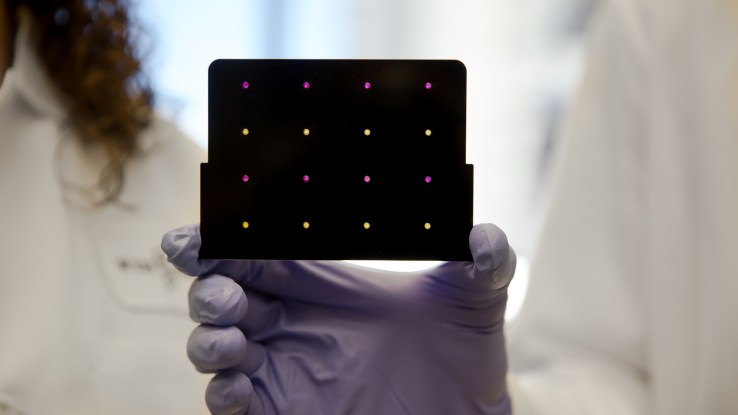
    In record time, the team — comprising members from Harvard, MIT, University of Toronto, Arizona State University, Cornell, University of Wisconsin-Madison and Boston University — built upon a technology developed by Collins’s team at Harvard’s Wyss Institute to create a simple, paper-based test that can be deployed to limited resource areas, detecting the disease in a fraction of the time and money of existing models.
    “We were trying to address a few needs,” explains Collins. “The need for a low-cost test and a need for a faster test and a need for a test that can be readily deployed in the field with little resources. I think this platform addresses each of those challenges nicely. The sensors themselves cost pennies to make. The development cost is also quite inexpensive. You’re talking probably less than a buck each for the test.”
    A drop of blood from the patient is boiled to release the RNA genome from the virus, followed by a bit more processing, at which point it’s applied to the paper.
    “What we’ve got is a really nice paper-based synthetic biology platform,” Collins says. “What we showed is that you can take the inner workings of cells, take a few dozen enzymes, and you can spot them on paper, freeze dry them, store them and distribute them at room temperature with very little loss of activity. That’s really at the heart of the innovation of the platform.”
    The whole process takes around two hours and can be performed entirely in the field with low-cost equipment, meaning it doesn’t need to be shipped to a big lab like the CDC for further testing. At present, the system is capable of detecting Zika and dengue, along with Ebola, the original target for the system.

    MIT-Zika-Detect-2-press
    Collins believes that it will be applied to a wide of pathogens in future applications.
    “We’re looking to use the test for the flu. We’re looking to use the test for HIV. We’re looking to develop the test for Lyme disease. We’re looking to use it for leprosy. And in a completely different form, we’re looking to see if we can use the platform to develop rapid and inexpensive cancer diagnosis.”
    In the meantime, the team’s primary focus is finding the best and quickest way to deploy the Zika test to the areas hardest hit by the outbreak.
    “We’re in discussions with groups in Brazil and Colombia to explore how we can get this into the field and into the hands of patients,” says Collins. “More testing is needed, but the platform holds great promise, and when we couple that with the right folks, I think this can be moved quickly for deployment.”

    Thursday, 5 May 2016

    Deep Space Industries partners with Luxembourg to test asteroid mining technologies

    Posted By: Uni logo - 06:16:00


    Deep Space Industries, the asteroid mining company, has signed a Memorandum of Understanding with the Luxembourg Government to co-fund the development and launch of DSI’s first spacecraft. Known as Prospector-X, the small spacecraft will test key technologies in Low Earth Orbit that will be necessary for future asteroid prospecting.
    Prospector-X / Image courtesy of Bryan Versteeg/Deep Space Industries
    Prospector-X / Image courtesy of Bryan Versteeg/Deep Space Industries
    The agreement is a small, but important step toward developing the technologies necessary to enable the potentially very lucrative business of asteroid mining.
    “Our promising cooperation with DSI within the spaceresources.lu initiative clearly demonstrates the strong commitment of the Luxembourg Government to support the exploration and future use of space resources.” Étienne Schneider, Luxembourg Deputy Prime Minister and Minister of the Economy
    Back in February, Luxembourg became the first European country to announce their intention to establish the necessary legal and regulatory framework required for in-space commercial mining activities.
    The U.S. had gone even further last year when President Obama signed the U.S. Commercial Space Launch Competitiveness Act (CSLCA). CSLCA states that U.S. companies are entitled to maintain property rights of resources they’ve obtained from outer space, providing companies like DSI and Planetary Resources regulatory peace of mind.
    Prospector-X / Image courtesy of Bryan Versteeg/Deep Space Industries
    Prospector-X / Image courtesy of Bryan Versteeg/Deep Space Industries
    In Luxembourg’s February announcement they mentioned that they were considering investing in already-established asteroid mining companies like DSI and Planetary Resources.
    Today, Luxembourg begins a partnership with DSI, and they’re already planning to work with others, stating that “separate negotiations to formalize our relationship with other companies active in this field are underway.”
    Planetary Resources seems like a likely contender, considering they already launched their first spacecraft in July of 2015 in order to test their own asteroid prospecting technologies.
    DSI, which has an office in the NASA Ames Research park and has worked with NASA through several contracts, will open up a second location in Luxembourg.
    While parts of the spacecraft are currently under development, DSI will work with Luxembourg to complete the full system. Prospector-X will be built and tested at both locations.
    Prospector-X / Image courtesy of Deep Space Industries
    Prospector-X / Image courtesy of Deep Space Industries
    Rick Tumlinson, Chairman of the Board of DSI, told TechCrunch that one of the key technologies that will be tested on Prospector-X is an electrothermal thruster named Comet-1.
    While Tumlinson wasn’t giving away many details, he notes that it’s a very advanced type of thruster that uses water as its propellant. He noted that advancing this technology would be of great benefit to the space industry, especially if a company could find a way to harvest water from asteroids.
    DSI, of course, hopes to be that company.
    In general, asteroid mining involves harvesting resources that will either be kept in space – asteroids could be made into gas stations for traveling spacecraft, for example – or with the intent of bringing these resources back down to the ground to sell on Earth.
    “We are going out to places that are dead and deadly, and we’re harvesting the stuff of life so that humanity can go out there and live and explore.” Rick Tumlinson, Chairman of the Board, DSI
    For now, DSI is focusing on harvesting water from asteroids for in-space applications like providing fuel for other spacecraft. This activity also ties nicely into their goal of perfecting a rocket thruster that requires water as propellant.
    Tumlinson likened their plan to the oil industry saying, “It’s almost as if we were drilling for the first oil and we were developing the internal combustion engine.”
    DSI has plans to harvest valuable metals and gasses from asteroids as well.
    However, asteroid mining technologies will take years to develop, so deriving revenue from harvested asteroid materials isn’t likely to happen in the near future. In the meantime, DSI plans to make money by selling the technologies and spacecraft capabilities they develop in the process.
    “Part of the beauty of what we’re doing is that the thruster and the other technologies and capabilities that we’re demonstrating are applicable to the space market right now.” Rick Tumlinson, Chairman of the Board, DSI
    After Prospector-X flies in Low Earth Orbit, DSI plans to launch their next spacecraft, Prospector-1 on a mission to an asteroid. Estimated to launch in four years, Prospector-1 will return information about the asteroid’s composition and what Tumlinson referred to as “diggability” (essentially how easy the asteroid would be to mine).
    Down the road, Tumlinson said that multiple Prospector-1 spacecraft could be sent to different asteroid candidates in order to identify appropriate mining locations.
    The business of asteroid mining certainly holds a lot of promise. Many asteroids have water ice that can be harvested to create rocket fuel. Others contain useful metals that are considered rare here on Earth. The value of asteroids is unquestionable. Extracting that value in a cost-effective way, however, is the part humanity hasn’t quite figured out yet.
    Companies like DSI and Planetary Resources are making the bet that their technologies and business plans will ultimately bring them to the goldmine of asteroids. We’ll just have to wait a awhile to see they’re right.

    Copyright © 2016 Uni logo™ is a registered trademark.

    Designed by Unilogou. Hosted on Blogger Platform.