• unilogou. Powered by Blogger.

    Showing posts with label drones. Show all posts
    Showing posts with label drones. Show all posts

    Friday, 29 July 2016

    Is this what GoPro's Karma drone looks like?

    Posted By: Uni logo - 03:17:00
    Https%3a%2f%2fblueprint-api-production.s3.amazonaws.com%2fuploads%2fcard%2fimage%2f160172%2fgoprodroneleakrumortop

    It's no secret GoPro is developing a drone called "Karma" for release later this year. But what it looks like, nobody outside of GoPro really knows.
    Last month, GoPro posted a teaser video for the animated film The Secret Life of Petsand speculation ran wild that the company may have subtly and intentionally teased its upcoming drone.
    Right at the 0:25-second mark, you can see clear GoPro Hero 4 product placement. It's attached to a dog, which has an unidentifiable quadcopter hovering above it.
    Surely, GoPro wouldn't be foolish enough to spoil its unreleased drone by putting it front and center in a teaser video, would it?  
    Mashable reached out to GoPro for comment on the images and will update this story if the company provides a response.
    Many commenters said it was the 3DR Solo drone, but it's not. The drone design in the teaser doesn't resemble the Solo and the camera placement is different. The drone in the video is also more compact.
    I chalked the drone up as fictional. I mean, even if it is GoPro product placement, it's a drone in an animated film.
    Then this image popped up on Twitter from GoPro enthusiast Konrad Iturbe:
    The image was reportedly posted to Reddit's GoPro subreddit, but, according to Iturbe, it was quickly removed for some unknown reason — but not before he saved the image. 
    The two images of the purported drone certainly look similar, with a top-mounted gimbal holding a Hero 4 camera in place, but the arm blades and legs are slightly different.

    A composite of the GoPro drone seen in the animated short and from a leaked image.
    IMAGE: COMPOSITE BY KONRAD ITURBE
    Iturbe told Mashable the image he posted to Twitter originated from GoPro's server, according to an exchange he had with the user who first posted it to Reddit.
    In direct messages exchanged on Twitter, Iturbe provided several prior instances when unannounced information regarding GoPro software and hardware products were gleaned from digging through code for the company's website.Phone leaker extraordinaire Evan Blass, a.k.a. @evleaks on Twitter, retweeted the image, giving it potential authenticity.
    Mashable reached out to Blass and he denied his retweet was confirmation that the purported drone image was legitimate.
    At this point, the leaked drone could be real or it could be a complete fake.
    The only official spec we know about the Karma drone is that it'll shoot 4K-resolution video.
    Other than that, the speculation is that it'll be compatible with the Hero 4 Black and the upcoming Hero 5.
    Here's some footage GoPro says was taken with its drone:

    Wednesday, 22 June 2016

    Israeli air force works on battlefield IoT technology

    Posted By: Uni logo - 03:02:00
    An Israeli Air Force (IAF) event recently gathered together 400 of the country’s top military minds to brainstorm next generation connected battlefield technology.
    As reported in the Jerusalem Post, the Mahanet event held in Haifa drew together top technologists from across all branches of the Israeli military to collaborate on bleeding edge warfare innovations.
    The specialists worked on a variety of projects, some which will be mothballed while others will become future military capabilities for the Israeli military.
    One project involved an IAF attempt to develop a platform for battlefield assistance that could also incorporate internet of things (IoT) technology.
    “Virtual reality can simulate a battlefield, and generate scenarios where [pilots] are attacked,” said Lt. Guy Cohen, the head of the air force innovation team. “I can use the Internet of things to link up a battalion commander in my sector to someone sitting an [air force] control center.”
    Such breakthroughs could change “the way I attack, or look at the whole area and communicate with gestures,” said Cohen. “We are looking at how we can take these things to our world of command in the IAF.”

    Israeli tech used in aircraft servicing

    Another application of virtual reality that the IAF conference explored was using VR technology in training technicians on how to service the F-35 fifth generation fighter jets, which are expected to enter into active service later in 2016.
    And for those who prefer to launch remote air strikes while laying in a relaxed posture, the techies conceived another project that enabled a pilot to navigate drones while lying in a specially wired bed.
    “If you’re on the battlefield and you can’t afford to be exposed [to enemy fire], we can take sensors and use them to enable soldiers lying down to control drones,” said Cohen.
    The collaborative work also focused on developing innovations that could enable the Israeli military to rapidly transfer data from intelligence officers or ground units to aircraft.
    A previous Mahanet conference hatched a project to land an Israeli robot on the moon, which is now scheduled for a 2017 launch onboard a small spaceship.

    Tuesday, 21 June 2016

    The FAA's new rules for drones are bad news for Amazon

    Posted By: Uni logo - 15:52:00
    Https%3a%2f%2fblueprint-api-production.s3.amazonaws.com%2fuploads%2fcard%2fimage%2f122766%2fde09133ffb1043ee84ec97e6b80ba6c2

    The U.S. government just grounded delivery drones.
    The good news is commercial drone flight in the U.S. has its first set of operational rules, which were released on Tuesday from the Department of Transportation and the Federal Aviation Administration.
    However, much of what's outlined in those new rules pretty much dashes the hopes of Amazon, Walmart and others who want to start air-dropping products to our homes. So while these new rules do lay the much-needed groundwork for commercial drone operation in U.S. airspace, they leave little (but not no) wiggle room for any use cases besides search and rescue operations and research.
    “We are part of a new era in aviation, and the potential for unmanned aircraft will make it safer and easier to do certain jobs, gather information and deploy disaster relief,” said U.S. Transportation Secretary Anthony Foxx in a press release.
    Officially known as The Small Unmanned Aircraft Regulations (Part 107), the rules, which go into effect in August, apply to all commercial (or non-hobbyists) drones under 55 pounds. That might include Amazon's delivery drone, which weighs roughly the limit.
    Weight, though, may not be the biggest hurdle for potential drone delivery services. The FAA and DoT are also requiring that all drones remain within visual line of sight with their pilots and that the pilots can view the fliers unaided by anything more powerful than prescription glasses. 
    It's unclear how Amazon Prime Air or anyone else could use drones to deliver packages from a warehouse to someone's home and still be able to keep eyes on the drone for the whole flight.
    The new rules also set maximum speed to 100 mph (far faster than most amateur drones can fly) and a max altitude of 400 feet.
    The drones cannot fly over "unprotected people" unless "they are directly participating in the UAS operation," notes the release. That rule would likely prohibit the commercial drones from flying over private homes.
    Pilots have to be at least 16 years old and have a remote flying certificate and have passed an aeronautical test. In a possible nod to the threat of drone-borne terrorism, there will also be TSA background tests for all of these drone pilots.
    Mashable has contacted Amazon for comment on the new rules and will update this report with its reply.
    Some in the aeronautics space, though, are already applauding the new rules.
    "We want to congratulate the FAA on publishing the final small UAS [unmanned aircraft system] rule today. The final rule will be highly beneficial to the industry overall, as it resolves many uncertainties in the law and creates an improved regulatory environment." said Dave Mathewson, executive director of the Academy of Model Aeronautics (AMA).
    It's worth noting that the FAA's new rules do not apply to model aircraft.
    While these rules appear to make commercial drone delivery systems virtually impossible, the FAA and DoT are also including an online waiver portal (still to be built), where pilots and companies can apply for waivers to some of these restrictions (the FAA does not say which ones), as long as they can prove that they will still be able to conduct the drone flights safely.
    You can read a summary of the new commercial drone rules here.

    Monday, 23 May 2016

    This is what Xiaomi's first drone looks like

    Posted By: Uni logo - 20:13:00
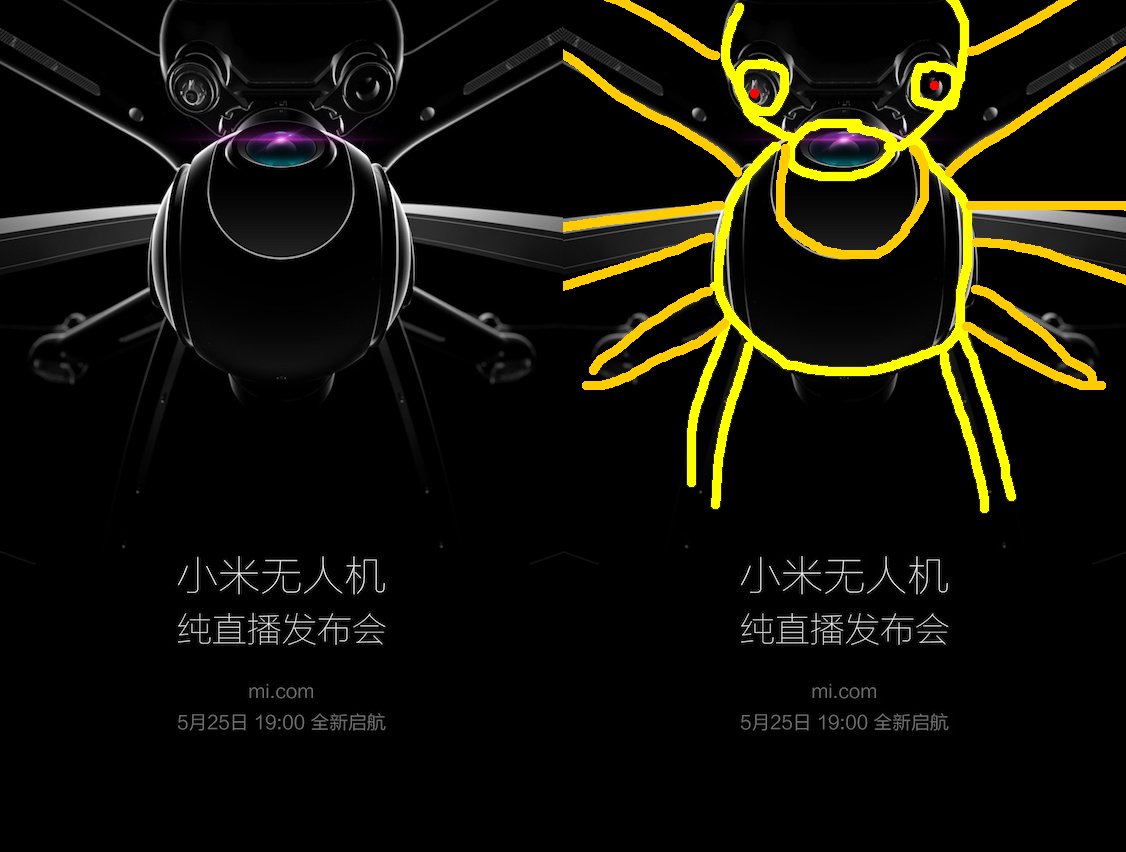
    Https%3a%2f%2fblueprint-api-production.s3.amazonaws.com%2fuploads%2fcard%2fimage%2f95312%2fscreen_shot_2016-05-23_at_9.10.38_am

    Chinese tech giant Xiaomi is getting into the drone business.
    The company sent out a teaser image for its upcoming drone last week. Ahead of its big unveil on May 25, Android Central has discovered a 20-second teaser video, which was posted to Youku, China's version of YouTube.
    Based on the short teaser video, we now know Xiaomi's sleek white drone will have four blades and a ball-shaped camera mounted on the underbelly of the drone that swivels. The drone is rumored to be able to shoot in 4K resolution.
    Xiaomi's drone will likely compete directly against DJI's drones. Though DJI makes professional drones designed specifically to carry large cameras for filmmakers, the company's consumer drones, such as the new DJI Phantom 4, have proven to be a huge hit with hobbyists and regular folk.
    With the Phantom 4, DJI introduced several useful and safety features such as tap-to-fly for easier operation by beginners, auto-follow (for selfie addicts) and obstacle avoidance.
    But the Phantom 4 is pricey at $1,400. Xiaomi has made a name for itself selling highly polished devices, like its new flagship Mi 5 Android smartphone, at low prices. If it does the same with its drone, DJI may have to start worrying.
    Here's the teaser Xiaomi sent out last week. Anyone else see a bee?
    No? Just me? Maybe I've been staring at the teaser for too long...
    We'll find out more details on Xiaomi's drone later this week. Thursday can't come soon enough!

    BONUS: DJI Phantom 4 drone review

    Saturday, 21 May 2016

    Four ways IoT is saving the environment

    Posted By: Uni logo - 13:54:00


    The technological advances inherent in the Internet of Things (IoT) are providing researchers, town planners, ecologists and scientists with new ways to not only prevent, but also solve, environmental problems — from toxic water supplies to reducing climate change in rural areas. Here are some of ways IoT is bringing sustainability:

    #1. Reducing e-waste

    3015164_6e979e27
    The problem of e-waste is familiar to anyone with old devices. Once a device becomes obsolete or beyond repair, it invariably ends up in landfill, often in another country. While there have been schemes to refurnish phones and computers, the sheer scale of e-waste is a complex problem. Many sustainability experts have suggested that the tech industry should take some responsibility as the enablers of the problem in the first place, and through this process, the notion of the circular economy has grown. A circular economy is characterized as one that “is restorative and regenerative by design and which aims to keep products, components and materials at their highest utility and value at all times.”
    Project Mainstream is global project targeting areas of sustainability thwarted by complexities such as e-waste, using a circular economy model. As connected devices are embedded with chips and sensors, they can be tracked throughout their life cycles. In the future, this means that consumers will be notified when older products can be repaired or refurbished. If a device is returned to the manufacturer  – as an alternative to disposal – the sensors will signal which components can be repurposed or reused. One example, IBM is working to keep industrial products in continuous loops to maximize residual value and ensure that end-of-lease and client-owned IT equipment is refurbished, resold, disassembled or sold as parts, to be used for repair and maintenance work.

    #2. Tracking endangered species

    IoT technology has enabled scientists, conservationists and citizen scientists to track and quantify endangered species through an increased ability to collect, transmit, store and share data. In the Phillipines, dugongs are photographed by local fishermen then uploaded to a central database. The fishermen, many of whom are unable to read or write, are being trained to use the smartphones and are being provided with local charging facilities. The tracking enables conservationists to lobby for appropriate sea protections where dugongs are situated.
    In Australia honey bees are fitted with tiny micro censors by the CSIRO to monitor bee movements. The research is being led by CSIRO and aims to improve honey bee pollination and productivity on farms, as well as help understand the drivers of bee Colony Collapse Disorder (CCD), a condition decimating honey bee populations worldwide. The sensors are tiny radio frequency identification sensors that work in a similar way to a vehicle’s e-tag, recording when the insect passes a particular checkpoint. The information is then sent remotely to a central location to help scientists increase their knowledge of bee migration. The censors have also been trialled in Brazil and are predicted to work well in remote locations, particularly when the sensors will be able to generate power from insect movement and store energy in batteries.

    #3. Fighting deforestation

    download
    The use of drones to monitor deforestation is nothing new, but U.K.-based companyBioCarbon Engineering is working to use drones in the fight against deforestation. In an effort to plant a billion trees a year, drones take detailed 3D images of the landscape to determine the nutrients, biodiversity and topology. This is followed by a precision planting pattern where the drone fires a biodegradable seed pod at each position, each containing nutrients for healthy tree growth. While the program is still in planning stages, it has potential to provide fast and accurate reforestation.
    In many tropical countries, there’s a thriving black market for illegally cut timber. Earth Observation, a provider of forest and marine monitoring solutions, has developed an infrared and GPS-based system that creates a unique biometric record of individual trees that have been legally authorized for harvest and uses a smartphone app to transmit data to a tracking system. The system is designed to circumvent opportunities for bribes and falsification of data that allow the trade in illegally cut timber to flourish. Using proprietary algorithms, TreeTAG generates a one-time code that captures precise data on the potential maximum yield of each tree, as well as the species, time, date, and exact location where each tree is felled. If a tree is cut outside of a government-authorized logging concession, the system will not generate a “tag.”

    #4. Monitoring the oceans

    Where you start thinking about the internet in the ocean you know the possibilities of technology are getting very big. Catalina Sea Ranch is an America’s first off shore shellfish ranch. Besides fishing, they are also working on creating a wireless data capturing system for the ocean.
    As CEO Phil Cruver explains:
    The National Oceanic and Atmospheric Administration (NOAA) Integrated Ocean Observation System (IOOS) provided a NOMAD buoy that will be anchored at our ranch and equipped numerous marine embedded sensors at strategic positions in the horizontal and vertical water plane. The wireless sensor network will help generate continuous real-time data, which will be transmitted to the cloud for remote and independent analysis by research institutions and to offer insights for offshore aquaculture operations.”
    In Italy, researchers at SUNRISE are also working to enable seas, lakes and rivers to be digital highways for data transfer from sensors, robots, and underwater vehicles capable of performing tasks too dangerous for humans. These include environmental monitoring  – both shallow and deep water – as well as border control and protection of offshore critical infrastructures, de-mining, surveillance and protection of submerged archaeological sites.  Efforts include an underwater communication system based on acoustic waves, which can travel tens of kilometres under water. It’s a long-term, complex and cross-collaborative protect that, if successful, will revolutionize our understanding of the ocean as we know it.

    Saturday, 7 May 2016

    Single-propeller 'drone' flies when you throw it like a frisbee

    Posted By: Uni logo - 00:40:00

    A drone, or quadcopter as it's technically called, typically has four propellers to generate enough thrust to let it hover in the air. The propellers are arranged in such a way to counterbalance the weight of the drone itself.
    Researchers at the Institute for Dynamic Systems and Control at ETH Zurich have created a new kind of flying machine (technically, not a drone) that only needs one blade to fly.
    The flying machine is called the Mono spinner and is billed as the "simplest, controllable, flying machine in existence" since it lacks actuators and aerodynamic surfaces. It only has one moving part: the rotating propeller.
    The three-person research team (Weixuan Zhang, Mark Mueller and Raffaello D'Andrea) said the Monospinner was born after they asked "what is the minimum number of moving parts necessary for controlled flight?"


    IMAGE: ETC ZURICH

    The researchers have provided an in-depth look at the math and science that went into getting its flying machine into the air here. The gist: "An unconventional equilibrium is found by analyzing the vehicle’s dynamics. For a certain constant angular speed and propeller force, the Monospinner is able to remain substantially in one position. Feedback control keeps the vehicle near this equilibrium."
    To fly it, just throw it into the air like a frisbee:


    IMAGE: ETC ZURICH

    Needless to say, you probably want to stay away from one of these guys. Just look at how it's spinning at an angle. It could easily take your eye out.


    IMAGE: ETC ZURICH

    Controlling the Monospinner.
    IMAGE: ETC ZURICH

    Friday, 6 May 2016

    GoPro's drone delayed until the holidays

    Posted By: Uni logo - 00:47:00
    Gettyimages-520524232

    Waiting for GoPro's top-secret drone? Well, you'll have to wait some more.
    GoPro announced in its Q1 financial results report it's delaying its Karma drone until the holidays. The drone was originally scheduled to launch within the first half of the year.
    "While we had to make the difficult decision to delay our drone, Karma, the upside is that Karma's launch should now benefit from the holidays," said Nick Woodman, GoPro's founder and CEO.
    Though nobody outside of GoPro knows exactly what the Karma will look like, the company did drop at least one hint last year. And that is, the drone's camera will be at least 1440p resolution and video will look super stabilized. You can see the smooth footage taken from the drone yourself below
    "The [quadcopter] boom exists because of GoPro and now it's growing much bigger than GoPro," Woodman told Mashable last year. "People are getting into quads not because they like flying little quads around, but I think the original impetus is they want the incredible content that a GoPro and a quad enables."
    The question now for drone fans is: Do you wait for the Karma or just go out and buy the excellent DJI Phantom 4? Decisions, decisions.

    Thursday, 5 May 2016

    Europe's aviation safety agency sets up drone collision task force

    Posted By: Uni logo - 04:45:00
    Http%3a%2f%2fi.blueprint.mashable.com%2fjoo_dmqeet7arocdfqbe_rnxjtm%3d%2fblueprint-api-production.s3.amazonaws.com%2fuploads%2fcard%2fimage%2f80586%2fgettyimages-485983770

    As drones become more commonplace in the world, regulations and safety testing inevitably follows. The European Aviation Safety Agency announced on Wednesday that it has set up a task force to look at the risks of drones colliding with aircraft.
    The announcement, first seen by the Associated Press, says the task force will study different vulnerabilities on aircraft, including outer frames, windshields and engines. They will be looking at all different kinds of aircraft, including large and small planes as well as helicopters.
    If the need exists, EASA may perform actual tests for collisions between drones and aircraft, which would probably mean launching drones at stationary aircraft at certain speeds, rather than flying aircraft into drones.
    The task force is made up of aircraft and engine manufacturers and plans to publish its results in July.
    A spokesperson for EASA told Mashable the task force has been created based on recent media reports of aircraft and drones colliding. 
    In April, a British Airways plane hit an object while approaching an airport, and the pilot said he believed it was a drone. It turns out the object may not have been something else.
    "Sometimes what was thought to be drone ended up being another object," the spokesperson said. "However it is worth looking at this."
    More and more regulations around drones have been surfacing since they've boomed in popularity over the past couple years, including the need to register drones of certain sizes with the U.S. government. 
    In 2014, the Federal Aviation Administration enacted a law limiting the flight of drones around airports.

    Wednesday, 4 May 2016

    Autonomous medical drones will soon transport emergency organ donations

    Posted By: Uni logo - 09:51:00
    Https%3a%2f%2fblueprint-api-production.s3.amazonaws.com%2fuploads%2fcard%2fimage%2f79957%2fdrn8u

    The drones we have today do everything from deliver packages to provide surveillance footage, but now we're getting closer to something that could even save someone's life. 
    EHang, the company with the first autonomous drone on the market capable of transporting a human, has just sealed a deal that will use the drones to transfer donated organs to people in emergency situations.
    Pharmaceuticals and lung transplant tech company Lung Biotechnology PBC is acquiring up to 1,000 of EHang's autonomous drones for its Manufactured Organ Transport vehicle system (MOTH). Terms of the deal were not disclosed. Lung Biotechnology will use an advanced version of the EHang 184 drone revealed in January.
    IMAGE: EHANG
    The collaboration between the two companies will span up to 15 years and will involve the drones executing pre-programmed flight plans to hospitals and recharging pads strategically located to ensure that organs are delivered while still viable for transplantation. 
    "We anticipate delivering hundreds of organs a day, which means that the MOTH system will help save not only tens of thousands of lives, but also many millions of gallons of aviation transport gasoline annually," said Martine Rothblatt, CEO of Lung Biotechnology in a statement sent to Mashable
    No date has been given for when the first flights will take place, but as the partnership aggressively ramps up toward regular service, medical drones could hit the skies before delivery drones become ubiquitous. If this collaboration works, it's not unrealistic to imagine automated ambulance drones transporting humans for common emergency hospital visits in the future. 
    As if the autonomous drone part of the system wasn't innovative enough, on the ground, the transport tech will support the delivery of pig-to-human xenotransplantation and organs regenerated through through stem cells therapy.
    Yes, the drone age is truly upon us. 

    Copyright © 2016 Uni logo™ is a registered trademark.

    Designed by Unilogou. Hosted on Blogger Platform.