For the truly devoted Pokémon trainers/Instagrammers/texters, Pokémoji and Pokéstickers are here.
While the emoji are not official and aren't available in app form, you can screenshot and send them to add some adorable flair to your texts. See all of the Pokémoji, created byKévin Magalhaes and Laureen Minet, below:
IMAGE: KÉVIN MAGALHAES AND LAUREEN MINET
Totally available in iTunes, however (sorry, Android users), are new Pokémon stickers that also look amazing, courtesy of Fatima Ouchao.
IMAGE: INSTA EMOJI FOR POKÉMON GO
IMAGE: INSTA EMOJI FOR POKÉMON GO
These images are the ones Ouchao supplied in the App store, but we couldn't resist looking at all of them, so here are a bunch more.
IMAGE: INSTA EMOJI FOR POKÉMON GO
It's been a big few weeks for emojis, what with the nostalgic Disney emoji and the very current Rio-inspired emoji on Twitter. And then, of course, there's the big news that we'll actually have diverse, professional female emojis being lady doctors and mechanics and and coders and whatnot.
None of this might seem like a huge deal, but as those at New York magazine, Wired, and Slate are pointing out, emoji are having a measurable impact on the way we communicate. Who and what become emojified could more and more important in the future.
's upcoming expansion Rise of Iron introduces a plethora of standard new features along with a complete game-changer: Private PvP matches. Previously, Destinyonly supported matches assembled through the game's matchmaking system, and now players can set up their own games against other teams.
By giving players the ability to choose who they play against in PvP, Destiny is setting itself up to enter the world of esports. If the new feature isn't enough evidence that the game is dipping its toes into competitive gaming, the game's developer Bungie also released guidelines and licensing information for hosting Destiny competitions.
The new PvP features
The new private match feature, which was announced on Tuesday by Bungie during Gamescom, allows up to 12 players to compete in Crucible matches with customizable settings. Players can pick which map they play on, score and time limits, and certain game modes.
With the new expansion comes a new game mode, Supremacy, which is identical to Call of Duty's Kill Confirmed mode. When a player gets killed, they drop crests, which can then be picked up by anyone. If you pick up crests from a player you killed, you get points. If you pick up a crest from someone else's kill, you get points. You can also pick up crests that drop from your own killed teammates to take your enemy's points, which means the game encourages close-range kills.
Along with the new mode there are three new maps: Last Exit, Skyline and Floating Gardens.
Rise of Iron also introduces viewable Clan rosters. Previously, if players wanted to see their fellow Clan members they had to go online. This expansion allows you to connect and interact with Clan members in the game.
Destiny entering esports
By allowing players to set up their own matches with hand-picked opponents and specific settings, Bungie is pushing Destiny into competitive gaming. Matchmaking helps players get into competitive games and grow, but tournament play requires private matches.
For Destiny players who are more interested in PvP than PvE, private matches open up a whole level of competition. Top teams can now specifically practice together without worrying about denting their matchmaking rating. Also, online Destiny tournaments can be organized.
Bungie hasn't announced any plans to specifically promote or put on any tournaments by itself, but the company is giving everyone else the go ahead as long as they follow the rules. Organizers who are looking to pay out more than $5,000 in prizes, charge in-person fees or set up other large-scale ordeals will have to obtain a license.
Destiny: Rise of Iron is expected to arrive on Sept. 20. Players do not need the expansion to play in private matches, but Rose of Irons is required to play any of the new maps or the new game mode.
players, beware: Niantic is starting to get serious about cracking down on cheaters.
The company is starting to permanently ban players who cheat either by spoofing their location or by using software to access the game "in an unauthorized manner."
First spotted by Redditors in the Pokémon Go developer subreddit, Niantic quietly updated their FAQ page to address the issue of banned accounts. While Niantic has banned users before, the update suggests the company is starting to ramp up its punishment of cheaters.
Among the offenses that can get you permanently banned are "falsifying your location, using emulators, modified or unofficial software and/or accessing Pokémon GO clients or backends in an unauthorized manner including through the use of third party software." In other words, creating or using just about any third-party Pokémon Go app is enough to earn you a ban. That said, it appears Niantic is targeting the creators of third-party software more than those who use the tools — at least for now.
creating or using just about any third-party Pokémon Go app is enough to earn you a ban
The company does offer a form for banned users to appeal the decision, if they believe a mistake has been made, though it's not clear how these cases are handled.
Niantic previously updated its app to address the wave of third-party Pokémon-tracking apps and services that sprung up in the wake of the app's success. Though that update blocked apps like Pokévision, enterprising players have found other ways to cheat the game, like spoofing their GPS location — a technique that also violates Pokémon Go's terms of service.
Though clever members of the Pokémon Go developer community will likely continue to try to stay one step ahead of Niantic, the company has made it clear it's committed to weeding out cheating in the game.
"We will continue to work with all of you to improve the quality of the gameplay, including ongoing optimization and fine tuning of our anti-cheat system," the company says.
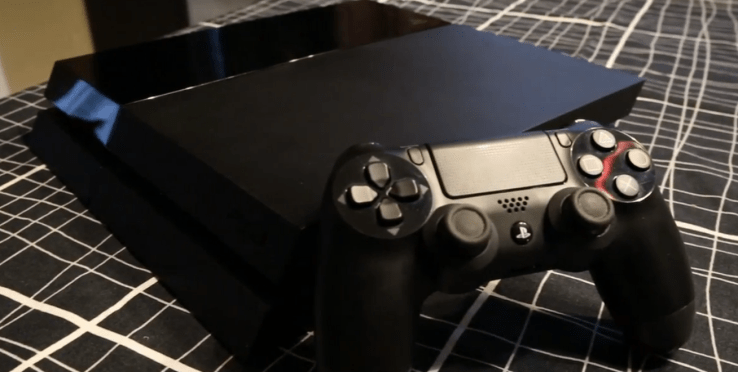
September 7 is going to be a busy day. Sony sent out invites for a press event in New York. The company will likely unveil the successor to the PlayStation 4. On the same day, Apple could also hold its usual iPhone launch event for the rumored iPhone 7.
The event is called “PlayStation Meeting,” and the company plans to “share details about the PlayStation business.”
Given that Sony already acknowledged that the PlayStation 4 ‘Neo’ was real and wouldn’t be announced at E3 in June, everything indicates that Sony is ready to announce the PS4 ‘Neo’ just in time for a launch before the holiday season.
Rumors of a more powerful PlayStation 4 codenamed ‘Neo’ started emerging in March on Kotaku. The new console is supposed to be much more powerful than the existing PlayStation 4 in order to support more demanding games, and especially for the PlayStation VR headset.
Virtual reality is quite demanding, and that’s why many people are buying new graphics cards for their computers. The PlaySation 4 was released three years ago and could be a bottleneck for good looking virtual reality games. If you want a smooth experience, you need to run a game at a consistent frame rate above 60 frames per second — otherwise you’ll get nauseous. And because the screen in your VR headset is so close to your face, you want a good resolution as well. The existing PS4 will support the PlayStation VR, but the PS4 ‘Neo’ is the console you want for virtual reality.
In addition to virtual reality, the PS4 ‘Neo’ could be a good companion for your brand new 4K TV. The new console should support 4K movies, TV shows and even games. Sony doesn’t want to fragment its user base, so don’t expect PS4 ‘Neo’ exclusive games — all games should still work on the good old PS4.
Microsoft will unveil a competitor to the PS4 ‘Neo’ next year. The Xbox One ‘Scorpio’ could be even more powerful than the ‘Neo’, but will also launch a year after Sony’s new console. We will have a team on the ground in New York to cover Sony’s PlayStation event.
The HTC Vive VR headset will get its own app store this fall, as the company moves to broaden the experiences available to its users.
Viveport will offer virtual reality experiences in areas like education, communcation, entertainment, shopping and more, said Rikard Steiber, SVP of virtual reality at HTC.
"VR is going to change the world for the better. It will democratize access to experience, anyone can travel anywhere, and learn anything," Steiber told Mashable. "The experiences that were only available to a few are now available to everyone."
Viveport's launchthis fall will bring many more pieces to HTC's virtual reality ecosystem. Currently, Vive owners access VR games and software through Steam, Vive launch partner Valve's PC game platform. Viveport adds an additional layer, with a PC and mobile app to purchase and preview apps, as well as its own home space that acts as both storefront and content launcher.
But Steiber promises much more interactivity from your Viveport VR experience, saying the company will allow users to customize their home menu with skins, apps and widgets.
"My Viveport could be a tropical beach, and yours could be the bridge of a spaceship."
Launching and using apps, Steiber said, will be "a bit like Minority report," with gesture controls reliant on the Vive's two wand-like controllers. Steiber and his team are also encouraging developers to add as much controller support into their apps, despite the fact the Vive is the only headset with included controls currently on the market.
"To get true presence, you need to have interactivity and you need to have room scale," he said. "If you are a developer, I would go for the more immersive experience first, to see how far you can possibly go, then scale for platforms with fewer features."
Developers will get a chance to on the ground floor of Viveport, as Steiber said the beta would be out soon. He also promised that developers who submitted their apps during the beta period would get their apps featured in Viveport when it launches more broadly to consumers this fall.
The HTC Vive VR headset will get its own app store this fall, as the company moves to broaden the experiences available to its users.
Viveport will offer virtual reality experiences in areas like education, communcation, entertainment, shopping and more, said Rikard Steiber, SVP of virtual reality at HTC.
"VR is going to change the world for the better. It will democratize access to experience, anyone can travel anywhere, and learn anything," Steiber told Mashable. "The experiences that were only available to a few are now available to everyone."
Viveport's launchthis fall will bring many more pieces to HTC's virtual reality ecosystem. Currently, Vive owners access VR games and software through Steam, Vive launch partner Valve's PC game platform. Viveport adds an additional layer, with a PC and mobile app to purchase and preview apps, as well as its own home space that acts as both storefront and content launcher.
But Steiber promises much more interactivity from your Viveport VR experience, saying the company will allow users to customize their home menu with skins, apps and widgets.
"My Viveport could be a tropical beach, and yours could be the bridge of a spaceship."
Launching and using apps, Steiber said, will be "a bit like Minority report," with gesture controls reliant on the Vive's two wand-like controllers. Steiber and his team are also encouraging developers to add as much controller support into their apps, despite the fact the Vive is the only headset with included controls currently on the market.
"To get true presence, you need to have interactivity and you need to have room scale," he said. "If you are a developer, I would go for the more immersive experience first, to see how far you can possibly go, then scale for platforms with fewer features."
Developers will get a chance to on the ground floor of Viveport, as Steiber said the beta would be out soon. He also promised that developers who submitted their apps during the beta period would get their apps featured in Viveport when it launches more broadly to consumers this fall.
That’ll be the narrative all season after Westbrook signed an extension with the Thunder, even if the arrangement is still a short-term one.
Russell Westbrook took a sledgehammer to the rumor mill late Wednesday night by reportedly agreeing to an extension that will keep the All-NBA point guard in Oklahoma City through 2017-18. The renegotiated contract boosts Westbrook’s salary considerably this next season (a season for which Westbrook was already under contract) and locks in the following season as well, meaning the point guard’s likely new free agent date is July 1, 2018.
The obvious upshot is that the Thunder no longer have to worry about losing All-NBA talent for nothing in consecutive offseasons. There were compelling reasons for Westbrook to take this deal — not the least of which is that this setup is his most lucrative long-term path — but that doesn’t make it any less of a coup for Oklahoma City.
The fear of Westbrook leaving next July as Kevin Durant did this summer was so great that if the guard didn’t agree to this extension, OKC would likely have traded him to ensure there was a return on investment. Obviously, keeping Westbrook and guaranteeing that he can’t bolt in 2017 is a preferred outcome.
But what happens now? This is not the end of the story of Westbrook and the Thunder, just a twist in the narrative. Here’s what happens because of Westbrook’s decision.
1. The Thunder are buyers
OKC was able to offer a renegotiated 2016-17 salary for Westbrook only because the Thunder had cap space this summer. (Thanks, Kevin.) As we’ve discussed all year, the salary cap exploded, giving most teams a large amount of space to sign free agents. Along with the cap (now $94 million and projected to be $102 million next summer), the luxury tax threshold also rose. It sits at $113 million this year and should rise again in 2017.
Because the free agent market is picked over and due to salary-matching rules, it’s unlikely OKC will be able to fully leverage that payroll flexibility between now and next summer. That’s fine. Next July is where an extra year of Westbrook really pays off.
OKC didn’t have a real shot at chasing free agents in 2016. Durant decided on July 4. Most of the top options had found deals by then and Westbrook didn’t commit to stay another year until August. In 2017, Westbrook will already be locked in and the Thunder should have gobs of cap space (presuming they don’t hand out massive early extensions to Victor Oladipo, Steven Adams and Andre Roberson, which is possible but unlikely). The Thunder will be able to credibly chase top free agents.
(This all assumes there’s not a work stoppage.)
If they don’t land any big free agents? Well, Westbrook would still be a highly tradable asset.
2. The 10-year breakpoint becomes an even more prominent tool
A key reason Westbrook chose this route is because he wants to sign his next long-term deal once he has 10 years of service in the league. With 10 years under his belt, he can sign a deal starting at 35 percent of the cap in lieu of 30 percent. With a $100 million salary cap, that’s an additional $5 million in the first year and just under $45 million over a five-year deal (factoring in raises).
There’s a huge financial incentive to lock in once you are a 10-year veteran. It explains Durant’s 1+1 contract in Golden State (he will likely opt out in 2017 and sign a longer, more lucrative deal with the Warriors as a 10-year vet, barring contract rule changes in a new labor deal). It explains James Harden’s renegotiation and extension, which locks him in until 2019 ... when he’ll be a 10-year veteran.
Players and agents are smartly focusing in on that milestone. Teams are offering deals (like Westbrook’s contract in OKC) that play to that strategy. It’s something all analysts should pay attention to when reading tea leaves, and something the league is surely aware of as it looks for ways to increase star retention capacity for teams and boost parity.
3. We have a new babyface to battle Durant’s heel
We all know Westbrook’s decision comes with huge financial incentives, and we all know it’s really just one extra year of commitment. That’s hardly a lifetime tether.
For the broader audience — and arguably for us, too — that doesn’t matter. What matters is that Russell Westbrook chose to commit to tiny, underdog Oklahoma City a month after Kevin Durant bolted for Silicon Valley.
Westbrook is obviously a hero in Oklahoma now, but this will spread beyond: He’s going to be the nation’s favorite sports babyface for the next year or two. He already checks a lot of the Wildly Popular Athlete boxes. He plays crazy hard, he’s essentially indestructible and he has a sharp competitive edge. Ignore for a moment that he’s awful with the media, that his fashion is insane and that he has intense handshake choreography. Those are niche topics compared to the broader, marquee narrative which is that when the going got tough, Russell Westbrook got tougher.
Durant didn’t need help becoming a national villain — he accomplished that by joining the 73-win Warriors. In fact, the Warriors’ own heel turn was nearly complete and Durant was the coup de grace for that whole collective. But by providing a stark contrast, Westbrook has deepened the Durant dislike we’ll see in full effect for the next year. And every little bit of anti-Durant sentiment has the effect of boosting the pro-Westbrook sentiment.
By doing the opposite of what Durant did, Westbrook has elevated his standing among the broad, non-obsessive NBA fandom. (Westbrook has long been a hero among the obsessed.) He’s being touted as an MVP favorite because his box scores are going to be insane. Instead, tout him as the presumptive 2016-17 MVP because America eats this stuff up. This is Derrick Rose in 2011. Watch it happen.
What’s amazing is that the power of the narrative will overcome the basic facts of the situation, which reveal that Westbrook is a surly shot-jacker from L.A. with expensive taste and tendencies toward being a difficult teammate. As an avowed Westbrook booster since forever, I couldn’t be more pleased to witness all that get shrouded by a narrative that says Westbrook is a loyal tough guy willing to sacrifice to bring a little city some big glory.
Whatever gets America fully on board with the Westbrook Experience works for me.
Pokémon Go creator Niantic has released a statement on its Facebook page explaining some of the recent changes. You may have noticed on Twitter, Facebook and Reddit that some of these changes have been quite controversial. Hence today’s statement.
First, the ‘3-step’ indicator in the nearby Pokémon screen is gone for good. Yes, it was broken. But Niantic doesn’t have any good alternative for now. The company promises that it’s going find a way to improve this feature and bring it back in some other form.
And it brings us to the second point. Third-party tracking services, such as Pokévision, PokéHound and PokéNotify received cease-and-desist letters. While I haven’t been using these services, my friend Arthur thinks they are pure evil and should die in a fire. But they existed for a reason — if the ‘3-step’ indicator was broken, players needed some kind of hints about where to find Pokémon. Otherwise it’s just pure luck.
Sure, Pokévision and others probably went too far. But as a colleague who shall remain nameless wrote, “it was the only thing keeping their game playable while tracking is broken. It’s like suing the locksmith for helping you get into your house when you’ve got a pot on the stove about to burn your house down.”
Anyway, Niantic has the final say regarding this issue. The company says these services were making the servers unreliable. Pokémon Go doesn’t have an API, so it seems like Pokévision and others created countless of accounts on many servers around the world using Android emulators. With these emulators, they could fake movements around cities and reverse-engineer the game to create a sort of lightweight API and gather Pokémon data.
Quite a cool trick. But it’s clear that these services were using a ton of server resources. Pokémon Go doesn’t need additional server load as Niantic is still trying hard to make the game scale. And it could also be a nice excuse to kill them anyway.
Here’s the full statement:
Trainers,
As many of you know, we recently made some changes to Pokémon GO.
– We have removed the ‘3-step’ display in order to improve upon the underlying design. The original feature, although enjoyed by many, was also confusing and did not meet our underlying product goals. We will keep you posted as we strive to improve this feature.
– We have limited access by third-party services which were interfering with our ability to maintain quality of service for our users and to bring Pokémon GO to users around the world. The large number of users has made the roll-out of Pokémon GO around the world an… interesting… challenge. And we aren’t done yet! Yes, Brazil, we want to bring the game to you (and many other countries where it is not yet available).
We have read your posts and emails and we hear the frustration from folks in places where we haven’t launched yet, and from those of you who miss these features. We want you to know that we have been working crazy hours to keep the game running as we continue to launch globally. If you haven’t heard us Tweeting much it’s because we’ve been heads down working on the game. But we’ll do our best going forward to keep you posted on what’s going on.
Oh, how fickle fandoms can be. Pokémon Go, the craze that swept the globe, finds its user ratings in the UK and US bashed down to below two stars in the iTunes app storeafter recent updates peeved players big-time.
The 1.5 star rating in the UK App Store is based on just under 1,000 ratings that specifically refer to the current version of the game, the majority of which give it a measly one star—the lowest rating. The game also has just 1.5 stars in the US version of the store too. Across all the game versions, the average rating in both countries is now three stars.Why the fall in support for the amusement that surprised the world not exactly a month prior? Fans have been pissed at Pokémon Go engineer Niantic since a report on Sunday evacuated a carriage following component that permitted players to discover close-by pokémon. The organization likewise cut down outsider applications which showed where distinctive pokémon brought forth, leaving little for players to use to track their most loved beasts.
Appraisals in the Google Play store demonstrate a four-star normal, yet late one-star surveys uncover players aren't content with the impact this has had on the gameplay. "Do you anticipate that me will walk capriciously around a territory bigger than 6 football fields in less than 6 minutes for a Pokémon I can't track?" an analyst named Dustin Clowers composed on Monday. "Get your head out of your rear ends and acknowledge what made this diversion awesome. No one needs to lounge around getting winged animals and rats. Empower following through application and outsider, or consider your 5 minutes of popularity over."
Another analyst, Thomson Lee, resounded this slant: "What a joke. Following was a principle highlight in this amusement as it permitted us to chase for close-by pokémons that we needed."
Over the weekend, Pokémon Go developers Niantic updated the game to make some changes—and fans aremad.
The tweak raising the most ire from smartphone-wielding pokémon trainers isn’t a change in the game per se but the clamping down on related apps that mapped out where players could find different pokémon. Niantic CEO John Hanke had previously suggested in an interview withForbes that using such services amounted to cheating.
Don’t be a fun sponge, John. It’s not really cheating, is it? Against the terms of service, possibly. But finding out where an item in a game is and then playing the game in order to find it? That’s not cheating.
Apps such as the popular Pokévision used data from Pokémon Go to locate the spawn locations of the different critters in real-time. On Sunday, the Pokévision site displayed a message stating it was unavailable, and its creators explained in a tweet that they were “respecting Niantic and Nintendo’s wishes.” Other similar apps also stopped working.
Why do people care? The apps allowed players to see where to go to collect rare pokémon in their quest to catch ‘em all. As Hanke pointed out, a lot of the fun of Pokémon Go is not knowing which pokémon will spawn near you. In that respect, these mapping apps affected the gameplay insofar as they give players a little more information than the game’s own interface and offered a glimmer of hope beyond the Rattata-infested monotony.
But they don’t provide a “cheat” to actually obtain the pokémon; players still have to get out and go to the relevant real-world location to make their catch (unless you’re spoofing your GPS location, in which case yes, you’re a filthy cheat). Letting trainers know that there are actually good pokémon out there surely only incentivises them to put in more effort.
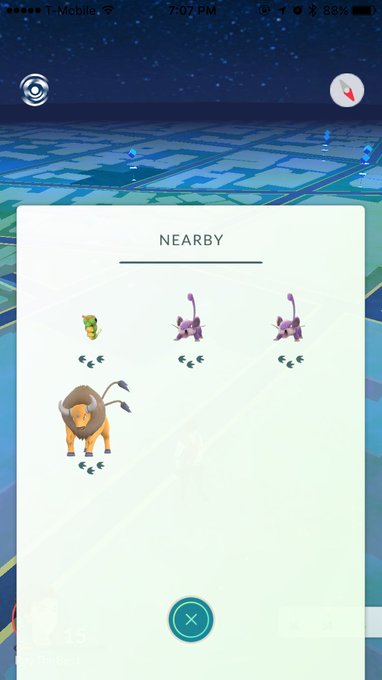
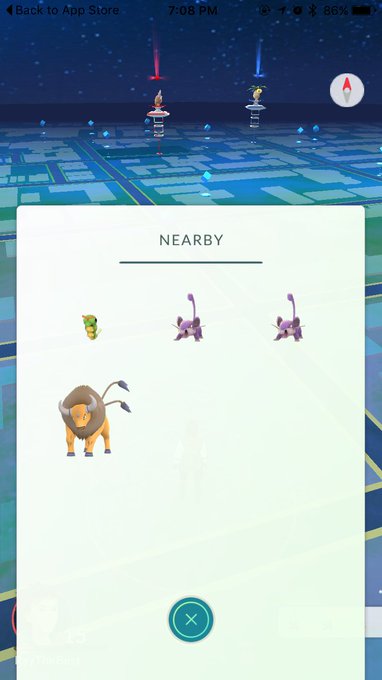
The developers must surely understand this, because they originally included a feature that played pretty much the same function as these unofficial apps. When the game first launched, “nearby” pokémon would show up with a marker of one, two, or three footprints next to them indicating how far the player had to walk to find them at any moment. But this feature soon fell victim to a bug and continuously showed three footprints for every pokémon, making it pretty impossible to use as a tracking aid.
A large part of Pokémon Go fans’ anger at Niantic—and the anger is strong, based on the 6,000+ replies to a “Rage megathread” on the biggest Pokémon Go subreddit—comes from the fact that these third party apps were seen by many as a useful stand-in for the game’s own buggy tracking feature, rather than any additional “cheat.” To make matters worse, the footprint feature was entirely removed in the recent game update; the app now shows no footprints next to nearby pokémon.
To me, the Pokémon mapping services weren’t cheating by virtue of the fact they were easily available to everyone (Pokévision, for instance, was free). They also didn’t really offer an edge in the main multiplayer aspect of the game—gym battles—so it’s not like you could use the services against anyone.
Notably, that’s not the case for other shortcuts that are accepted as part of the game, most notably the advantage offered by in-game purchases. Buying “incense” or “lures,” which attract pokémon to a location, is one easy way of catching more different species. By comparison, a shared treasure map of pokémon hotspots seems like a pretty democratic “cheat.”
As a result, it’s also clear that the trend for sharing information on rare pokémon locations won’t be killed with this clampdown, though it’ll be less convenient to build tools to do this. Threads in regional Pokémon Go subreddits share locations of recent catches and known “nests” of specific species through word of mouth; one enterprising London player has made a new map based on crowdsourced reports of regular spawns (Russell Square for Rhyhorn, Lincoln’s Inn Fields for Machop, and so on) rather than tapping into app data.
As for whether Niantic will bring its own tracking feature back, who knows? If there’s one thing Pokémon Go fans are complaining about more than the update itself, it’s the lack of communication from Niantic. I reached out to Niantic’s press team and the PR company it uses for this article, but have not yet received a response.
My Batman was an asshole. I can see the headlines now.
"Scourge of Gotham!" "The Bat-Man Brutalizes Petty Criminal!" "Can GCPD Keep the People of Gotham Safe from the Growing Threat of Masked Vigilantism?!"
Batman - A Telltale Series, which launched its first episode Tuesday on just about every platform, gets about as dark as the Dark Knight ever can be. By the end of the first episode alone Bruce Wayne's alter-ego will have broken multiple criminal bones, run a man through with a rebar and even shut out the memory of his dead parents.
Maybe.
Choice has been the great strength of every recent Telltale game, but it's especially powerful in a story about a beloved character that's been interpreted and explored in dozens of different ways over the past 75 years.
Personally, I chose to tread the path of Frank Miller's take in All-Star Batman & Robin, the Boy Wonder. That was a dark Batman who delighted in his own viciousness. I didn't send anyone to their grave or pick on someone who didn't deserve it, but only because the opportunity didn't present itself.
The story opens on what is effectively "Year Zero" for Batman. He's a new enough presence in Gotham that the general public doesn't know what to make of him, but he's also been around long enough to have an in with a young GCPD lieutenant, James Gordon.
Gotham's super-villainy is similarly embryonic at the start of the story. Mob boss Carmine Falcone is the biggest threat casting a shadow across the city. Catwoman is kicking around, but extreme wrongdoing from the likes of Penguin, Riddler, Bane, etc. are — at best — slyly hinted at, if they're touched on at all.
This is a Gotham gripped by crime, but you, the player, know what's really out there. Those poor virtual citizens don't even know what true wrongdoing is yet.
The episode fittingly opens with a seemingly mundane armed robbery at Gotham's City Hall. The mayor's office is the target, but why? It's one of several mysteries Batman starts to chase after he interrupts the lawbreaking and enforces his own — and, by extension, your own — brand of justice.
The neat thing about Batman - A Telltale Series is how it forces you to really think about your performance. The role you take on is an aspect of the metagame in all Telltale adventures, but it's a conscious presence in Batman due to the nature of its titular star.
You actively think about this as you play: Batman is always putting on a performance. When he's the Dark Knight, his theatrics are meant to strike fear into Gotham's criminal underbelly. And when he's billionaire playboy Bruce Wayne, he's a self-possessed rich kid.
These dual facets of Batman's personality are true in just about every iteration of the character — including this one. So as you play, you're actively thinking about roles that are already intentional performances, and it fosters a much stronger personal connection to the character.
Would Bruce get mad at Alfred here? Would he push back against the butler's constant mothering? Remain silent and brooding?
They could all fit, depending on the comic you're reading, and they're all courses you can take as you play. In its first episode, Batman is very good about offering choices that feel faithful to the different interpretations of the character through the years.
No matter what you choose, it still hits the right beats. As Bruce, you'll bicker with Alfred over safety concerns and schmooze with Gotham's elite. As Batman, you'll use gadgets to pick apart crime scenes and trade punches with lowlifes.
It's also worth noting: this game features one of the coolest Batmobiles we've ever seen.
A Batman game is only as good as its story, and this one is only a fifth of the way through. Rocksteady's Arkham series is the notable gold standard, but Batman - A Telltale Series takes a different, headier approach in letting you play into the role of whichever Batman you want to be.
For that reason alone, this is a game that's worth any fan's time.
players in Sydney, Australia, may have three less PokéStops from which to get their Poké Balls, Razz Berries and potions.
The western suburb of Rhodes had been inundated with avid Pokémon Go fans since the game launched in July, leading residents to complain about crowds, rubbish and noise. In response, the local Canada Bay council began a campaign to have its PokéStops removed, and it appears to have emerged victorious from this particular battle.
According to Fairfax Media, three intersecting Poké Stops placed in Peg Paterson Park — which reportedly had been responsible for attracting hordes of Pokémon Go players — simply vanished sometime on Monday.
Whether this is thanks to the recent game update or a separate change by the game developer Niantic is unclear.
Mashable reached out to Niantic for comment but the company did not immediately respond.
The council had submitted requests to Niantic to have the PokéStops removed, and encouraged residents to do the same. "The recent phenomenon of Pokémon Go has seen unprecedented numbers of people flocking to Rhodes," Deputy Mayor Helen McCaffrey said in an August newsletter.
"I would like to thank residents, building managers and businesses for their support and patience as we all try to find an appropriate solution to the ongoing issues of noise, traffic and rubbish, as a result of the game's popularity."
Irate residents had posted pictures of trampled grass and rubbish on the council's Facebook page, ostensibly left behind by gamers. Others shared videos of crowds of people spilling off the footpath and cars circling the neighbourhood as they hunted Pokémon.
"Walking the dog at night suddenly feels like I'm in an ep of Dr Who or Torchwood or the walking dead or some post apocalyptic zombie phone reality where #pokémongoaddicts have taken over the kids park and cross roads without looking for cars," another posted.
The PokéStops and Gyms in Pokémon Go were chosen from a data set created by the players of Niantic's previous augmented reality game, Ingress. For the most part, public artworks, historical sites, and unique buildings and local businesses were chosen, Niantic CEO John Hanke told Mashable Australia when the game launched.
Hanke also said the game aimed to keep people safe while getting them out of the house and interacting with the real world. "We're trying to strike a good balance," he said.
Hopefully Niantic will reveal how it decides which PokéStops to remove. There may be some cemeteries and memorials that would like to know.
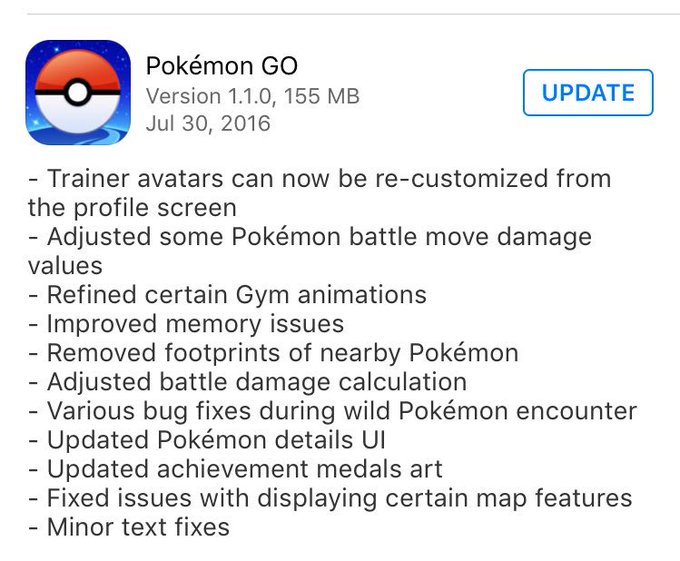
Almost a month after the app took the world by storm, Pokémon Go has now been updated with some major changes that should make it more difficult to cheat in the game.
Developer Niantic pushed out versions 1.1.0 and 1.1.1 of the game over the weekend, and there are some notable upgrades and downgrades.
For starters, the footprints that used show up below Pokémon inside of the "Nearby" section of the game have been removed.
Players had complained that the footprints system didn't make any sense. Some claimed it just didn't work. It was believed the number of footprints (1-3) was supposed to show how close you were to a Pokémon.
Speaking from experience, I can't say the footprints mechanic ever worked. Good riddance!
Another feature that got removed was the battery saver mode. With battery saver mode turned on, the screen would go black when your phone was held upside down, and then it'd vibrate only when a new Pokémon spawned or when you were at a PokéStop.
Also speaking from experience, the mode frequently glitched and didn't work. Sayonara. You're better off getting a battery pack or battery case for your phone to extend playing time.
With version 1.1.0, you can also re-tweak your Pokémon trainer avatar. Previously, you couldn't. You were stuck with whatever look you picked at the beginning. It's a good change.
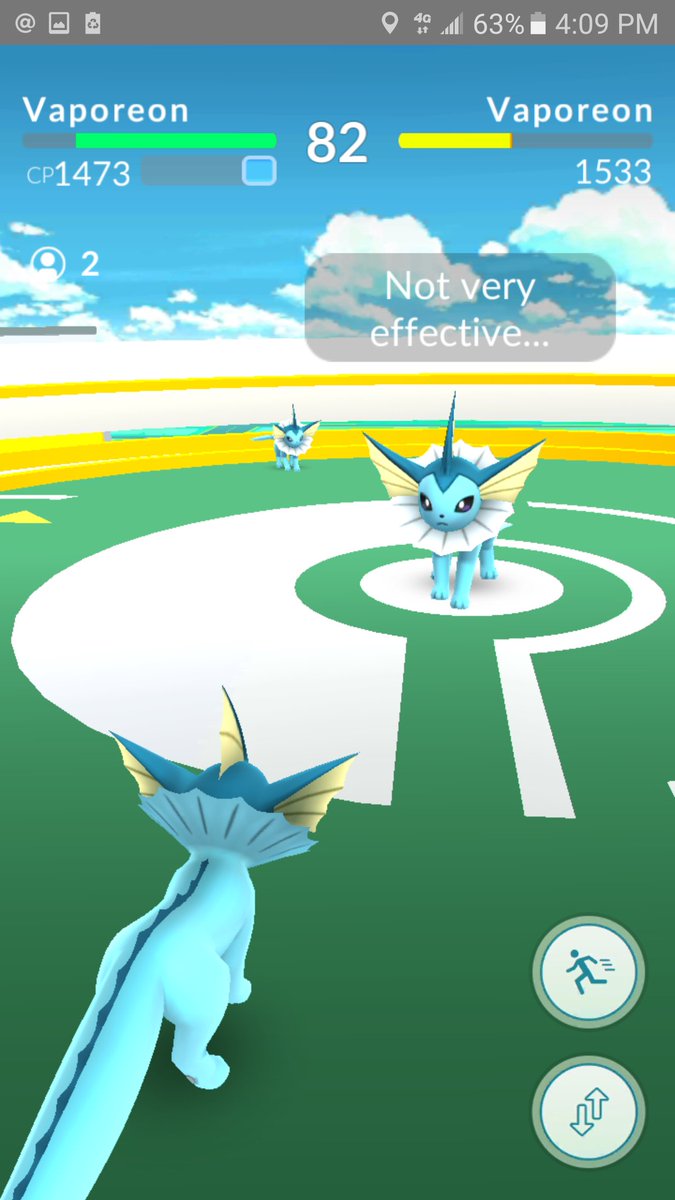
Niantic also adjusted a number of Pokémon stats in an effort to balance the game.
The most controversial change to Pokémon Go might be the nuking of third-party Pokémon tracking services like the popular PokéVision, which showed maps for where to find the monsters.
The site, which used to have a map populated with Pokémon, states its "services are currently unavailable" and to defer to its Twitter.
To be fair, Pokémon-tracking services aren't technically cheats. They're more like game guides. But, hey, any violation of the game's terms and services is a violation.
Mashable has reached out to Niantic for comment on Pokémon-tracking services like PokéVision and will update this story if we hear back.








 Popular
 Tags
Tags Videos