• unilogou. Powered by Blogger.

    Showing posts with label MARK ZUCKERBERG. Show all posts
    Showing posts with label MARK ZUCKERBERG. Show all posts

    Thursday, 1 September 2016

    Facebook's Trending topics are more important than you realize

    Posted By: Uni logo - 00:48:00
    In this Saturday, March 19, 2016, file photo, Facebook CEO Mark Zuckerberg speaks during a panel discussion held as part of the China Development Forum at the Diaoyutai State Guesthouse in Beijing.


    Facebook isn't a great place to get your news. Yet millions of Americans use the social network to learn about what's going on in the world every day.
    This is core to a new controversy over Facebook's Trending feature, which exists to connect users to relevant stories. The company fired several trained journalists from the Trending team last Friday, leaving artificial intelligence and technical staff to identify and deliver stories to the site's users. 
    Facebook CEO Mark Zuckerberg later commented on his company's place in the news business.
    "We are a tech company, not a media company," Zuckerberg said Monday. "We build the tools, we do not produce any content."
    To that end, the Trending feature — the list of stories you see on the right side of your News Feed on the desktop or after you tap the search bar in the mobile app — now strips away the context that would've been written by Facebook's journalists and only displays simple terms that are buzzing on the social network. If you click or mouse over a term, you'll see a headline from a news source like Mashable. 
    A lot of people are upset about how the change rolled out, calling the new Trending feature a "disaster," "a public embarrassment" and "half-baked quiche."
    How Facebook defines its new "Trending" feature.
    How Facebook defines its new "Trending" feature.
    IMAGE: FACEBOOK
    Frankly, people should be upset. Since the layoffs, the Trending team has promoted a false story about Fox News' Megyn Kelly and a viral video in which a man masturbates with a McDonald's sandwich. Its topics are all over the board and seem to defy logic and timeliness: "Eevee" has been at the top of my desktop feed for nearly two days even though I don't play "Pokémon Go," and there's still no sign of "Gene Wilder," who died Monday. 
    Facebook squeezed the potential out of Trending topics. It's never been a great product — Twitter is much better at delivering timely trends — but that doesn't mean it didn't have promise. Consider the social network's "echo chamber" problem: Users typically see content they're inclined to like and agree with in their News Feed, because that's how Facebook keeps them coming back. The Wall Street Journal's "Blue Feed, Red Feed" feature is a good look at how this actually works. 
    Trending topics could be a way for Facebook to key readers into important news they may not see otherwise — instead, we get McChicken sex. That's fun news, sure —Mashable and many other sites reported on it — but does it need to be elevated by the world's largest social network?
    At best, Trending delivers old news — at worst, it perpetuates outright lies and whatever you'd call someone molesting processed lunch meat. Granted, the new iteration is less than a week old, and Facebook could be planning improvements. But for now, the breakdown of Trending highlights a tension between what Facebook wants to be and how people realistically use its product. While the company says it doesn't want to be a media enterprise, its readers have come to rely on the social network for information, and Facebook's approach to Trending stories is failing them.

    Facebook is totally a media company

    Sixty-seven percent of all U.S. adults use Facebook, and 44 percent of them get news there according to a recent survey from the Pew Research Center. One imagines that many of Facebook's  1.13 billion daily users worldwide also get updates on the social network. 
    The News Feed is the modern front page, but Facebook's leadership evidently doesn't feel much of a responsibility over what it puts there — recall that Zuckerberg insists Facebook is a platform, not a media enterprise.
    Social media news use: Facebook leads the pack
    The CEO's statement is a bit disingenuous. Facebook may not write the articles that appear in the Trending module or your News Feed, but it is responsible for the algorithms that repurpose them and deliver the content. Picture a newspaper: Facebook is the front page team, printing press and delivery boy rolled into one. 
    The company's algorithms pay attention to what users are clicking, making us culpable in a sense for whatever "trends." But Facebook's human employees created those algorithms, and it follows that they bear responsibility for them. The company has also happily partnered with outlets like ABC News for the creation of live video content tied to important events.
    This is fundamentally a question about whether Facebook should accept responsibility over the information its product delivers to users. Facebook could get rid of its Trending topics feature tomorrow and this would still be a question worth asking, because so many of us get updates from our News Feed.
    The company probably shouldn't have fired news editors — if anything, it could have given them more power to vet and deliver timely information to the site's users as events unfold all over the world. Algorithms aren't good at recognizing news; people are.
    Abandoning the idea of news curation won't make people stop using Facebook for news — it'll just degrade the quality of information they receive. No one is asking Facebook to write full news articles or replace the media — it really shouldn't! — but it already has so much power over how readers access information. 
    To ignore that responsibility makes Facebook a worse product. That's especially true given the company's mission to "connect the world" — there's a lot happening out there beyond what our friends post about.

    Sunday, 31 July 2016

    Zuck says augmented reality will flourish on phones before glasses

    Posted By: Uni logo - 05:38:00

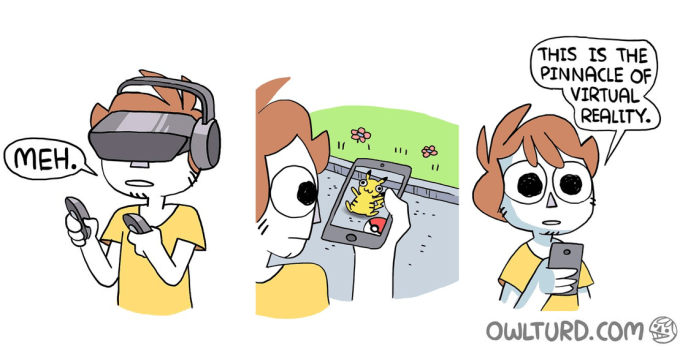
    Snapchat selfie lenses and Pokemon Go, not Magic Leap and HoloLens. Smartphones are how Mark Zuckerberg sees augmented reality going mainstream, rather than potentially awkward headsets and glasses. That’s an important clue to how Facebook will adapt to this next computing platform.
    Pinacle
    Yesterday on the call after Facebook’s sensational Q2 earnings report, Zuckerberg fielded what could have been a lighthearted question about Pokemon Go with a serious answer:
    Well-known Facebook analyst Mark Mahaney of RBC Capital asked “when you see what seems like phenomenal success of Pokemon Go, what are your reactions to that?”
    Zuckerberg responded (emphasis added):
    “I like everyone else am enjoying Pokemon Go. The biggest thing that I think we can take away from this as we invest in augmented reality in addition to virtual reality is that the phone is probably going to be the mainstream consumer platform [where] a lot of these AR features first become mainstream, rather than a glasses form factor that people will wear on their face.
    I think we’re seeing this in a number of places, whether it’s location through Pokemon or some of the face filter activity, I referenced the Masquerade app that we acquired earlier in my remarks. That’s kind of a fun way to augment social experiences that you’re having with someone. I think there’s a big opportunity to build out that platform and a lot more functionality around that.
    And one of the big themes that we’re talking about here is becoming video first. And as people look for richer and richer ways to express themselves, just like people in the past have shared a lot of text and photos on Facebook, we think in the future more of that is going to be video, and more of these augmented reality tools I think are going to be an important part of delivering that experience and making that fun to use and expressive as it can be.
    Essentially, Zuck thinks it’s more likely that the device in everyone’s pockets I’d more likely to deliver AR at scale than headsets that could be expensive, cumbersome, weird looking, and that no one owns yet.
    This aligns with what Apple CEO Tim Cook said on his company’s earnings call this week about the the ability to instantly scale the user base of a product if it lives on an already-popular platform. “In terms of AR and the Pokeman phenomenon, it’s incredible what’s happened there” Cook beamed. “I think it’s a testament to what happens with innovative apps and the whole ecosystem and the power of a developer being able to press a button and offer their product around the word.”
    Facebook has watched this play out with the Oculus Rift vs the Gear VR. Despite the Rift being much more powerful, it’s tethered at home, expensive, and requires a high-grade gaming computer most people don’t own. The Oculus-made Gear VR, a cheap headset powered by popular Samsung Galaxy phones, is mobile, comparatively cheap, and runs on a device tons of people already own. That’s why the Gear VR had already reached1 million active users while the Rift is confined to hardcore gamers and VR enthusiasts.
    Snapchat’s animated selfie lenses and Pokemon Go prove that people are eager to play with VR…as long as it doesn’t require special hardware. Sure the object recognition and overplayed graphics aren’t the most technologically impressive uses of VR. But Facebook, Instagram, Messenger, and WhatsApp aren’t necessarily the most technologically impressive uses of mobile, yet they became the most popular apps.
    Facebook has already begun to publicly invest in AR through the acquisition of MSQRD, an app that makes animated selfie filters similar to Snapchat’s. And Zuckerberg has repeatedly said AR is a big piece of Facebook’s long-term roadmap.
    Gear VR Camera
    Apps that augment the videos you share to Facebook may be the company’s next step. And since the Gear VR can take advantage of the rear camera on your Galaxy, it could simulate augmented reality by combining the real-world image with added effects — though this will look blurry and have more lag compared to those graphic appearing on a transparent visor like HoloLens.
    In any case, with these new comments, we can expect Facebook won’t rush to launch its own MagicHoloLeap headset.

    Thursday, 28 July 2016

    Facebook sees 2 billion searches per day, but it’s attacking Twitter not Google

    Posted By: Uni logo - 04:52:00

    Facebook wants to be known as a place to search for mentions of current news in hopes of drawing more public chatter that normally ends up on Twitter. While Facebook stumbled with its natural language Graph Search, it refocused on keywords, and is now seeing 2 billion searches per day of its 2.5 trillion posts. That’s compared to 1.5 billion searches per day in July 2015, and 1 billion in September 2012. That’s a 33% climb in just 9 months.
    What Mark Zuckerberg said on today’s earnings call was that “The growing way that people use search is to find what people are saying about a topic across more that 2.5 trillion posts. Now people are doing more than 2 billion searches a day between looking up people, businesses, and other things they care about.”
    What wasn’t said but is clearly implied is that it that Facebook thinks you should talk about things on Facebook because your words will find new audiences thanks to its powerful search engine and massive user base. Twitter has ruled this space, but Facebook has been trying to catch since launching public post search last year.
    If Facebook can keep generating more search queries, it could open up new monetization opportunities through paid search ads that highlight a business or publisher, though Zuckerberg after today’s stellar earnings cautioned that wasn’t going to happen immediately. After all, Facebook crushed earnings today, raking in $6.44 billion in revenue and $2.05 billion profit this quarter

    Search Stumbled, Now Speeding Up

    For the first half of its history, Facebook’s search engine was primarily focused on helping you find people you’d met in real life and add them as friends. In 2013 it touted its new semantic Graph Search engine as the third pillar of its service alongside the feed and profile.
    But users were confused by the complex search queries required, like “Friends of friends in San Francisco who work at TechCrunch”. A recent tell-all book from former Facebook employee Antonio Garcia Martinez called Chaos Monkeys who said the feature was mostly used by guys seeking single women in the network who lived nearby.
    Eventually, Facebook retreated on Graph Search and in late 2014 launched true keyword search so you could find posts by you or your friends, and later expanded that to include all 2 trillion posts on Facebook.
    That was a big turning point for Facebook because it finally pitted its search engine against Twitter’s. When big global news events happen, people flock to the Internet to talk and read what others are saying. While Facebook had trending topics, you couldn’t find individual keyword matches until last year.
    facebook-public-search

    Search -> Chatter -> Ads?

    Full post search appears to have accelerated query volume for Facebook. Facebook is now adding 20X more users per quarter than Twitter [Correction: That’s at a 3.7X faster rate, not 20X faster]. Facebook recruited 60 million users this quarter compared to Twitter’s 3 million. With 1.71 billion total users, Facebook simply has more voices, even if they’re not as trained to rapidly post publicly about current events.
    Facebook’s goal now will be to highlight why users should bring this talk to its social network. To that end, it built a special sports chatter feature called Stadium, has focused on Facebook Live for citizen journalism, and has iterated on its Trending Topics feature.
    While Facebook has toyed with some search ads in the past, it currently concentrates on News Feed ads to drive revenue. When asked on the earnings call if Facebook would strive to better monetize commercial searches about products or businesses, Zuckerberg responded:
    “So when we talk about our strategy, I often talk about how when we develop new products we think about it in three phases. First, building a consumer use case. Then, second, making it so that people can organically interact with businesses. And then third, on top of that, once there’s a large volume of people interacting with businesses, giving businesses tools to reach more people…and that’s ultimately the business opportunity.
    So I’d say we’re around the second phase of that in search now. We have a pretty big navigational use case where people look up people and pages and groups that they want to get to, and look at, and search. One of the big growing use cases that we’re investing a lot in is looking up the content in the ecosystem and that is an area that we’re very excited about, which helps people find more content.
    But certainly there’s a reasonable amount of behavior in there which is looking for things that over time could be monetizeable or commercial…and at some point we will probably want to work on that but we’re still in the phase of just making it easier for people to find all the content they want and connect with businesses organically.”
    Facebook is keeping the search business model in a bottle for later.
    So while this announcement was about search, it’s not Google, but Twitter that should be concerned for now.

    Tuesday, 28 June 2016

    Why it's a good idea to cover up your webcam

    Posted By: Uni logo - 06:41:00
    Https%3a%2f%2fblueprint-api-production.s3.amazonaws.com%2fuploads%2fcard%2fimage%2f124019%2fe3b5f9e8e8324b63a8e34a729f3cb7d9

    If Mark Zuckerberg is covering up his webcam at work, does that mean we should all be following suit and covering up our webcams too?
    Yes.
    Zuckerberg, the CEO of Facebook, dabbled in a little hacking before starting his venture with social media, so if he's covering his webcam, you should at least consider that security measure for yourself. And if his own action isn't convincing, consider the fact that FBI Director James Comey said he does the same
    Why? Because webcams can be, and have been, hacked. In fact, even the FBI has hacked into people's computers to access their webcams for surveillance. There's really very little stopping someone else doing the same thing to you.

    How webcam hacks happen

    There are two major kinds of webcams: Internet-connected webcams and computer-connected webcams. 
    Internet-connected webcams typically connect over Wi-Fi. Most have their own IP address, which enables remote access, letting you connect directly to the webcam from anywhere in the world. Of course, that means evil-doers could potentially connect to it as well, so your camera should be protected by a strong password. Unfortunately, these webcams often come with weak default passwords, and many people don't change them.
    A 2014 report on Naked Security revealed that, at the time, 73,000 Internet-connected webcams were accessible if you just put in the default password. If this setup matches your description, change your password immediately to something strong. And if you don't need to use it, it's still a good idea to cover it up.
    Computer-connected webcams on the other hand can be a bit more difficult for hackers to get into, but that doesn't mean it's impossible. These are the webcams are the cameras built right into your computers (usually above your laptop screen) or connected via USB.
    Hackers can access these cameras through malware. If you accidentally click a bad link or download the wrong file, that malware could contain executable code to turn on your webcam and send that video feed to a website or save it somewhere else. Worse, often this kind of malware can even disable the camera's LED light, so you'd never know your camera's been hijacked just by looking at it.
    If you don't want people watching you when you don't know it, the only thing that's a surefire method to make sure you aren't being recorded is to put a physical barrier over your webcam. After all, antivirus programs can't catch everything.
    What about your phone's camera? It's definitely possible to hack into a phone camera, and it's been done, at least on Android. However, it's probably less of a concern since, when you're not actively using your phone, it's typically in a pocket, handbag or sitting face-up or face-down on a tabletop. That means it's less of desirable target for hackers, since you're far less likely to be in a compromising position when you're in front of the camera. Also, the sandboxing of mobile operating systems makes hijacking a camera inherently more difficult.
    Besides, covering your phone's front-facing camera would make selfies a lot less convenient. And we can't have that.

    Copyright © 2016 Uni logo™ is a registered trademark.

    Designed by Unilogou. Hosted on Blogger Platform.